






For decades, residents of Ogeecheeton, a historically Black neighborhood in West Savannah, have voiced concerns about dust they say is from the concrete block factory next door. The dust settles on their yards, cars, homes and skin, and steals into their lungs.
On Oct. 21, they took a step toward addressing a problem that has been hanging in the air, they say, for too long.
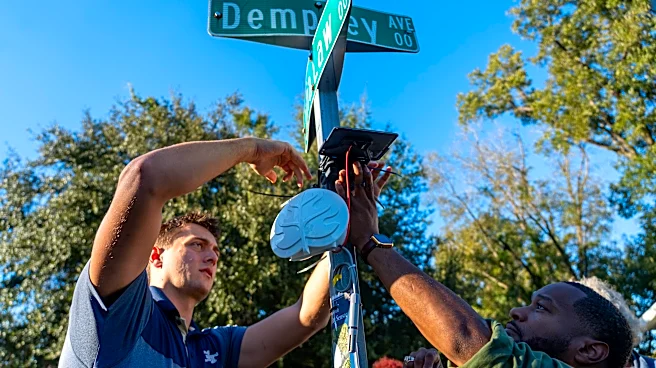
Residents working in partnership with the City of Savannah, researchers from Georgia Tech and the Massachusetts Institute of Technology (MIT) and the nonprofit organization Harambee House installed an air-quality monitor in Ogeecheeton, across the street from Clarkes Block Company on Tremont Road.
The concrete factory loomed in the background, a stone's throw away, as researchers
strapped the tiny, solar-powered monitor to a street sign. The device will measure particulate pollution in the neighborhood from “fugitive dust”—fine particles that drift uncontrolled from industrial or construction sites. According to the U.S. Environmental Protection Agency (EPA), fugitive dust has been linked to human respiratory conditions like asthma, chronic bronchitis emphysema, and chronic obstructive pulmonary disease.
“For years, our residents have expressed concerns about what we see, smell and experience in our neighborhood,” said Johnnie Mae Law, president of the Ogeecheeton Neighborhood Association. “Now, with this air quality monitor, we hope to begin gathering data needed for a better understanding of those concerns.”
"Our message is simple," she continued. "We’re not asking for special treatment. We’re asking for clean air, a healthy environment and the same protection afforded to other communities.”

Clarkes Blocks Company did not respond to a request for information about how they comply with Georgia air quality regulations around fugitive dust. According to the Southern Environmental Law Center, which is providing legal advice to the neighborhood air-quality monitoring project, residents have filed complaints about Clarke Blocks three times in the last 10 years with the Georgia Environmental Protection Department.
The Ogeecheeton monitor will be joined by three additional monitors planned for Greater West Savannah, where neighborhoods have long sat near industrial operations. The sensors will be installed in neighborhoods near SRM Concrete and Knight’s Redi-Mix, both concrete manufacturing companies that can generate fugitive dust.
Data from the air-quality monitors could inform future solutions, such as planting trees or other vegetative barriers that reduce dust blowing into residential areas, or zoning and land-use policies that prevent industrial operations from setting up shop next to people’s homes.

The monitors could also help fill a data gap left by federal and state air-quality monitors. Savannah has one federal-regulated air-quality monitor that measures particulate matter, including that found in fugitive dust. It’s located at the intersection of Augusta and Old W. Lathrop Avenues, in the Woodville neighborhood of West Savannah.
But that doesn’t necessarily help residents in Ogeecheeton.
“That monitor is miles from here and not next to a concrete plant,” said Alex Cabral, an associate professor at MIT whose lab developed the low-cost sensors being installed in Ogeecheeton and around West Savannah. “What it’s measuring there, we don’t know that it’s representative of what people are experiencing here. And that’s not a unique Savannah problem. That’s a nationwide problem.”
Federal monitors are good at providing an overview of a region's air quality, she added. “But they’re often not placed near actual sources of pollution.”
Stephanie Castellano covers climate change and the environment in coastal Georgia. You can reach her at scastellano@usatodayco.com. This reporting content is supported by a partnership with Journalism Funding Partners.
This article originally appeared on Savannah Morning News: Hyperlocal monitors will track air pollution in West Savannah | Exclusive