









Even as a proposed data center in the Colleton County area of the South Carolina Lowcountry continues to make headlines, and local governments are urgently approving moratoriums to slow or stop the potential development of more data centers, other artificial data project developers have eyes on this area of the Southeast.
Data centers, the physical infrastructure of the Internet composed of servers, networking equipment, and supporting power and cooling systems, have been around since the world wide web was created, but construction on new, more massive data centers has accelerated in recent years for the purpose of supporting rapidly growing artificial intelligence (AI) technology.
Supporters, citing the United States' need to keep up with the latest
innovation amid global competition, say these data campuses bring new high-paying jobs and other economic benefits, but opponents argue they not only cause harm to the environment, including noise pollution, but also consume massive amounts of water and electrical energy.
While a six-month moratorium is temporarily stalling the Colleton County data center proposal, and counties like Jasper County have also passed moratorium measures, plans are underway to construct even larger centers in the nearby Augusta, Georgia area at the Savannah River Site and in nearby Effingham County, Georgia.
Project Camellia bringing jobs, protests to Rincon
The Augusta Chronicle reported recentlythat OpenAI, the company that launched ChatGPT in November 2022, is building a massive 3.2 gigawatt data center codenamed Project Camellia in the Rincon area of Effingham County, Georgia, less than 40 minutes from downtown Savannah.
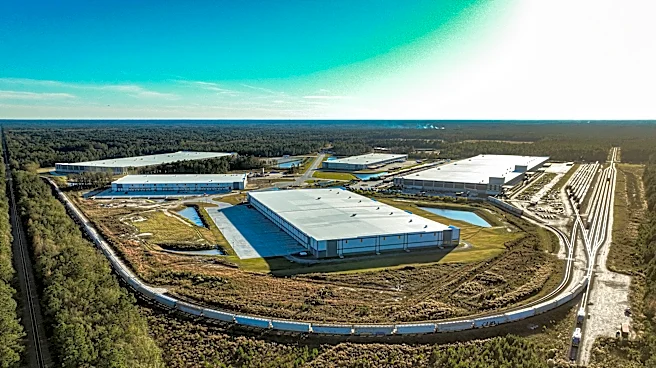
Project Camellia calls for four 720,000-square-foot data center buildings to be constructed across a 1,440-acre site in the Savannah Gateway Industrial Hub over the next five years. Project Camellia is expected to create about 1,000 construction jobs and another 1,000 permanent jobs once the campus is complete.
OpenAI expects to complete this project in phases, coming online as early as 2028 with the goal of being completely operational by 2032.
When making the announcement, OpenAI stated it is committing to paying the full infrastructure and electric-service costs, with built-in protections for the area's electrical grid, and it would use a closed-loop water system, recirculating water rather than continuously using it up.
While the company promised the water will not be diverted from local communities and their ongoing water needs, an OpenAI spokesperson said the fully operational campus is expected to use about 30,000 gallons of water per day — roughly the equivalent of 100 homes.
The company is reportedly investing $20 billion to begin construction and said it expects the project to be privately funded without use of public money.
Following the initial announcement, The Savannah Morning News recently reported that the proposed AI data center has already sparked citizen protests and criticism that the project, which was given significant tax breaks and economic incentives, was launched without citizen knowledge and input.
As an incentive, OpenAI said it is committing $80 million in local support (separate from tax revenue) for schools, utilities, housing, and other factors of the community; plus $71 million in credits for Georgia college students to use Codex, OpenAI's coding platform.
EffinghamGateway.com reported that the project is expected to provide the school district with approximately $32 million annually. Local school district officials said the additional tax revenue generated by the project could support salary increases for teachers or be used for new school facilities, technology upgrades and other educational needs without increasing the local tax burden.
Proposed data center at Savannah River Site closer to becoming a reality

The Augusta Chronicle recently reported that a proposed 1-gigawatt artificial intelligence data center at Savannah River Site is closer to starting construction.
The U.S. Department of Energy has chosen to enter negotiations with Amentum, a global tech company, for a phased lease to develop a data center and a power plant to run it, according to the National Nuclear Safety Administration.
Sprawling DOE land assets such as SRS – it covers more than 300 square miles across three South Carolina counties – are being leveraged to entice private-sector investors to build more data centers, reported The Chronicle.
SRS was one of four federal sites selected to participate in the program outlined in President Donald Trump's Executive Orders on Accelerating Federal Permitting of Data Center Infrastructure, Deploying Advanced Nuclear Reactor Technologies for National Security.
The project plan "pairs new AI infrastructure with dedicated onsite energy generation, helping ensure the project’s electricity needs are met without shifting costs to existing utility customers," the NNSA said in a statement. "The project includes a 1-gigawatt data center and approximately 2 gigawatts of onsite energy generation consisting of natural gas bridging to nuclear energy."
The government's selection of Amentum does not mean it has been or will be awarded the final lease. By working with the private sector, according to NNSA Administrator Brandon Williams, "we can move faster, apply innovative technologies, and make productive use of federal land while maintaining our commitment to mission delivery."
Amentum already oversees logistics and technical services to many U.S. government agencies, specializing in nuclear security and cybersecurity. Williams said in September 2025 that "the work being carried out at NNSA to harness AI will have an impact on national security as the Manhattan Project did in the 1940s."
What's the latest on the Colleton County data center project?

Prompted by citizen concerns and vocal opposition, including a pending lawsuit filed by two landowners, a South Carolina Lowcountry county has approved a third and final reading on a data center moratorium.
Plans for a proposed 800-plus-acre data centerto be located in a rural portion of Colleton County, as well as any future plans for other data centers there, were officially put on hold Monday, July 6, by the Colleton County Council with a third and final reading of a moratorium related to data center approvals and development.
This ordinance imposes a six-month moratorium on data center approvals and considerations, but may be extended if needed, to give the county council, county staff, and the county Planning Commission adequate time to review and consider amendments to the land use code. The moratorium also allows Colleton County officials to review areas where data centers may be allowed, either as a special exemption or a conditional use, and the conditions under which they can be developed.
However, despite this moratorium, on Aug. 10 the Colleton County Planning Commission and the Colleton County Council approved the first reading by title only on an ordinance related to a "digital infrastructure overlay which could still allow for changes to the comprehensive plan and zoning ordinance that regulates proposed data centers in that county.
Data center opponents and environmental groups fear that this overlay could allow data center development to be approved without any notice to the public and no public vote by a board or commission, and have described the measure as "underhanded tactics" to enable data center development directly contradicting the six-month moratorium passed in July.
"If this zoning overlay passes, data centers could be approved without any notice to the public and no public vote by a board or commission," claimed the Coastal Conservation League in a Sept. 2 statement. "The overlay could green light the largest data center in South Carolina, a one-gigawatt facility that would use nearly as much electricity as one million homes. The zoning overlay also allows for on-site energy generation, meaning polluting 'popup power plants' could be built alongside data centers in vulnerable rural areas. This is our chance to make our voices heard, as they are meant to be. We need transparency and accountability from our representatives, and we need them to do what’s right by protecting our natural and rural landscapes."
A petition has been organized by the CCL, who is asking both Colleton County residents and anyone who enjoys the "natural gems" of the ACE Basin to consider signing it. The petion can be found here: New/Mode | Make your voice impossible to ignore
Are there any data centers already located near me?
Surprisingly, many Lowcountry residents don't know that there is already one operational data site in their area.
Cogent Communications operates an older style, smaller-scale data center in Allendale County, according to its website and S.C. data center maps.
The 1.4-acre, 30,800-square-feet facility is located at 831 North Hampton Avenue in Fairfax, which is near the border with Hampton County.
The site has access to 2.08 megawatts of power and offers connectivity to Cogent Communications, Time Warner, FiberLight, Comcast and AT&T, states its website.
How can I track data centers in my area and state?
The Southern Environmental Law Center has provided a list of sites to help South Carolina and Georgia residents locate or track the development of data centers in the Southeast and around the country.
- FracTracker Alliance: https://fractracker.org/data-centers/
- Baxtel’s Global Data Center Map: https://baxtel.com/map
- Data Center Map: https://www.datacentermap.com/
- Development of Regional Impact (Georgia): https://dca.georgia.gov/community-assistance/coordinated-planning/regional-planning/developments-regional-impact
The reporting of Latrice Williams of The Savannah Morning News, Joe Hotchkiss of The Augusta Chronicle and Miguel Legoas of USA Today contributed to this story.
This article originally appeared on Savannah Morning News: Data centers near the South Carolina Lowcountry - What to know