







A green sea turtle nest was discovered on Jekyll Island during this year’s nesting season, a rarity among the loggerhead sea turtles that make up the majority of sea turtles nesting on the Georgia coast.
This is just the third time that a green sea turtle has been documented nesting on Jekyll since monitoring began in the 1950s.
“It was just exciting, the novelty of having a green turtle nest,” said Katie Aaron, a conservation technician with the Jekyll Island Authority. “It was also our last nest of the season, so it was a great way to finish off our surveying.”
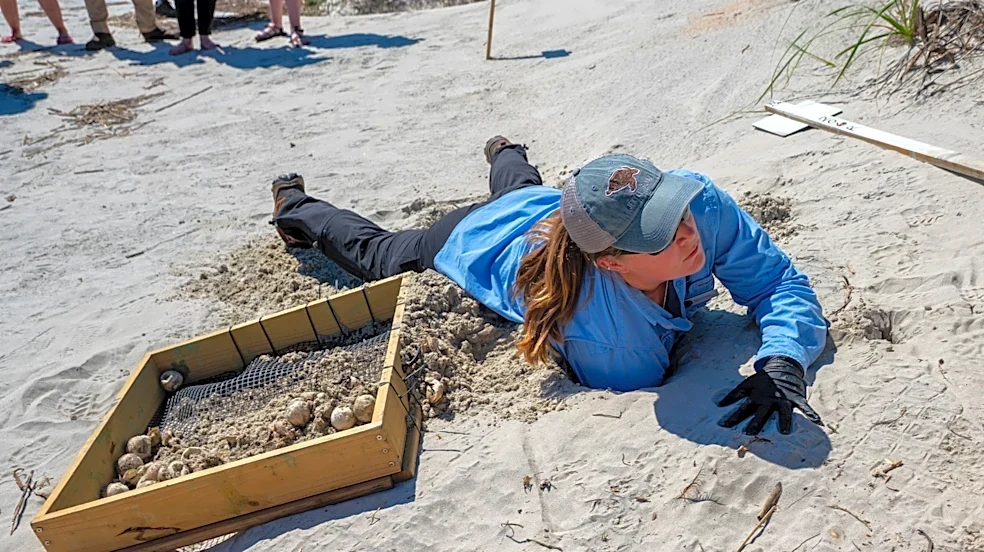
The nest hatched on Oct. 11. Three days later Aaron and her colleague Will Hicks were up to their elbows in sand, inventorying its contents. They counted 66 hatched eggs, which means the nest is
considered a success, and 84 unhatched.

Of the three documented green sea turtle nests on Jekyll Island, this is the second to have hatched successfully. The first was back in 2007. A 2015 nest yielded no hatched eggs at all.
Green sea turtle nests are still very rare along the Georgia coast—only 6 others were found this year, all on Cumberland Island. But Hicks said their numbers are slowly starting to increase.
“We’re starting to see this northern expansion of the range of green sea turtles. They’re more of a tropical, subtropical nesting species. They like warm waters, primarily in the Caribbean and South Florida. They’ve slowly made their way into Georgia over the past 10 to 20 years.”
Ocean waters made warmer by climate change could be a factor, he said. But more likely it’s because “there are just more turtles” overall, thanks to decades of conservation efforts that are just starting to pay off.
“We’re seeing higher and higher nesting numbers of green sea turtles and other sea turtles as well,” Hicks said. He also pointed out that green sea turtles may have been more common in Georgia before monitoring began, but “were just extirpated for whatever reason, and are potentially now expanding back to that range.”
“That’s just something we probably will never know,” he said.

Sea turtles don’t reach sexual maturity until around 30 years of age. That means there’s a roughly thirty-year time lag from conservation work that started in the 1980s, but didn’t really take effect until the early 2000s, when legislation targeted shrimp trawlers, the main culprit behind sea turtle declines.
Georgia’s sea turtle nests, which are mostly loggerhead turtles, have been slowly but steadily increasing by about 4% on average since 2004. But we could be due for a sea turtle “boom” soon, said Hicks. He said that population models show sea turtle populations could recover over the next 30 years to pre-1940s numbers, before the animals began dying en masse in trawling nets.
“Our hopes and dreams for the next 30 years is that we continually see this nesting population increase and increase to potentially tens of thousands of nests per year. We would love to see that here in the state.”
Will the green sea turtle who birthed her babies on Jekyll island return next year, or whenever she’s ready to lay eggs again?
“More than likely, yes,” said Hicks. He explained that, if they can, female sea turtles will return again and again to the same nest site. He and Aaron take genetic samples from all sea turtle nests on Jekyll and send them off to a University of Georgia lab that analyzes sea turtle DNA from up and down the state.
“So eventually, we will find out who this turtle is,” he said. “It’ll be interesting once those genetic results come back to see where she’s been nesting.”
Stephanie Castellano covers climate change and the environment in coastal Georgia. You can reach her at scastellano@usatodayco.com. This reporting content is supported by a partnership with Journalism Funding Partners.
This article originally appeared on Savannah Morning News: Rare green sea turtle nest found on Jekyll Island