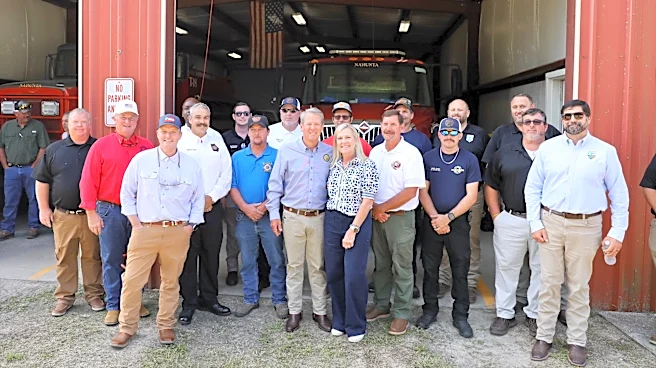





Rural fire departments that battled historic wildfires in southeast Georgia this year will receive more than $100,000 in funding to fight future wildfires, Gov. Brian Kemp recently announced.
The spring 2026 wildfires were some of the most destructive in Georgia’s history. Brantley, Clinch and Echols Counties bore the brunt of the damage.
The Highway 82 Fire in Brantley burned 22,419 acres and destroyed 110 homes. It was “the worst home loss we’ve ever had from a single fire in this state,” Georgia Forestry Commission Director Johnny Sabo told state lawmakers in spring.
The Pineland Road Fire in Echols destroyed 32,575 acres of unpopulated commercial timberland.
The two fires
burned for more than a month, costing the state $35 million. That’s more than half the annual budget of the Georgia Forestry Commission, the state agency tasked with fighting wildfires.
The funding Gov. Kemp announced Tuesday is designed to help rural areas with fewer resources to fight wildfires. It comes partly from the Volunteer Fire Assistance 50/50 program, a federal program that supplies 50% of the dollars rural fire departments need to buy firefighting equipment and vehicles. The rest comes from public donations and matching funds from the Georgia Forestry Foundation.
Funding will be distributed across seven fire departments in Brantley, Clinch and Echols counties.
The money will go toward bulldozers to plow firebreaks around the perimeter of a wildfire to prevent it from spreading, as well as air-based operations that, when needed, fight blazes by spraying water from above.

Between January and April 2026, Georgia saw 2,858 wildfires that collectively burned more than 82,000 acres. Those numbers are well above average, said Wendy Burnett, public relations director for the Georgia Forestry Commission.
Typically, the state averages about 2,300 wildfires per year, with each fire burning an average of 7 acres, totaling more than 16,000 acres.
The severity and scale of the spring 2026 wildfires were due to extreme drought conditions across southern Georgia.
Where there’s fire, there’s smoke
Intensifying wildfire conditions, brought on by climate change, are exposing more Americans to harmful smoke.
According to a new analysis by the nonprofit Climate Central, exposure to wildfire smoke has surged in the United States in recent years. The average American inhaled four times as much wildfire smoke between 2020 and 2025 than between 2006 and 2019.

Fine particulate matter in smoke can enter the lungs and bloodstream, causing cardiovascular and respiratory problems ranging from mild irritation to death.
Although most large wildfires occur in the western U.S., studies have found that about three-quarters of smoke-related mortality and asthma morbidity occur in other U.S. regions, due to smoke’s ability to travel, even across long distances, to areas with denser populations.
When the Georgia wildfires were at their height in April, the Georgia Public Health Department warned residents of worsening air quality statewide.
According to the U.S. Centers for Disease Control and Prevention, during wildfire smoke alerts, people should avoid indoor activities like burning candles, cooking food that generates smoke, smoking, and vacuuming, which can stir up dust particles.
Stephanie Castellano covers climate change and the environment in coastal Georgia. You can reach her at scastellano@usatodayco.com. This reporting content is supported by a partnership with Journalism Funding Partners.
This article originally appeared on Savannah Morning News: Wildfire-ravaged Georgia counties receive funding for equipment