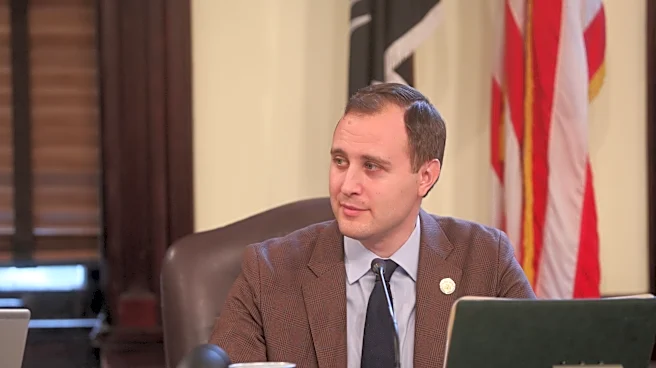








Savannah Alderman Nick Palumbo sees a central issue when it comes to AI and governance.
That issue is government policies and procedures have not caught up to the pace of new technology. Savannah Mayor Van Johnson also said at a July workshop the city is “behind” in crafting an advanced framework for AI use in city governance.
Palumbo has now taken a crack at drafting a framework for guidelines around how the city uses AI and what it requires of vendors it pays for that technology. The alderman shared with council an outline of his proposal in early August, just a month after a July workshop where council briefly discussed the issue.
“We have to address the challenge to meet AI where it is today, and the challenges (AI systems) bring,” Palumbo
said.

Savannah City Manager Jay Melder said in July the city has existing policies for current AI uses, such as through the city’s Microsoft Copilot license. Melder added the city does need a further framework around how AI will, or will not, be used in helping make decisions about operations and funding.
The city manager said a further framework would need to address where AI is appropriate to use, in what ways is the AI in use and where human review or decisions are incorporated into the policy.
“I think those are the bigger points related to AI governance,” Melder said.
Palumbo’s proposal speaks to some of those broader questions and is based on four pillars: that the city publishes what it uses, humans sign off on decisions that matter, Savannah’s data stays Savannah’s, and the city asks questions of technology providers before it signs contracts.
Palumbo said the spirit of his proposal is in ensuring transparency in how systems are used and protecting residents' data.
Specific items outlined in the proposal include having the city publish a list of the AI systems it uses, what the systems do and which department uses them. The proposal also includes a requirement that the city vet AI systems for privacy risk, bias and whether resident data is used to train the AI models.
“Ultimately, it’s the council that should decide what is shared and what is not in my mind,” Palumbo said. “This has to be a public debate, an agenda item, just like a procurement contract.”

Johnson served on an AI advisory committee for the National League of Cities in 2024. The result of that committee was an NLC report and toolkit on the issue.
The report outlines both potential benefits and risks to cities using AI systems ranging from predictive AI to the now-common generative AI agents such as Copilot or ChatGPT. The report includes examples of cities leveraging AI to improve city services, citing Tempe, AZ using AI to predict which water pipes may be most at-risk of failing based on historical data, and Memphis, TN leveraging it to more rapidly identify potholes.
The report also cites examples of existing policies or frameworks such as publicly published generative AI guidelines in San Jose, CA and encouragement of human fact-checking AI-generated content in Boston.
“There is no one-size-fits-all approach to AI adoption in cities. As you consider emerging tools, we hope this resource serves as a starting point to help you envision the role and impact of AI in your community,” said Johnson and co-chair Nikki Lee, a councilmember in Tuscon, AZ, in an opening message in the report.
Johnson said in July that he wants a city framework to be completed “soon.”
Palumbo also said he hopes his proposal will help “get the ball rolling” while welcoming feedback from city staff and council. The alderman added he hopes the city will conduct a workshop on the topic in the future.
Evan Lasseter is the City of Savannah and Chatham County government reporter for the Savannah Morning News. You can reach him at ELasseter@savannahnow.com.
This article originally appeared on Savannah Morning News: Savannah alderman pushes towards further guidelines on AI use in city