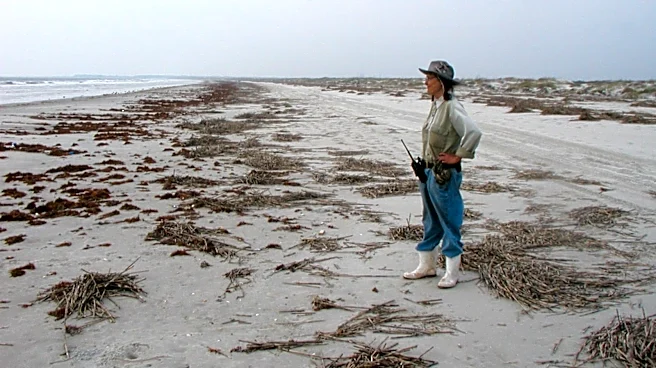






When Will Harlan first met Carol Ruckdeschel on Cumberland Island in the 1990s, she was “on the beach holding a bloody knife and waving me over.”
Harlan had recently graduated from college and was working as a seasonal park ranger on Cumberland. Ruckdeschel was a biologist who had been living alone on the remote Georgia barrier island since 1972, making a daily study of its wildlife.
Harlan nervously approached Ruckdeschel, who was standing over a sea turtle carcass.
“She wanted me to hold the turtle guts in my hands as she sliced them open, and all this goop spilled out onto the beach, along with a bunch of its stomach contents,” he said. Together they worked to autopsy the dead turtle, one of the thousands of sea turtle autopsies Ruckdeschel
had performed since her arrival on Cumberland Island.
“She was unraveling a murder mystery right there on the beach,” said Harlan.

In Ruckdeschel’s early years on Cumberland, sea turtle carcasses lined the beach. Their shrimp-filled bellies and frequently broken necks pointed to the culprit: shrimp trawlers off the coast of Georgia, which used large dragnets to scrape shrimp from the ocean floor, but also frequently trapped, mangled and drowned other marine creatures.
Ruckdeschel began organizing a network of volunteers to collect data on sea turtle carcasses along the coast of Georgia. Mortality from shrimp trawlers was threatening sea turtle populations worldwide, but “she was really the first one in the Southeast to do this,” said Mark Dodd, a senior wildlife biologist with the Georgia Department of Natural Resources.

Ruckdeschel’s data served as the impetus for legislation that required commercial shrimpers in American waters to use Turtle Excluder Devices—contraptions that prevent sea turtles from getting caught in trawling nets. Her volunteer network also caught the attention of the National Oceanic & Atmospheric Administration (NOAA), which formally took over and expanded the network in 1980. The multimillion-dollar program, which Ruckdeschel started from scratch, now monitors sea turtle strandings along the coastal U.S.
Without Ruckdeschel’s efforts, said Dodd, “We would have lost loggerhead [turtles] as a species in Georgia.”
Since Turtle Excluder Devices were fully implemented in 1991, sea turtle populations have rebounded. In Georgia, where dead sea turtles once outnumbered sea turtle nests, nesting has increased every year since 2004. This year, Dodd said his team surveyed more than 4,000 nests on the Georgia coast; up from roughly 385 in 2004.

Ruckdeschel, who celebrates her 85th birthday this year, has now amassed more than 50 years of data on Cumberland Island’s sea turtles and other wildlife. Her meticulous field notes and recordkeeping have given scientists invaluable insights into Cumberland’s unique ecology. From her beginnings as a “dirt-poor naturalist” with only a high school diploma, occupying an abandoned cabin on Cumberland Island with no electricity or running water, Ruckdeschel has grown into one of the world’s most respected sea turtle biologists, said Harlan.
Ruckdeschel’s legacy will be celebrated this Saturday, Sept. 26 in St. Mary’s, Ga. She will be honored in speeches by Harlan, who wrote a bestselling biography of Ruckdeschel in 2015; as well as Greg Lockhart, the mayor of St. Mary’s; Dr. Wayne Clough, former president of Georgia Tech and Secretary of the Smithsonian Institution; and regional biologists and conservationists.
The event, which will take place at St. Mary's Waterfront Park, will have live music and food trucks. It is free and open to the public.

Over the years, Ruckdeschel has also served as an advocate for conservation of Cumberland Island, helping fight off proposals to develop parts of the island and secure a federal wilderness designation for its northern half. It’s an ongoing battle, as the National Park Service is currently considering a controversial land swap that would give up federally protected land on the marsh side of the island in exchange for private land on the ocean side. The park service also recently moved to increase the daily maximum number of visitors to the island from 300 to 700; a measure that environmental activists like Ruckdeschel oppose.
Despite her fame, Ruckdeschel continues to live simply in the wooden cabin she moved into as a young woman on Cumberland Island. With no stores and no bridge to the mainland (and few paved roads), Ruckdeschel lives mostly off the land, growing and hunting her own food. As one of the island’s only full-time residents, she has “had her ear to the sand” for the last several decades, reporting on Cumberland's changing ecology and threats to its natural beauty, said Harlan. Along with its saltwater marshes, the island is one of the last strongholds for old-growth maritime forest habitat in the Southeast.
“When you meet Carol, you care about what she cares about,” Harlan said. “That's why I think a lot of people fall in love with Cumberland. They see the island through her eyes, and they see it more vividly.”
Stephanie Castellano covers climate change and the environment in coastal Georgia. You can reach her at scastellano@usatodayco.com. This reporting content is supported by a partnership with Journalism Funding Partners.
This article originally appeared on Savannah Morning News: ‘Jane Goodall of Sea Turtles’ honored for lifetime research | Exclusive