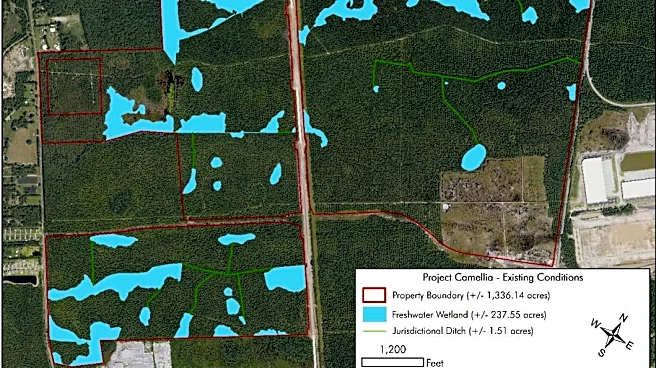








OpenAI has applied for a federal permit to fill 72 acres of wetlands at the site of its planned data center campus in Effingham County.
The permit application was filed with the United States Army Corps of Engineers and made accessible to the public on Oct. 5. If approved, the permit would allow OpenAI to build four large data center facilities plus infrastructure on ecologically sensitive land within the Savannah Gateway Industrial Hub, a 2,600-acre campus where the county hopes to attract major industries.
The request has raised concerns among environmental groups, as well as local residents who have sought ways to channel their anger after the July announcement that an OpenAI data center was coming to town took them by surprise.
The most immediate
concern for nearby residents is the flooding that may occur after paving over the wetlands. The total footprint for each of the four proposed data centers is 183 acres.
“That is a massive amount of impervious surface being added to an area that’s bordered by two permanent creeks, and we know we have flooding issues off Dasher Creek,” said Jeff Beauvais, an activist with the conservation nonprofit One Hundred Miles. “So for folks who are downstream, this is not going to help.”
OpenAI said it has employed engineers to study stormwater runoff from the site, and the company plans to build stormwater infrastructure that will match the natural drainage capabilities of the existing wetlands and natural soils. The built infrastructure, according to OpenAI, will eliminate any risk of increased flooding downstream.
Beyond flood control, wetlands provide a range of benefits—they provide wildlife habitat; filter and store rainwater; and replenish groundwater, which is a source of drinking water for more than one-third of Americans. Under the Clean Water Act, developers need a permit from the federal government to destroy or disturb wetlands. That permit can only be approved if the development site represents the “Least Environmentally Damaging Practicable Alternative,” or LEDPA.
In other words, said Beauvais, if there is a site available that would minimize the harm to wetlands, the developer should be required to use that.
OpenAI said that it considered various layouts for its four proposed data centers and associated infrastructure that would meet the Army Corps’ LEDPA criteria. It said the plan it submitted to the Army Corps preserves 70% of the wetlands within its project site, including a larger, contiguous strand of wetlands.
But, for Beauvais, the permit “…leads me back to the question of why Effingham County, why coastal Georgia at all? There are probably hundreds of sites across the United States that meet the criteria they have laid out and would have far fewer wetlands impacts than going to an area like coastal Georgia, where you can’t throw a stone without hitting a wetland.”
Wetlands in this region are already threatened by the rapid growth in distribution warehouses, he added; although it is difficult to quantify how many have been lost to development, because the legal definition of “wetlands” frequently changes, and what one government agency considers a wetland may be different from another.
The public can comment on OpenAI’s permit application until Nov. 4. One Hundred Miles is also pushing for the Army Corps and OpenAI to hold a public hearing, where residents can voice their opinions in person.
“I think the most valuable thing is not letting this go unanswered," said Beauvais, "and forcing the Army Corps to answer some tough questions around this permit."
Stephanie Castellano covers climate change and the environment in coastal Georgia. You can reach her at scastellano@usatodayco.com. This reporting content is supported by a partnership with Journalism Funding Partners.
This article originally appeared on Savannah Morning News: OpenAI applies for permit to fill wetlands for data center | Exclusive