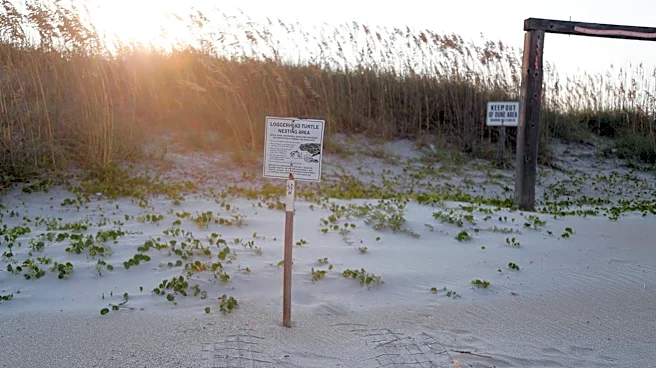









Loggerhead sea turtle nests reached a record high on Tybee Island this year, surpassing a previous record set in 2022.
The island saw a total of 59 nests this year, up from 35 in 2022.
The severe erosion on Tybee’s beach—roughly 60% of sand has been lost since it was last “renourished” in 2020—doesn’t seem to have dissuaded nesting mamas, said Allison Williford, program director for the Tybee Island Marine Science Center.

Erosion is a natural process that occurs on all barrier islands, although it occurs more rapidly on developed islands like Tybee. Tybee’s beach has been regularly replenished with fresh sand since the 1970s.
But the island is overdue for its next delivery of sand, which is scheduled for this winter after the nesting season concludes.
Williford attributes the high nest numbers on Tybee to the steady recovery of sea turtle populations all along the Georgia coast. The state also saw a record number of sea turtle nests this year: It logged more than 4,200 nests; up from an all-time low of 384 in 2004.
That’s due to decades of sea turtle conservation efforts in Georgia, said Williford, which brought loggerheads in particular back from the brink. Shrimp trawlers off the coast were ensnaring and drowning sea turtles in their nets; in numbers high enough that local populations of loggerheads were on track to be eradicated well before the end of the 20th century.
Starting in 1991, conservation efforts led to a law requiring Turtle Excluder Devices (or TEDs) to be used on all shrimp trawler nets. Sea turtle numbers have been on a slow but steady ascent since 2004.
“I think we’re just starting to see the benefits of all that long-term conservation,” said Williford.
Tybee’s eroding beach does mean that some sea turtle nests require human intervention. Williford and her team will relocate nests that are below the spring high tide line, or wrack line, so they’re not in danger of being washed out to sea prematurely. This year their team relocated 23 nests to safer ground. Three of those were emergency relocations of eggs that were exposed by erosion, Williford said.

How does beach renourishment affect nesting sea turtles?
The long-awaited beach renourishment on Tybee will mean more sand for next season’s sea turtles. But renourishment holds pros and cons for the reptiles, said Williford.
“It could be helpful to give them more beach, but also it’s not helpful to change the consistency of the sand on the beach,” she said.
Sand that is dredged and trucked in from another location can differ in its composition, grain size and temperature, which can put off sea turtles. It might be harder or even impossible for turtles to dig through. Williford noted these concerns but did not say they have affected nesting numbers or nest locations on Tybee, which are influenced by a variety of factors.
Still, beach renourishment, wherever it is done, “has to be closely monitored so the conditions are suitable for sea turtle nesting,” Mark Dodd, a senior biologist for the Georgia Department of Natural Resources, wrote in an email.
Most Georgia beaches are undeveloped and have plenty of sand. So if the imported sand on Tybee doesn’t suit a nesting mother’s preferences, she has plenty of alternatives.
“Sea turtles have been on earth for millions of years,” Williford said. “They’re going to find a way.”
Stephanie Castellano covers climate change and the environment in coastal Georgia. You can reach her at scastellano@usatodayco.com. This reporting content is supported by a partnership with Journalism Funding Partners.
This article originally appeared on Savannah Morning News: Despite erosion, Tybee sees record number of sea turtle nests