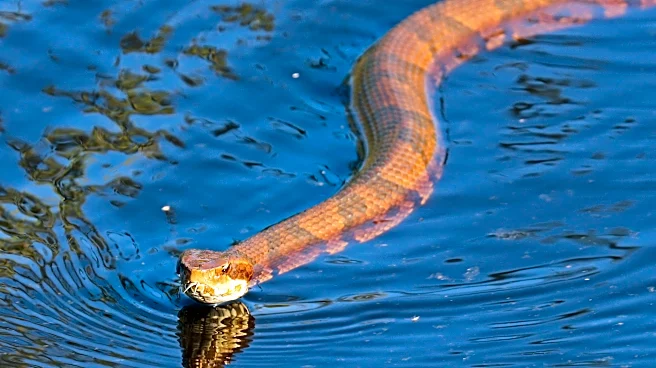






As the weather cools down for fall, snakes across Georgia will be on the move, actively hunting before finding shelter to stay warm. Two common yet dangerous species that live here are the copperhead and cottonmouth.
How can you tell them apart, what should you do if you see one, and how can you keep them away? Here's what we know:
What’s the difference between a copperhead and a cottonmouth?
Copperheads and cottonmouths are both venomous pit vipers found in Georgia, but there are some noticeable differences. Copperheads are generally associated with land. You may encounter them around wooded areas, rocky terrain, ravines and other places where they can find cover.
Cottonmouths, on the other hand, are strongly associated with water. They can be found around streams, rivers, ponds, lakes, swamps and other wet
areas. That doesn’t mean every snake near water is a cottonmouth. So, what do you need to look for?
How to identify a cottonmouth in Georgia
Cottonmouths are typically larger and heavier-bodied than copperheads. Adults can appear dark gray, brown or almost black. Younger cottonmouths generally have more noticeable patterns, while older snakes can become much darker and lose some of that contrast.
There’s a defined feature that gives the cottonmouth its name: When threatened, the snake may open its mouth, exposing a pale interior. It’s an unmistakable warning, but one you should try not to trigger. If you get close enough to a snake to make it open its mouth, you’re already too close.

Why water snakes are mistaken for cottonmouths
This may be the biggest reason snake videos turn into arguments online. Georgia has multiple harmless water snakes that can look surprisingly like cottonmouths. One example is brown water snakes with similar size, coloring, and habitat, but they are nonvenomous.
So, if someone posts a video of a large, dark snake swimming through a pond, that doesn’t automatically mean they’ve found a cottonmouth.
How to identify a Georgia copperhead
Copperheads get their name from the copper-colored appearance of their heads. Their bodies are usually tan, brown or reddish-brown, with darker bands running across them. Those bands often have the distinctive hourglass appearance people associate with the species.
Copperheads are also generally smaller than cottonmouths, although size alone doesn’t identify a snake. While they can grow to over 4 feet long, you're more likely to encounter a much smaller one.

Do copperheads smell like cucumbers?
The short answer is no. Georgia Wildlife says it's a common myth that copperheads smell like cucumbers and if you smell it in the woods, a snake is nearby. While copperheads have a unique scent, it doesn't smell like cucumber and it doesn't even mean a snake is nearby.
Can you tell a venomous snake by its head?
A tip that's been widely circulated is to look at a snake's head: A more triangular head indicates a venomous snake. A similar tip is to look at the snake's eye: Venomous snakes have slit-shaped pupils.
However, neither are foolproof methods of identification. Not all venomous snakes have vertical slit pupils and triangle heads, and some nonvenomous snakes have these features. Also, a round-headed snake can flatten its head when it feels threatened, making its head appear more triangular.
But more than that, it's just never a good idea to get close enough to a snake to confirm the shape of its head, eyes, or teeth. One of the top rules for any snake, venomous or not: Leave them alone.
What should you do if you see a snake?
As we just said, it's always best, first and foremost, to leave a snake alone and give it plenty of space. Do not try to pick it up. Do not corner it. Do not try to get closer so you can get a better picture/video to post online.
UGA's Savannah River Ecology Lab says if you're walking somewhere you may encounter snakes, wear closed-toe shoes and long pants. If you see one, it's usually just moving from one point to another. Remain calm, let it pass, and don't try to remove it. Even if your intention is to just nudge it or move it in another direction, the snake may consider this an attack.
Snake boots are available at Bass Pro Shops
What to do if you're bit by a snake
Snakes are not interested in humans, even if one is in your line of view. We are not part of their diet and we are much bigger than them. Snakes generally only bite if they feel threatened. That's why, once again, it's best to Leave them alone.
That being said, the American Red Cross has these steps to follow if it happens:
- Call 911
- Keep the injured area still and lower than the heart.
- Don't allow the victim to walk.
- Wash wound with soap and water.
- Cover the bite with a clean, dry dressing.
- Keep the victim from getting cold or overheated.
It's worth remembering that nonvenomous snakes may bite you too, even if it's not as dangerous as a venomous snake bite. But, again, it's unlikely to happen if the snake feels safe and left alone.
@robertirwin Giving a helping hand to someone who doesn’t have any! 🐍
♬ original sound - Robert Irwin
How can I keep snakes out of my backyard?
While copperheads generally won't bite humans if they are left alone, for the sake of your children or pets, here are some methods from Northwest Exterminating to help prevent the snakes from ever entering your yard:
- Eliminate food sources: Snakes will move along in search of something to eat, so ensure your backyard is free of food. This also includes making sure that pests that snakes like to prey on are not in your yard.
- Get rid of water: Eliminate standing water in your yard whenever possible and repair leaky faucets and hoses. Since snakes are attracted to areas that offer a lot of moisture, you should also maintain pools, ponds, and other water features.
- Eliminate hiding spots: Snakes will seek out places to breed and rest, so it's best to get rid of coiled hoses and use hose boxes instead. If possible, avoid the use of rock piles when landscaping, and store firewood in boxes and elevate it. Grass should be mowed and dense brush cleared out. Seal off or add fencing to open areas under sheds or buildings (if you choose to use a snake-proof fence, ensure it's made of steel mesh or plastic sheeting, is at least 3 feet high and 4 feet deep, is flush with the ground, and angled outward).
- Use snake-repelling plants: Common snake repelling plants include marigolds, lemongrass, mother-in-law's tongue, wormwood, onion, and garlic.
- Fill in burrows: Fill in any holes with dirt or gravel dug by gophers, moles, or voles.
- Use natural repellents: Use natural repellents around the perimeter of your property like ammonia, naphthalene, sulfur, clove and cinnamon oil, garlic and onions, vinegar, and lime.
Miguel Legoas is a Deep South Connect Team Reporter for USA Today. Find him on Instagram @miguelegoas and email at mlegoas@gannett.com.
Jennifer Lindahl is a Breaking and Trending Reporter in Alabama for USA TODAY’s Deep South Connect Team. Connect with her on X @jenn_lindahl and email atjlindahl@usatodayco.com.
This article originally appeared on Savannah Morning News: Copperhead or cottonmouth? What Georgia residents should know
Our editors independently choose our recommendations. Some content is produced with paid support from a third party, however our editorial decisions remain independent. If you buy through our links, the USA TODAY Network may earn a commission. Prices and availability may change.