








(Editor's Note: October is national Breast Cancer Awareness month, and St. Joseph’s/Candler, along with media partners the Savannah Morning News and WSAV, lead programming throughout the month as part of the Paint the Town Pink awareness campaign.)
During the last decade, tremendous strides have been made in the detection and treatment of breast cancer, according to a board-certified diagnostic radiologist at St. Joseph’s/Candler.
Dil Patel M.D. believes that “a significant amount of research and money” has made several groundbreaking innovations available, including clinical trials, 3-D mammography, breast MRI ultrasound and contrast-enhanced mammography.
At Candler’s Telfair Pavilion, for example, the cancer team helps women (and men) “plug-in
with the clinical trial people,” Patel said. Clinical trials test new medicines to see if they are effective against certain types of cancers. Additionally, from an imaging standpoint, the Telfair Pavilion offers annual screening mammography, 3D mammography, breast MRI ultrasound, and contrast-enhanced mammography.

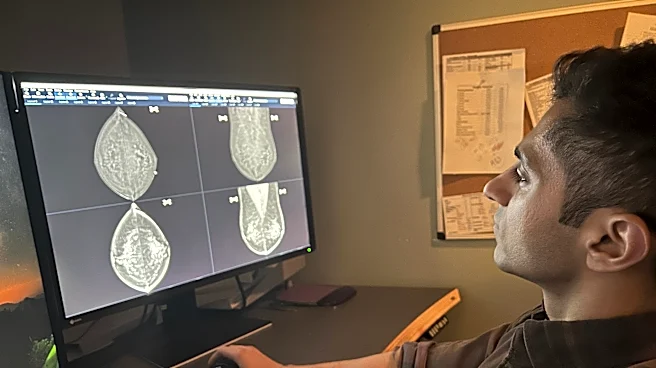
“Contrast-enhanced mammography is similar to a regular mammogram, except we also have the addition of the IV contrast that's injected,” Patel explained. “The patient will come in, get the IV placed by the nurse at Telfair, and then they'll get the regular mammogram images without the contrast. Then we'll inject the contrast and take a look at the pictures.”
Anything abnormal or a suspicious spot that takes up a lot of blood flow will show up as white on a background of dark gray breast tissue, he said.
“In certain subsets of patients, this can be very helpful because it really helps us pick out cancers a little bit easier,” he added.
The annual screening mammogram, however, is still the “gold standard for detecting breast cancer,” Patel pointed out. “The mammogram has definitely been proven to decrease the risk of the death rate from breast cancer. Over the past 20 to 30 years, the rate of breast cancer incidence has increased, but the death rate has significantly decreased. I think in large part that's due to the fact that we're just catching so many of these cancers at an earlier stage with the screening mammogram."
If something abnormal shows up on an annual mammogram, “we'll be able to get on top of it and figure out what it is so we can go from there with treatment.”
“Contrast enhancement does not replace (a regular mammogram). It's just a nice add-on to it,” he pointed out.

For example, if a patient with dense breasts comes in for a mammogram, they may have an abnormality that the radiological team may want to look at further, he said.
“We would call (the patient) back in to have the contrast-enhanced mammography,” he said.
Or, if a patient has specific breast complaints, such as a lump, pain, nipple discharge or retraction, or anything that's unusual in the breast, they can qualify for this contrast enhanced mammogram, which helps with detection, Patel said.
“Sometimes these symptoms can be absolutely nothing. They can be benign. But, on the off chance that it is something that ends up being cancerous, we certainly need to work it up further,” he continued. “So, if a woman (or man) ever has any of these symptoms, they should definitely go ahead and get checked out.”

Often cancer in the breast can show up without any symptoms, which is why both annual mammograms and self-checks are of great importance, he explained.
“If you feel a lump, nipple discharge, skin retraction, any of that, it's very important to come in and get seen as soon as you can,” he said. “And just because you have one of these symptoms, it doesn't mean something's wrong. It just means that we need to figure out what it is and get on top of it.”
Unfortunately, Patel added, some women do not schedule regular mammograms because of a couple of misconceptions flying around on social media and elsewhere.
“I think the two biggest that I've come across is that there is a risk of radiation from the mammogram,” he explained. “The radiation dose from a mammogram is exceedingly low and the benefit of getting the mammogram certainly outweighs the very minimal risk of the radiation.”

Also, some women believe that because they don’t have a family history of breast cancer, or if they’ve previously had a normal screening, they don’t need to have annual mammograms.
“It’s certainly very important to keep getting these screening mammograms every year, because as soon as something develops, we can catch it early and treat it early,” he advised. “If a patient goes five to 10 years without a screening mammogram, something that developed could potentially get a lot worse.”
Approximately 75% of breast cancers are diagnosed in women who don't have any family history, he said.
The American College of Radiology recommends that women at average risk for breast cancer-- those without a family history or no gene mutations -- should begin annual screening at age 40.
“If you do have some of these risk factors or family history of breast cancer, you ought to begin earlier,” Patel advised. “But that age will depend on each patient individually based on the age at which their family member was diagnosed with breast cancer. That is a good question for women to ask their primary care doctor.”
Women who lead busy lives, whether it’s with work outside the home or with children who need their attention, mistakenly believe they don’t have time to schedule a mammogram.
Mammograms are important and are generally quick, easy and pain free at the Telfair Pavilion at St. Joseph’s/Candler.
“There are a large number of people involved in the coordination of the mammography department,” Patel said. “They make sure nobody falls through the cracks.”
This article originally appeared on Savannah Morning News: Why annual mammograms are still the gold standard | Exclusive