








To the Editor:
I was very interested to learn that my great, great, great uncle, Bartley (aka Bartlett and Bartholomew) Smith was one of the Confederate soldiers involved in the defense of the city of Savannah at Fort Pulaski. Historically speaking, that is a very big deal. Uncle Bartley survived the destruction of Fort Pulaski, was captured when the Fort surrendered and ultimately died just a few weeks later as a POW in New York City.
The military records for Uncle Bartley show that he ranked as a Private in the famous Montgomery Guards, a brigade of citizens of Irish descent from Montgomery, Georgia organized in the summer of 1861, who garrisoned the Fort. Uncle Bartley had immigrated from Ireland sometime in the 1840’s. By the 1860’s Uncle Bartley was
ready to fight for his newly adopted country, and he enlisted with the Montgomery Guards.
The Sisters of Mercy presented a now very famous Irish themed flag to the Montgomery Guards on March 17, 1862, St. Patrick’s Day. Everyone in the state of Georgia understands the importance of St. Patrick’s Day in Savannah and presentation of that flag, with all its Irish symbolism on that day, was no coincidence. The flag of the Montgomery Guards is currently displayed proudly by the National Park Service in the Fort Pulaski National Monument museum. You can be sure that Uncle Bartley handled that flag during his time in the service.
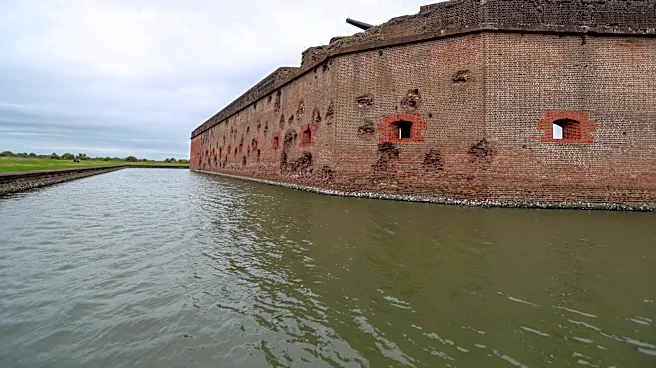
The formal name of Bartley’s military unit was Company E, 22nd Battalion, Georgia Heavy Artillery. He was most likely trained as a specialist in the art of loading, aiming and firing the giant size coastal defense cannon (plural) mounted on the walls of the Fort used to stop enemy ships headed up the river to attack the city. However, the siege of the Fort actually came by land. All accounts of the battle showed that the garrison fought bravely throughout the entire ordeal. They only surrendered when a giant hole was blasted through the wall of the fort and continued weapons fire pouring in through the hole threatened to set off their entire supply of gunpowder and needlessly kill everyone remaining in the Fort.
Since Uncle Bartley was a Private, he probably spent his time during the siege of the Fort totally exposed to dangerous weapons fire from Union forces. He was busy loading, aiming, and firing the cannon and making repairs whenever one was hit and damaged or knocked off its mounting. He and his entire unit fought bravely for Savannah but were overcome by newly developed cannon shells which could destroy brick walled forts in a matter of days or hours. The Fort was captured on April 11, 1862 and the Fort’s defenders were taken away as prisoners.
The captured soldiers were transported to a POW prison on Governor’s Island, New York known as Castle Williams. Shortly after arriving, or possibly during the trip, Uncle Bartley contracted pneumonia. He died on May 30, 1862 and his passing is recorded in the book “A Confederate Yankee, a journal of Edward William Drummond a Confederate.”
All during the war, a total of 47 Confederate soldiers died from disease at Castle Williams. Some were buried on Governors Island but most of the dead are now buried at Cypress Hill Cemetery in Brooklyn, New York. However, I was unable to locate a listing for Uncle Bartley. If anyone has a clue of where Uncle Bartley is buried, I would love to hear it. He died an unknown hero of the city of Savannah and should be honored.
Timothy G. Smith
Melbourne, FL
This article originally appeared on Savannah Morning News: Family seeks answers about lost Civil War ancestor | Opinion