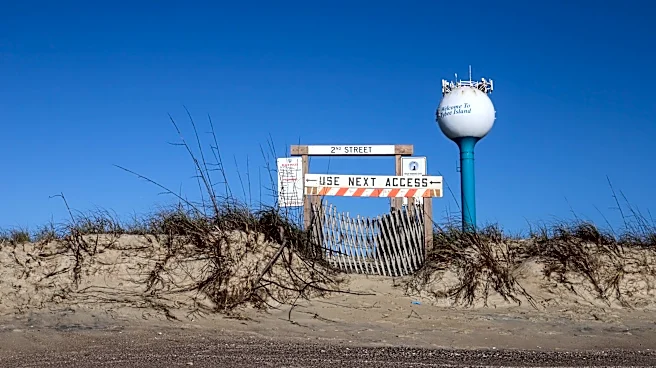






This April, when erosion from storms, sea-level rise and ship traffic had eaten away about 60% of Tybee’s beach, Tybee Island officials received some unwelcome news: The federal funding that has allowed for periodic reinforcement of the beach for the last 50 years would not be distributed to them this time around.
Since 1974, the U.S. Army Corps of Engineers has dumped massive amounts of sand on Tybee Island every seven to 10 years to replace parts of the beach lost to erosion. These “beach renourishment” projects, which the Corps undertakes up and down the East coast of the U.S., have always been “baked into the Corps’ budget,” said Tybee Island Mayor Brian West. The news that no federal funds would be allocated to Tybee’s planned 2026 beach renourishment took
city officials by surprise.
“It never occurred to me that I should check with the federal government to see if our money was there,” said Mayor West.

Following the announcement, West and a group of elected officials, including U.S. Senators Jon Ossoff and Raphael Warnock, repeatedly petitioned the Corps to recover the $12 million in federal funding needed to renourish Tybee’s beach this year. The full cost of the project is set at $20 million; Tybee Island had already raised the remaining $8 million from the city’s tax revenues as well as contributions from Chatham County and the State of Georgia.
In two letters to the Corps earlier this year, Sen. Jon Ossoff emphasized the severe erosion that has jeopardized Tybee homes, businesses and infrastructure. He cited a Corps analysis that found the shoreline is losing an average of more than 178,000 cubic yards of sand annually.
On Sept. 16, Tybee Island officials were notified that the federal government would allocate the $12 million to Tybee, allowing the beach renourishment project to move forward this winter as planned.
The news came as a relief.
Tybee’s beach is “desperate” for renourishment, said Mayor West. Without fresh sand serving as a buffer, “It wouldn’t have taken much of a storm to break through our dunes in a couple of places, especially down on the South end.”
“We would have had ocean in our parking lots,” he continued.

Regular renourishment is critical to Tybee's beach economy. The 5-mile beach supports a $200 million visitor economy that has generated nearly 1,200 jobs, according to the city. It also serves as a critical nesting ground for sea turtles and a resting point for migrating birds.
West said that in the future, Tybee beach renourishment will need to happen more frequently to keep up with sand loss. The Army Corps typically replenishes the sand every seven to 10 years; West said he’d like to shorten the cycle to five to six years.
“I don’t want to be in a position where if we don’t do it, then we’re going to have a serious problem,” he said.

But officials representing coastal governments like Tybee Island are concerned that they may not be able to depend on federal funding for future beach renourishment projects.
In 2025, according to the American Coastal Coalition, Congress allocated zero dollars for beach renourishment. It was the first time in 30 years that beach renourishment funding had been zeroed out, the advocacy organization said. In 2026, the bulk of federal funds appropriated to the Army Corps for beach renourishment went to projects in New Jersey. Project bids in that state happened to be significantly lower than expected, leading to a surplus in funding, some of which was then allocated back to Tybee Island.
Going forward, West said he won’t assume that federal funds will always be available to rescue Tybee’s beach.
“I’m not going to be mayor in seven years, but I’m probably going to call whoever is and say, ‘Hey, you need to make sure that money’s there.’”
Stephanie Castellano covers climate change and the environment in coastal Georgia. You can reach her at scastellano@usatodayco.com. This reporting content is supported by a partnership with Journalism Funding Partners.
This article originally appeared on Savannah Morning News: Tybee to move forward with beach reinforcement after funding scare