



The year was 1940 and First Bryan Baptist Church stood alone.
Around the church was vacant dirt, land that appeared it had just been cleared. All that was visible were sparse powerlines and buildings off in the distance. Such was the scene of one photo now placard in Yamacraw Square. The photo shows Yamacraw Village before its current rows of public housing were built.
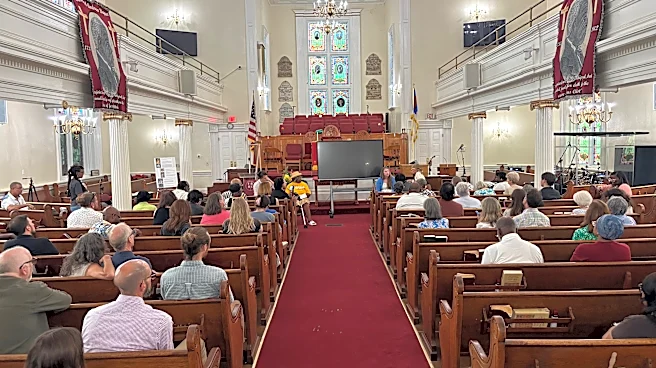
The photo was referenced Thursday night inside First Bryan for a Historic Savannah Foundation panel discussion on Yamacraw Village’s past, present and future. The event was aimed at promoting and preserving community memory of Yamacraw’s history as its housing faces potential demolition.
“We're here to build community, to discuss community memory, and to think about the history of
this site and the history of our city,” said HSF CEO Collier Neeley at the event’s start.
The Housing Authority of Savannah submitted a demolition application to the U.S. Department of Housing and Urban Development in August last year with aims to redevelop housing on the site. Demolition has long been sought for Yamacraw by HAS, a path supported in principle by the community’s formal resident’s council, due to extensive deferred maintenance on the site.
The panel discussion featured former Yamacraw resident and First Bryan member Georgia Benton, First Bryan preservation consultant Ellie Isaacs and Yamacraw Village Residents’ Council representative Shana Williams. Benton told stories of the Yamacraw Village site’s history, ranging from its home to Native Americans pre-settlement to a highly dense, and diverse, community of homes before being demolished for public housing.
“Yamacraw was the Ellis Island of the south,” Benton said, “… because I don’t care what your ethnicity was, how poor you were, if you made it to Yamacraw you had a place to stay, food to eat and you had an opportunity to move up in society.”

Isaacs noted how Yamacraw was the second, and largest, public housing community built in Savannah after the U.S. Housing Act of 1937. Today, it is officially Savannah’s oldest public housing community.
Williams, of the residents’ council, shared the council’s longstanding requests to HAS if demolition goes through. The council has requested legally enforceable guarantees from HAS including a right to return and a commitment to 100 income-based housing units to be rebuilt on the site.
To date, HAS has made such commitments verbally and in its relocation plan submitted with the demolition application. But legally enforceable guarantees have not been made, Williams said.
She added the council remains in negotiations with HAS over the requests.
“We want the process to continue, and for us to be involved in the process," Williams said.
The primary action item discussed was related to the federal Advisory Council on Historic Preservation’s to the Section 106 review process in the National Historic Preservation Act of 1966. The Section 106 review provision requires public input and inventory of historic resources to weigh in on construction projects impacting historic places.
Potential changes being considered by the council would remove the public input process, which Yamacraw’s demolition application underwent. Isaacs, on behalf of First Bryan, participated in that process. One example of a comment the church made was a request to retain the Yamacraw name on any future development.
“If these changes occur, it would eliminate all of that," Isaacs said.
Neeley said HSF will provide updates on the potential changes and information for how residents can weigh in on them as opportunities arise.
Evan Lasseter is the City of Savannah and Chatham County government reporter for the Savannah Morning News. You can reach him at ELasseter@savannahnow.com.
This article originally appeared on Savannah Morning News: Historic Savannah Foundation hosts panel on Yamacraw Village's history