





Kelly Speare, an assistant professor in the Department of Biological Sciences in the College of Arts & Sciences at Texas Tech, has been researching coral reefs for more than a decade.
Her latest findings indicate these important underwater ecosystems respond to external pressures in surprisingly different and resilient ways.
Speare’s paper outlining the findings was published in Ecology. For four years, Speare has been observing how coral reefs off the coast of French Polynesia have fared in the face of threats from fishing pressure, which can impact key reef processes, including herbivory and predation.

“I’m really interested in these processes,” Speare said, “because humans are strongly influencing them, and there are a lot of hypotheses about
how these changes may be driving degradation of coral reefs at large scales.”
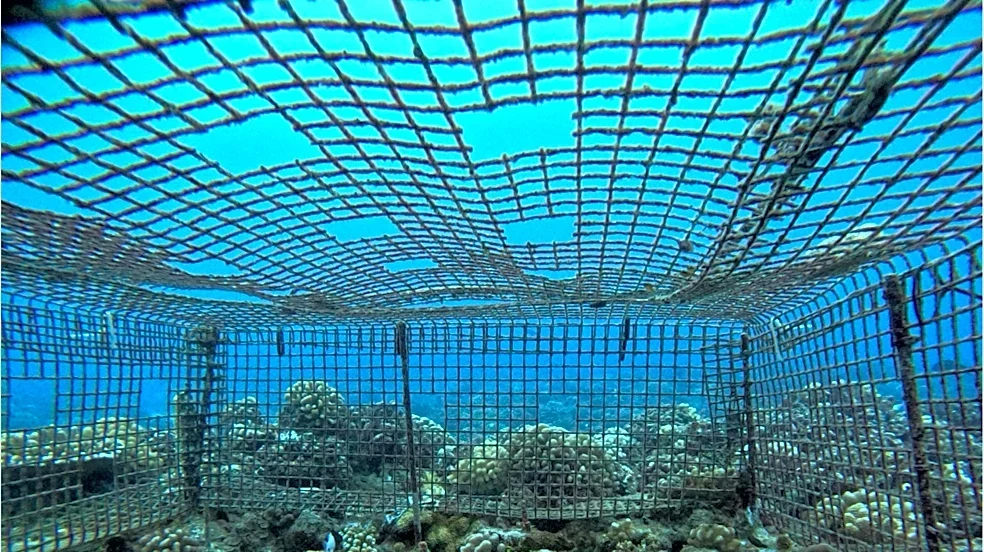
Speare and her team took a closer look at these impacts through experiments that manipulated fishes’ access to the reefs by setting up large exclosures, measuring roughly one meter by one meter. This allowed them to manipulate the size and numbers of consumers – herbivores that eat algae and corallivores that eat corals – impacting the reef. Manipulative experimental studies such as this one allow researchers to isolate certain factors to test their influence on the reef environment.
“One of the unique things about this study is the scale at which we did it,” she said. “There were large exclosures, and it was over a long-time scale, which is really important, because it takes time for some of these ecological interactions to play out.”
The team was especially interested in how consumers altered the competition between the corals and macroalgae, and how those interactions influence the trajectory of the reef community.
“When the consumer pressure was high, it favored a community dominated by corals,” she said. “That is interesting and in line with our hypotheses because we conducted a simulated disturbance and saw how the reef recovered from it.”

However, a surprising finding also emerged regarding the impacts of excluded consumers.
“We hypothesized you would end up with tons of algae and very few corals, and sometimes that is true, but sometimes you end up with plots that are totally covered in corals and have very little algae,” she said. “This was surprising and something we did not expect to find.”
Speare said they determined that without consumers, community development is ultimately unpredictable. In contrast, when consumer pressure is high, reef communities develop in a much more predictable and resilient way, consistently favoring corals over algae.
“Consumers really promote coral reefs that are dominated by corals, and that’s what everyone wants,” she said. “It may happen slowly, but they seem to promote resilience of the coral community state, which is really important.”
The findings are encouraging in light of other high-profile impacts on coral reefs such as rising ocean temperatures and increasing frequency of disturbances.
“There are things happening on a global scale that we know are having large impacts,” she said. “But I am motivated to understand these local anthropogenic stressors because local communities do have some agency to do something about them.
“So, my work focuses on how global and local stressors interact, because by understanding if they do or don’t interact, it gives communities a way to say, ‘We can’t control climate change, but we can control this factor and make smart choices about how much fishing we allow.”
This article originally appeared on Lubbock Avalanche-Journal: Texas Tech researcher explores resilience of coral reefs