





Our population is expanding, businesses are investing, and communities across the state are preparing for another generation of economic opportunity.
But growth does not happen by accident, and it does not continue without the infrastructure necessary to support it.
Among all of the infrastructure challenges facing Texas, none is more fundamental than water.
Today, Texans use approximately 17.7 million acre-feet of water each year. That demand is projected to exceed 19.2 million acre-feet by 2070, when our state's population is expected to increase reach 51.5 million residents.
The 2022 State Water Plan, the most recent iteration to be finalized, identifies a significant gap between future demand and available supplies.
The current plan projects
a shortfall of up to approximately 6.9 million acre-feet per year by 2070. But when the assumptions behind the plan are examined, including assumed but debatably plausible reductions in irrigated agriculture and the difficulty of developing certain, planned reservoirs, the potential gap could be much larger.
I personally believe it could reach 10 to 12 million acre-feet per year.
Whether the ultimate annual shortfall is 7 million acre-feet, 12 million acre-feet or something in between, one fact is clear: Texas needs to develop new water supplies soon.
Water infrastructure is different from many other public investments. A road can be designed and constructed in a few years. A water supply source, such as a reservoir or well field, may require decades of planning, permitting, financing, land acquisition and construction.
If you took a shower today, that means somebody decades ago planned for that water to be available to you now.
Likewise, for Texans to have the additional water they will need decades from now, the decisions to provide that water have to be made today. That is the challenge for our generation.
The state has identified multiple potential sources of water. Documentation obtained in 2024 from the Texas Commission Environmental Quality by the Texas Senate Committee on Water, Agriculture, and Rural Affairs, which I have chaired since 2015, indicates surface water remains available for appropriation in large, dependable quantities in six of the state's 23 regulatory river basins.
But in my view, some of Texas’ greatest opportunities to expand our water supply lie in the state’s brackish aquifers. In May, the Texas Water Development Board testified to my committee that it has completed 18 brackish aquifer studies to date and concluded that at least 3.3 billion acre-feet of brackish groundwater exists in the studied aquifers.
The Board is currently conducting five brackish aquifer studies with three more planned to begin in the future, meaning more brackish groundwater remains to be added to that total.
I believe brackish groundwater constitutes the most promising, near-term water supply solution for West Texas.
In September, my committee heard testimony about a brackish groundwater well field and treatment facility being constructed outside Childress to provide approximately 1 million gallons per day of water to the residents of Childress and its environs, much-needed relief for that drought-stricken region of the state.
In May, my committee heard testimony regarding a major brackish desalination project that will provide new water supplies to the cities of Abilene, Midland, and San Angelo.
Importantly, brackish groundwater has already been used for decades in communities including El Paso and San Antonio.
Marine desalination offers another promising way to expand Texas’s water supply, particularly along the Gulf Coast. Recently, promising marine desalination projects have been announced in Brownsville and the Houston area.
When my committee convened in May, we specifically researched policy changes to streamline desalination regulations as a means of encouraging more marine and brackish groundwater desalination projects in Texas.
And perhaps the most innovative opportunity to address our water supply needs, which will primarily benefit West Texas, lies in produced water from oil and gas operations.
Testimony offered before my committee in May indicates 32 million barrels, or over 1.3 billion gallons, of produced water flows from the Permian Basin every day.
In August, I attended the grand opening of a new produced water treatment facility in Orla that will process 10,000 barrels of produced water per day and treat the effluent to a quality so high it can be safely discharged into the Pecos River basin, which badly needs the water.
I believe this technology can be applied at scale across the region.
We know the water resources are there. We know the technology exists to develop many of them. We know the demand is coming.
The question is whether the capital will be available to fund the projects.
That’s why I authored Senate Bill 7 and sponsored House Joint Resolution 7 in the Senate. Together, they became Proposition 4, which more than 70% of Texas voters approved last November.
That initiative dedicates $1 billion of state sales tax revenue to the Texas Water Fund in support of water supply and infrastructure development each year for 20 years, and specifically prioritizes the types of non-traditional sources I outlined above.15
This legislative effort built on Senate Bill 28 and Senate Joint Resolution 75, legislation I authored in 2023 to create the Texas Water Fund and seed it with an initial $1 billion, which 78% of Texas voters ratified via Proposition 6 that same year.
But the state's down payments, historic and significant as those investments may be, aren't enough to cover the total cost of new water supplies and water infrastructure. The Water Development Board's latest estimates indicate $174 billion will be needed to cover water supply and infrastructure costs over the next 50 years.
The state funding I've helped to secure during the Legislature's last two regular sessions will need to be leveraged alongside federal funding, local funding sources, and private investment to meet all of the state's needs.
And there will need to be a steady hand in state leadership to ensure the state stays the course.
Infrastructure is not merely an expense, it is the foundation upon which the future of Texas will be built. The water infrastructure we rely on today, and the power and transportation infrastructure, too, is available to us now because previous generations made the investments and did the work necessary to ensure it would be. In turn, our responsibility is to ensure the infrastructure our progeny will need is there for them, too.
I ask for your support in that endeavor.
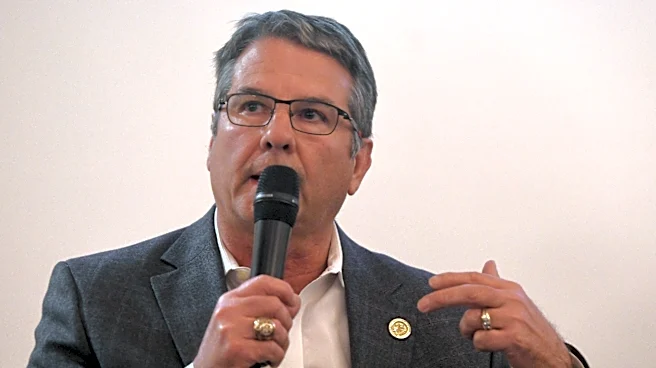
(State Sen. Charles Perry is a Lubbock Republican who represents Senate District 28 covering Lubbock, Abilene, San Angelo and Childress.)
This article originally appeared on Lubbock Avalanche-Journal: Sen. Perry urges Texans to support plans for water future | Opinion