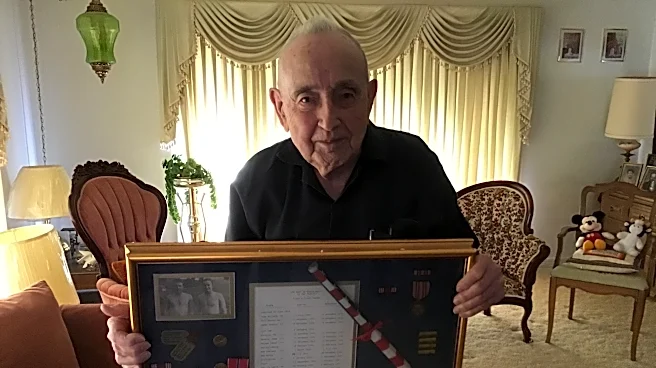






Lloyd Parker was drafted on July 5, 1943. His basic training took place in Camp Wolters near Mineral Wells, Texas.
At the time, it was the largest infantry replacement training camp in the U.S. Texan Audie Murphy, a future Medal of Honor winner, was trained there.
After three months of intense training, Parker and his unit, the 103rd Infantry Regiment, were sent to Camp Shanks in New York to be shipped to Europe.
So how did the troop ship headed to Europe turn into a 9,000 mile trip?
Parker, now a 101-year-old Levelland resident, explained in an interview with Larry A. Williams and shared with the Avalanche-Journal this fall.
An unexpected trip around the world
“We headed out into the Atlantic and had several destroyers with us to guard against German submarines," Parker said. "A couple
of days out, I went topside and looked around. There wasn’t another ship in sight! The captain of the ship came on the intercom and said, ‘Men, we are on our own.’ That gave me a bad feeling. We were issued winter gear, and we thought, well, were headed somewhere cold in Europe. Later, we were ordered to turn in our winter gear and issued summer gear. The captain told us that we were now headed to New Caledonia near Australia.
Instead of 14 days to Europe on the water, it took us 38 days! We became Shellbacks after crossing the equator.”
Parker and crew were headed for the Pacific Theatre.

Growing up in Texas
Lloyd Ennis Parker was born on Dec. 30, 1924 in Winnsboro, Texas to Walter and Nancy Parker. His dad was an itinerant farmer.
His mother kept busy with 10 children. Asked if he played any sports in school, Lloyd said, “No, I worked! I did like to hunt and fish. I attended a country school until the 9th grade and then graduated from Winnsboro High in May 1943."
He said he had an older brother who also served in WWII.
"My twin brother Floyd and I went in the Army together and were in the same unit," he said.
Now assigned to the 43rd Infantry Division, the 103rd was sent to New Zealand and on to New Guinea. This was mostly a mop-up operation.
“I saw my first Japanese soldier here – he was a prisoner," Parker said.
At the next stop, the Parkers would see much more action.
Gen. Douglas McArthur famously said, after leaving the Philippines in March 1942, “I shall return.”
Fighting in the Pacific theater instead of Europe
The brothers would find themselves in the middle of the “return.”
“We were going to make a beach head at Luzon on Jan. 8, 1945," Parker said. "The beach had already been bombed and strafed by the Army Air Corps and bombarded by the Navy. Our goal was a village about 10-12 miles inland. We only made about 3-4 miles and had to bed down in what was supposed to be a dry rice paddy. It was not dry! Bad intelligence. We moved out the next morning and took the village. We had quite a bit of resistance (from the Japanese). The next day 25-30 guerillas came down out of the hills. They were a motley looking bunch of U.S. and Australian troops who did not surrender when the (Japanese) took over the island in 1942. They had been giving them hell for 2-3 years! They had a lot of guts. They joined our outfit.”
He continued, “I was on an 81mm mortar as a gunner. The first (man) I killed, I couldn’t see because they were over a hill where we fired our mortars. We lost some good men in Luzon. They were buried there. We had three sets of twins in our outfit. One set was from Arkansas, one set from Loop, Texas and my brother and me. The ones from Arkansas didn’t make it back. The last name of the twins from Loop was Hand, so we took to calling them ‘right and left’.
"One of them was wounded. I was lucky – never wounded. We kept moving inland and arrived at the big POW Camp Cabanatuan where American prisoners had been held.”
The camp was liberated in January 1945 by the American 6th Army and Filipino guerillas in what came to be called “The Great Raid."
“Some of the prisoners were crying, some were silent and some couldn’t believe they were free," Parker said. "They looked terrible. They said the old guards had been shipped out, and new meaner ones came into the camp."

"Our next mission was to root out some (Japanese) in a resort town in the mountains," he said. " We didn’t make it there. We lost too many people. We got replacements. Every two-three weeks we got to go back and get a shower and some rest. The wounded were sent to New Guinea if they weren’t hurt too bad, then they would be returned."
He said the next battlefield was the IPO dam, which supplied about 30% of Manila’s water).
"We were supposed to get there before the monsoon season hit but we were too late," Parker said. "It rained a lot. We couldn’t see to do anything. The Army couldn’t even get food to us. They tried to parachute food into us. Some hit our lines; some hit the enemy lines. One wounded man couldn’t even get medical treatment – a guy from Tennessee. I’ll never forget when he finally left. He said, ‘Good luck you bunch of *******!’" Parker recalled with a chuckle. "I never saw him again."
He said their main Jeep driver was 35 years old.
"We naturally called him ‘grandpa,'" Parker said. "He had a lot of nerve. We took over the dam before the (Japanese) blew it up. I didn’t understand why they didn’t blow it up.
“One young man was picked to go back to the states. We were never sure why. He said, ‘I want to stay and kill one more...’. He was killed the next day. After the dam was secured, we went back to a rest area. An officer drove up in a Jeep and told us that the war was over. We didn’t believe him at first. Since I was single, I was sent to Tokyo as part of the Army of Occupation. Our squad was sent to a small village to guard a school building, filled with bombs, 24 hours a day. I came down with Malaria. I was sent back to Tokyo and given Atabrine. A doctor told me later to quit taking those or I would continue to get malaria. I was sent back to the states in December 1946 on a hospital ship. That’s all they had."
He said he was discharged at Ft. Sam Houston in Texas and headed back to Winnsboro.
Going to West Texas
"I had three first cousins in Lubbock and went to visit them," Parker recalled. "I ran into a guy from Levelland who helped me get a job at a service station there. A guy who worked across the street at Simon Garret Lumber came over one day and said he noticed that I was a hard worker and I should come to work for him. I worked there 25 years. I met Susie Mae Fite in Levelland. We married in November 1946. We had one son, Glen. Susie died in November 1995. I met Elwanna McHam and we married in 1997. She had two girls. Elwanna died in February 2017."
At one point in his later years, Parker delivered meals to shut ins, but now lives in a retirement community in Levelland.
Asked what he would like to be remembered for, he smiled and said, “That I could help them old people.”
Larry A. Williams is the Outreach/Veterans Liaison Co-chair for the Texas South Plains Honor Flight and co-author of "Texas South Plains War Stories."
This article originally appeared on Lubbock Avalanche-Journal: Levelland war veteran recalls eventful journey, WWII experience