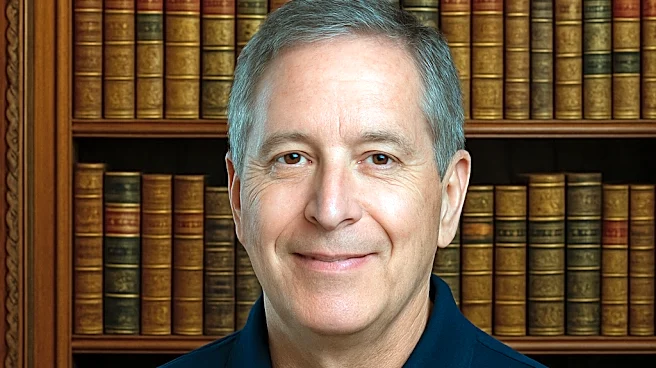





In this week's It’s Debatablearticle, Rick Rosen and Charles Moster explore the question: "Could a biological weapon inflict more damage on the United States than a nuclear attack—and are we prepared for it?" Moster is the Founder of the Moster Law Firm based in Lubbock with offices in Austin, Dallas, Houston, and Midland. He is also a technologist, software developer, and author of numerous published books in the areas of AI, futurism, and the law. He has contributed legal articles and seminars on whether the coming conscious computers should be granted full legal rights by the Supreme Court.
Moster-1
I just finished Annie Jacobsen’s horror story – “Biological War – A Scenario.” Spoiler Alert – Don’t read before bedtime. This Halloween dystopia
is for real.
During the Cold War and continuing to this day, Soviet – now Russian scientists genetically spliced together what are called “chimera” agents, infamously named after the ancient Greek mythical beast which combined the traits of a goat, snake and lion.
In this biological nightmare, the goal was to genetically modify the bacteria which causes plague, make it airborne, and then combine it with the virus which causes encephalitis – a deadly and grisly swelling of the brain which leads to rapid death. For the record, plague was the cause of massive death during the Black Plague which killed close to 60% of the population of Europe in the mid-14th Century.

Plague, of course, is now treatable with antibiotics, however, the Soviet chimeric version added a “trojan horse” feature of indescribable evil. The administration of antibiotics to their bioweapon immediately releases the encephalitis and certain death of the victim.
In Jacobsen’s scenario, an explosion at a secure bio-site in Russia leads to the release of this pathogen which the Russians refuse to disclose. A few international hunters in the area become infected and then travel home to airports across the world including LAX, Dallas-Ft. Worth, and other locations. By the time the epidemic is discovered, it is too late to stop. Inside of a week, most of our country is dead and dying. Tragically, the administration of antibiotics triggers the outbreak of encephalitis. The fatality rate is 100%.
So, is this real? I am afraid so. The pathogen was created by the Soviets but there is little data that the Russian Federation has continued research or stockpiled – but do you trust Putin? How about terrorist organizations? The greatest threat – BTW – is the use of AI to provide a blueprint for creating bioweapons in your garage. This is not science fiction as last week Anthropic pulled the plug on scientists attempting to use Claude to do just that.
Until I read Jacobsen’s book, I had no idea that biological war is a greater threat to our survival than thermo-nuclear war.
Apart from being more deadly, which is incomprehensible, anyone with a high school education and access to AI can create a bioweapon.
You need a nation state and enriched uranium to build a bomb, but a hyped-up religious fanatic on steroids or testosterone could bring about bio-doomsday. How frightening is that?
As to preparedness, you can forget that. Although FEMA has devoted some resources to the threat, there is no plan akin to nuclear civil defense to protect all of us. It would be a repeat of Covid emphasizing containment, tracing, and a feverish (sorry) attempt to find a vaccine. In Jacobsen’s account, we would be out of time.
(A quick aside – I asked my ChatGPT counterpart “Max” to provide a research assist on this topic and the system shut down claiming that the research was disallowed. I interjected that the information was necessary for this newspaper column. That did the trick and out poured the data requested and a lot more. So much for AI restraints.)
Admittedly, Rick has the short end of the stick on this debate. At the very least, he should return the favor in our next debate topic.
Rosen-1
An odd topic; like debating on a smaller scale which is worse: a root canal or a colonoscopy prep (actually, both suck). There is no doubt that biological weapons could cause grievous harm and are difficult—if not impossible—to deter. First, they are stealthy and not always traceable to a particular source. Second, because the United States abides by the Biological Weapons Convention, it cannot (and should not) retaliate in kind.
While a biological weapons attack could be catastrophic, at least some people would survive and find effective preventive measures or cures. Importantly, the infrastructure needed to combat diseases would still be intact. By contrast, mankind would not recover from a world-wide nuclear conflagration, which would destroy the very foundations of civilized society.

In a piece entitled Nowhere to Hide—How a nuclear war would kill you—and almost everybody else, the Bulletin of the Atomic Scientists states that within 24 hours of just a single 300-kiloton nuclear strike on New York City (the warhead strength of our Minuteman III missiles), 1,000,000 would be dead from the blast and radiation.
A Russia-United States nuclear exchange would cause 360,000,000 “quick” deaths. In an earlier column, Charles cited Annie Jacobson’s book Nuclear War, stating (perhaps hyperbolically) that “the entire United States population would be dead or dying in less than an hour after a Russian nuclear attack.”
A nuclear war would result in a near-total collapse of a nation’s physical, digital, and economic infrastructure. The intense heat triggered from nuclear explosions would cause widespread firestorms in urban centers, destroying local transportation hubs, bridges, buildings, and municipal services. Most hospitals, medical personnel, and medical supplies in targeted cities would be vaporized or incapacitated, leaving survivors without medical care. High-altitude detonations would release powerful electromagnetic pulses that would paralyze power stations and disable computers, vehicles, and telecommunications over vast geographic areas. With power stations disabled or destroyed, water treatment, fuel production, and food refrigeration and distribution would cease functioning.
And perhaps worse, nuclear war will inject millions of tons of soot into the stratosphere, creating a “nuclear winter” that would destroy our food supply. According to Biologyinsights.com, “indirect deaths from famine and societal collapse would far exceed the direct casualties from the detonations.” Recovery—if any—would take decades due to radioactive fallout, destruction of infrastructure, lack of food, absence of medical assistance, and the collapse of government.
If there is a “bright spot,” it’s that nuclear war might kill the pathogens Charles fears.
Moster -2
Even in the most dire circumstances, Rick can retain his sense of humor. Yes – this is an incomprehensible choice between two horribles. That said, however flawed, our nation has put forth a deterrent strategy to ensure that the unthinkable nuclear attack is answered in kind. The Russians and particulary North Koreans well understand that a nuclear attack will lead to their annhilation.
There is no such deterrent as it relates to a biological attack by a major adversary. Moreover, unlike a nuclear strike, the use of a biological agent would preserve the resources and infracture for 100% use by the aggressor. In such scenario, I would anticipate that the perpetrator would have developed an effective antidote to safeguard its own population. In this horrific scenario, our enemies would have the means and every incentive for a first biological strike.
Until I read Annie Jacobsen’s book, I had no idea of the existential threat that all of us face. Moreover, high school students are gaining access to the biological agents via the internet to develop these weapons of mass destruction now. A National Defense University study prepared in 2025 concluded that America lacked an integrated strategty to deter biological weapons.
It is bewildering that our government regardless of political affiliation has not addressed this grave risk head on. We count on our military to defend all of us. It has failed.
Rosen-2
A widescale nuclear conflict is truly the foremost existential threat to mankind. It would cause massive casualties and physical destruction in a matter of minutes, and—if humans survive—result in misery and suffering lasting for decades if not centuries. Nuclear weapons are clearly the planet’s most destructive devices. The prevention of nuclear conflict should be our nation’s highest priority. That said, I cannot deny Charles’ argument about the horror of biological weapons and their potential use.
Virtually every nation on earth is a party to the 1972 Biological Weapons Convention, which prohibits the development, production, stockpiling, acquisition, and retention of biological agents or toxins and the means of their delivery. The nation’ most dangerous adversaries—China, Russia, and Iran—are parties to the convention. these nations are also parties to a 1925 Protocol prohibiting Asphyxiating, Poisonous or Other Gases, and Bacteriological Methods of Warfare. Assuming nations adhere to their commitments under the Convention and Protocol, Charles and I have nothing to worry about. World leaders can sit around the proverbial campfire, roast marshmallows, and sing Kumbaya.
Of course, many nations treat conventions and treaties limiting the means and methods of warfare as suggestions, breakable at will whenever it is to their advantage. Contrary to Charles’ assertion, the nation has made preparations for a possible biological weapons attack. For example, the Department of Homeland Security established the National Biodefense Analysis & Countermeasures Center at Fort Detrick, Maryland to identify and attribute biological threats, and the Department of Health and Human Services has created stockpiles of medicines and medical supplies such as vaccines and anti-virals to deploy in an emergency.
I admit that there are weaknesses in the nation’s preparedness such as the its inability to recognize or acknowledge foreign biological threats. For example, at the outset of COVID-19, the government and various “experts” attributed the disease to pangolins rather than a negligently caused leak from nearby lab that actually produced the virus.
But the real problem was the immediate condemnation and censure of those who dissented. If there is an intentional biological attack, the government must quickly identify it as such and frame an appropriate response.
This article originally appeared on Lubbock Avalanche-Journal: It's Debatable asks if we're prepared for biological attack on U.S.