
Editor’s Note: Jack Becker, Librarian Emeritus, is the editor ofCaprock Chronicles. He can be reached at jack.becker@ttu.edu. Today’s article is by Sandy Fortenberry and frequent contributor to this column.
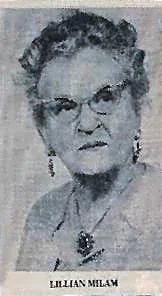
In 1926, Lillian Milam opened her home to a nine-month-old baby whose mother had passed away, marking the start of her lifelong dedication to supporting Lubbock’s neglected children. This first act of kindness laid the foundation of what would become the Milam Opportunity Home.
W. T. and Lillian Milam moved to Lubbock in 1926, where Lillian quickly became active in local church work and the federated aid society.
The couple began taking in abandoned children at their residence on 1103 19th Street, while searching for permanent homes for them.
Eventually, the Milams relocated to a larger house at 24th and Avenue K, and Lillian rented an additional house nearby as a boys’ dormitory. When W. T. returned from his work as a traveling salesman, he never knew how many children would be at his house. By 1935, her compassionate efforts became known as Milam’s Opportunity Home.

Although Lillian’s love for children was evident, her strength was in rallying support. Civic organizations, school groups, and various donors contributed items from bicycles, shoes, movie tickets, to Christmas gifts for the children. The Junior Welfare League, founded in 1935 and known today as the Junior League, backed the Milam Opportunity Home as its principal project. The Milam Home was an organization supported by the Community Chest, fore-runner of the United Way.
Beyond her charitable work, Lillian was involved in multiple community and social organizations. The Friendly 13, a social group, met regularly at her home. She was a member of the First Christian Church, participated in the Daughters of the Republic of Texas, and served several terms as president of the PTA at Dupre Elementary. In 1928, she became a charter member and first president of the Lubbock Art Club, later absorbed into the Lubbock Art Association. Lillian, a talented artist, ultimately chose to focus on her work with homeless children over her artistic pursuits.
As Lillian’s philanthropic efforts continued to grow, new facilities were needed. Construction began on a new building at 38th Street and Avenue H, supported by donations and labor from Lubbock craftsmen, bricklayers and the members of the carpenters union. Over the years, the Milam Home cared for hundreds of children.

Leslie C. Smith was placed at the Milam Home around age 13 when his widowed father could no longer care for him and his four siblings. Leslie left Lubbock High School in 1942 to join the U.S. Air Corps. He completed 62 missions before his plane was shot down on June 17, 1944, over the Mediterranean Sea.
His name is inscribed on the Tablets of the Missing at Florence American Cemetery in Italy. Before he died, Leslie expressed his wish, in a letter home, to help build a dormitory for orphan boys at the Milam Home. His dream was realized in 1952 with the construction of a dormitory named in his honor, which would house 18 boys.
More than 300 people attended the dedication, and children placed newspaper articles and keepsakes behind the cornerstone. The dormitory was later demolished, but the cornerstone still remains.
Upon Lillian’s retirement in 1956, the Milam Board Inc., under the leadership of president, G.P. Kuykendall, transferred two buildings and eleven acres of the Milam Home to Buckner Orphans Home of Dallas, which opened a Lubbock campus on the property.
On March 8, 1957, the Milam Home for Girls, operated by Buckner, was dedicated, honoring Lillian Milam for her devotion to caring for thousands of children. Buckner built a new facility at 4th and Loop 289 in 1967, closing the Milam Home at 38th and Avenue H.
The property then transferred to the West Texas District of the Assembly of God, which owned it for over a decade before it became the Lubbock Regional Mental Health and Mental Retardation Center.

The construction of Interstate 27 demolished some of the Milam buildings, including the Leslie Smith dorm, but the cornerstones were saved. In 1987, Lubbock MHMR honored the legacy of Lillian Milan with a memorial wall containing a plaque and two cornerstones.
In 1946, Lillian Milam’s story reached the national audience when Tom Breneman’s “Breakfast in Hollywood” radio program named her the “Good Neighbor of the Day.” That same year, she became the first Woman of the Year recognized by the Altrusa Club for her outstanding civic service in Lubbock. In 1950, she was honored as the local winner of radio station KCBD’s “Queen of America” contest.
Lillian Whitehurst Milam passed away in 1979 at age 95. The title she cherished most was the affectionate one given to her by the many children she cared for - “Mam-Maw.”
This article originally appeared on Lubbock Avalanche-Journal: Caprock Chronicles: Lillian Milam's home for Lubbock's neglected children