






Editor’s Note: Jack Becker is the editor of Caprock Chronicles and is a Librarian Emeritus from Texas Tech University. He can be reached at jack.becker@ttu.edu. Today’s article is the fourth of a five-part series by frequent contributor Chuck Lanehart, Lubbock attorney and award-winning history writer. These articles were originally published by The History Press in Chuck’s book, “Evolution of the Texas Plains,” in 2023. Published here with permission.
I worked as a teenage grunt roustabout in the Texas Panhandle during the summers of 1969-1971. These are my memories of the oil patch.
When I was a child, my geologist father took me to drill sites many times. The petroleum engineers and geologists would position a modest trailer house near the rig
as a base to oversee the final drilling operations (“bringing in a well”), and the men would live there for days at a time (“sitting on a well”).

Sometimes I was privileged to spend the night in an oilfield trailer house. It was like camping out on an airport runway, as the drilling rigs produced noise comparable to a jet engine (workers in the oil and gas drilling sector have some of the highest hearing-loss rates of any industry).
With his trusty slide rule and microscope, Dad would evaluate “core samples” of material taken from the shaft to determine the progress of the operation.
But the most fun was watching Dad and his buddy oilmen play a card game called “pitch,” dominoes and other rowdy games in the trailer. I loved those excursions.
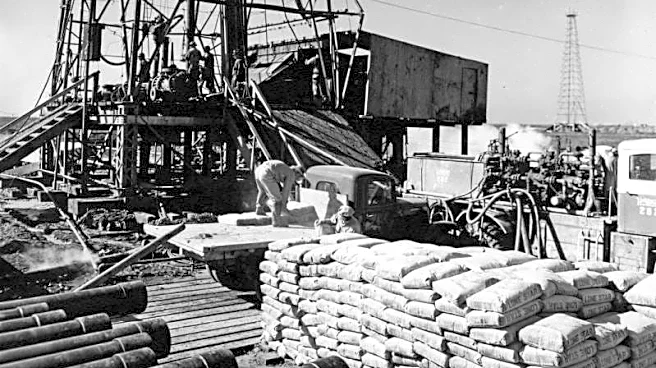
Dad would sometimes take me up to the drilling platform to meet the toolpushers and roughnecks and watch their work. Whoa! Roughnecks—protected by hard hats, steel-toed boots, leather gloves and thick coveralls—slung heavy chains around the drill pipe like cowboys lassoing a calf, and it was thrilling to watch. The spinning lengths of steel link chains rapidly turned and screwed together drill pipe joints. The chain was wrapped around the pipe, and the rig's drawworks pulled it, causing the pipe to spin and tighten. Due to high accident rates and injury risks, many modern rigs have replaced chains with safer, mechanical spinning devices. I thought the toughest, most courageous oilmen were those assigned to the “crow’s nest,” a small workspace where a single man maneuvered drilling pipe high above the derrick.
Those on the drilling platform were always covered in sweat, oil and grease. The drilling crew usually worked a 12-hour shift (called a “tour”), and the rig operated 24-hours a day, seven days a week, until the well “came in,” or was determined to be a “dry hole.”
As a part-time grunt roustabout, I never worked on a drilling rig like the experienced full-time skilled roughnecks and toolpushers, who might make up to $1,000 per month. Yet my job digging ditches and chopping weeds for $1.75 per hour helped me earn money for my college education, when state university tuition was between $200 and $400 per year.

Once, my job was to clean a heater-treater that had been purchased from a field in East Texas. East Texas heater-treaters used straw to filter impurities in the oil, but West Texas heater-treaters did not. My task was to remove all of the oil-soaked straw from the unit. At the end of the day, I was covered with oil, and my mother would not allow me into the house. I was required to strip in the garage, my work clothes were relegated to the trash heap, and I was dispatched to the shower.
My job as a grunt roustabout was mostly unremarkable. We chopped a lot of weeds around pump jacks and tank batteries. It was well before the days of power weed trimmers, so we were issued hoes and “yo-yos.”
A yo-yo was not a toy: it was like a scythe or sickle. It was also before the days of chemical weedkillers like Roundup, but I guess we were lucky not to have been exposed to the poisons of these products. We spray-painted pumpjacks. We broke out heavy iron pipelines, we connected pipelines. We loaded and unloaded pipe. We dug ditches, we filled ditches.
Once in a while, my roustabout crew would be dispatched to more interesting jobs. One day we traveled about 85 miles east to the fabulous Cree Ranch in western Oklahoma. I was familiar with the ranch, as my father’s employer, Cree Drilling Company, invited our family to use the place for short vacations many times during the 1960s.
There was a first-class lodge with a swimming pool for kids and a fully stocked 15-foot-long bar for misbehaving adults. There was a lake big enough for paddleboats and canoes, well stocked with huge catfish. We swam and fished during the day and hunted bullfrogs at night.
We ate fried catfish and frog legs for dinner, along with what we were told were buffalo burgers. The Cree Ranch was a magical place.
After my roustabout crew fixed a small leak in a water tank at the Cree Ranch, we hopped back in our pickups and headed back to Pampa. No swimming, no fishing, no bullfrogs, no buffalo burgers, no partaking of the pleasures of the bar. The life of a grunt roustabout was not very glamorous.
Part five, the final article of this series, will be published at a later date.
This article originally appeared on Lubbock Avalanche-Journal: Caprock Chronicles on the semi-pleasures of a Roustabout