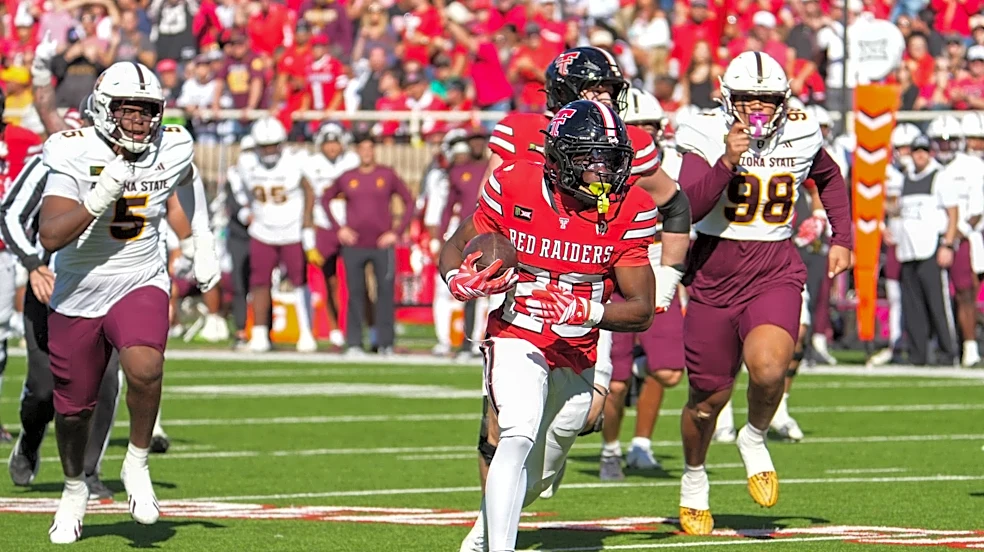





Normally in this space, I answer reader questions that come in via X or email about Texas Tech football, but this week the worst thing happened for the proprietor of the Q&A business: The Red Raiders walloped Arizona State 53-25 in their best performance of the season, leaving nothing, really, to complain about.
Questions usually come in at a steady pace. One week, more than 30. This week, crickets. I can't gripe about the offensive coordinator or the quarterback or the offensive coordinator or the pass rush or the offensive coordinator? Fine, then I'm not going to play this week.
So I thought I'd answer a question I've heard posed over and over lately: Why did the NCAA, in not allowing 2022 high-school seniors a fifth year of college eligibility
under the new age-based, 5-for-5 model, choose this hill to die on? That decision four months ago triggered a wave of lawsuits, and now the eligibility of football players such as Tech's Thomas Castellanos is being decided from month to month or week to week in season, and the eligibility of many basketball players sits in limbo with their season about to start.
Couldn't the NCAA have saved everyone a lot of hassle just by saying they're all good to go? After all, the NCAA granted an extra year to athletes during the COVID pandemic and later to athletes who started their college careers at non-NCAA programs, mostly junior colleges.
A lot to unpack here, and I'm not sure where to start, but let's begin wtih this: A great many 2022 high-school seniors are playing their fifth year right now, including some of unbeaten Texas Tech's most prominent players: Sheridan Wilson, Coy Eakin and Ben Roberts, original Tech signees, and Terrance Carter Jr., Howard Sampson and A.J. Holmes, transfers in to Tech, are 2022 high-school signees now playing in their fifth year. They're still playing, obviously, because they redshirted one year.
So the commonly repeated assertion that 2022 high-school seniors are the only recent class not receiving a fifth year is false. Sort of like the gaslighting theatrics of Louisville basketball coach Pat Kelsey, complaining he doesn't know the rules when this rule was spelled out for everyone in black and white.
Let's move on to the contention that because everyone received an extra year during the pandemic, those athletes and athlete classes currently involved in litigation should, too. The worldwide pandemic was a unique event. You can debate whether it called for drastic measures; after all, there were football players playing in 10 or so games in 2020 who wound up getting a whole 'nother year. Was that necessary? Maybe not.
The athletes currently seeking to be looped in to the new 5-for-5 model came along two years after the pandemic, though. There's no reason to conflate their justifications with those of the COVID group.

I asked above, couldn't the NCAA have saved a lot of hassle just by granting a blanket year of eligibility to everyone who came aboard in 2022? Perhaps, but that ignores that there was strong support for not doing so inasmuch as the 2022 signees who played four seasons without redshirting, it bears repeating, received exactly the length of career they expected going in.
In announcing the adoption of the new model in June, the NCAA did so by noting the unanimous approval (emphasis mine) of the Division I Cabinet. That decision wasn't made without feedback and support of the membership. Here, it's important to understand who makes up the Division I Cabinet.
Members of the Division I Cabinet aren't holed up in cubicles at the national office in Indianapolis. They're 20 people working at NCAA member schools all over the country. The current makeup includes the athletics directors at Arizona, Pittsburgh, South Carolina and Illinois, ADs from four smaller schools, deputy ADs from Michigan State and Washington State, commissioners or associate or assistant commissioners from four conferences, three athletes, faculty athletics representatives and a former AD.
Most critics have no clue who they're railing about when they're complaining about the dumb ol' NCAA.
Jasher Cox, in an Oct. 8 social-media post, gave a good description. Cox, a director of regional development at Notre Dame, wrote the following: "The NCAA isn’t some independent group of people sitting in a headquarters making rules for everyone else. Its membership is made up of the presidents, chancellors, athletic directors, and administrators from your favorite schools.
"Those are the people who serve on committees, shape policy, and ultimately create the rules. The NCAA staff administers and governs those rules. So if you have a problem with the NCAA, start by looking at your favorite school. The people making many of those decisions are the very leaders representing the institutions you support."
Not all complaints are invalid, but some understanding of the process is in order.
This article originally appeared on Lubbock Avalanche-Journal: Why did the NCAA choose to die on this hill? Here's why | Williams