
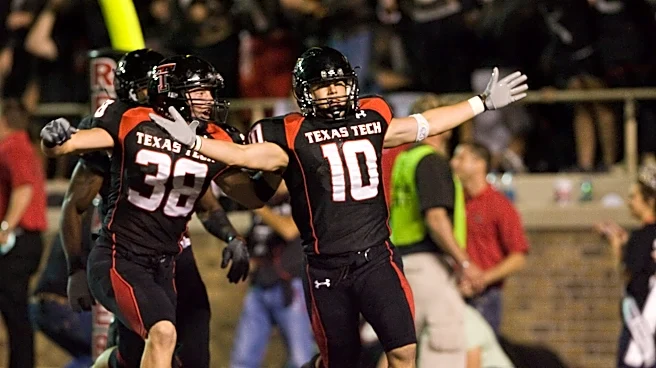
For the last two years or so, Joey McGuire has been touting how great the Texas Tech football team's three-headed monster in the backfield was going to look.
The plan to utilize each of Cameron Dickey, J'Koby Williams and Quinten Joyner had to be put on hold after Joyner's season-ending knee injury last August. Joyner returned to the field in 2026
, scoring a touchdown on his first official carry as a Red Raider.Since then, the three-headed attack has not lived up to McGuire's vision. Trying to utilize three different backs at a position where momentum is so important put all three players into awkward spots the first five weeks of the season.
Then, in Saturday's 29-6 win over Colorado, Dickey went down with an ankle injury, forcing a heavier
load on Williams and Joyner. Like the rest of the season, the results were mixed.
Joyner took his first carry of the game 26 yards, then had his next five go for negative-7 yards. The former USC transfer has been slow since returning to action, a problem amplified by an offensive line that's struggled to generate consistent blocks at the line of scrimmage.
Dickey and Williams, both healthy from the jump, have been able to overcome the line's shortcomings. Dickey's strong enough to bulldoze ahead while Williams has speed and shiftiness to get him into the open field.
Taking Dickey out of the equation for an extended period of time would put the onus on Joyner to get going. Williams already has a big role, and can handle being the No. 1 back (which he's shown he probably should be even with a healthy Dickey). It's Joyner the Red Raiders would need to take a major leap in Dickey's absence.
Luckily for the Red Raiders, the issue may not be as bad as initially feared for Dickey.
"We did get X-rays, because we were worried where the pain was," McGuire told reporters in Boulder. "X-rays came back negative. So usually whenever you're having an X-ray, you're probably looking at a high ankle sprain. It depends on the guy, but it's always hard playing with a high-ankle sprain with a running back."

That's good, because losing Dickey for an extended period changes a lot of things for the offense. Once he went out, Joyner took Dickey's place in short-yardage situations. It failed miserably. To compensate for Joyner's lack of burst and the line's inability to be consistent, Texas Tech dedicated an eight-man box on most of Joyner's rush attempts. Those plays resulted in either zero or negative yardage.
Texas Tech needs Dickey to be as healthy as possible to get the most out of a running game that's already struggling. Joyner isn't at his physical peak, so asking him to take Dickey's spot in the game plan isn't going to work.
But even if Dickey is fine and he'll be able to play again when Texas Tech returns from its open date on Sept. 17 at home against Arizona State, the Red Raiders have to make a decision on the running back rotation. Playing all three is good in theory, it just hasn't worked out well for anybody.
With a full complement of running backs available, Joyner may be the odd man out right now. It may not be that way all season. Joyner's shown some flashes of his old self, including his 30-yard touchdown run against the Buffaloes. Joyner showed patience, burst, physicality and aggression on that one run. Others have shown him to be tentative and flat-footed. His natural talents are still in there; he just has to let them out on a more regular basis.
Joyner had 10 total carries against Colorado. Three of them went for a combined 71 yards. His other seven carries went for negative-8 yards. It's not all on him. The offensive line needs to be better. But it's a two-way street and Joyner has often found himself on the wrong side of the road.
Texas Tech has three talented running backs and would love to use all three. In order to find consistency with its entire offense, it's probably time to stick with two, the ones who have shown the most.
This article originally appeared on Lubbock Avalanche-Journal: Cam Dickey's injury puts spotlight on Texas Tech football RB rotation