






When I was younger growing up in central, southwest, rural Indiana, church played a big part in my life. I was baptized in April 1994 and since my time as a teen, every two years I would hear the same thing on the Sunday before Election Day.
That anthem was for the congregation to vote, for one, and for two, vote for the candidate who had Christian morals. As I grew older, it became clear to me that phrase “Christian morals” became code to vote for Republican candidates because they were pro-life on the issue of abortion and stood in favor of the traditional definition of marriage.
In other words, social issues.
I remember asking my grandfather who sat next to me in the church pew and had vivid memories of living through The Great Depression what
he made of all that.
He told me when the preacher got political, it went in one ear and out the other. He went on to say the preacher’s political views had little to do with his salvation.
My grandfather was a wise man.
The preacher also shared how God was not just his personal god but the Lord of everyone. This meant regardless of whether we like someone, that person can be a follower just as much as the next guy or gal can. That no person has a monopoly on Christianity and neither does a political ideology or party.
For the longest time, there has been a strong political alliance between the conservative movement and Christian Evangelicals.
One could pinpoint it to Reverend Jerry Falwell’s “Moral Majority” movement that saw the Republican Party as a vehicle to drive such religious-based policy through our political institutions.
Since 1980, Republican candidates enjoyed more electoral success from Evangelical Christians than Democrats.
The problem that exists from a long trend of political support is the assumption that if someone is of the Christian faith, then she/he exclusively supports Republicans.
To break this down even further, if one quotes the Bible, then he/she exclusively supports Republicans. If anyone differs from that path, he/she is treated as a heretic or – worse – an apostate.
This brings me to the race for Texas’ now open U.S. Senate race, where differing expressions of the Christian faith are judged through partisan lenses. Democratic candidate James Talarico openly discusses his Christian faith. But because it is different from the conservative Christian perspective, it is somehow blasphemous.
A recent piece from The Washington Post highlights this. Because the Austin-area state lawmaker holds a different perspective on the Bible, he is called “evil.”
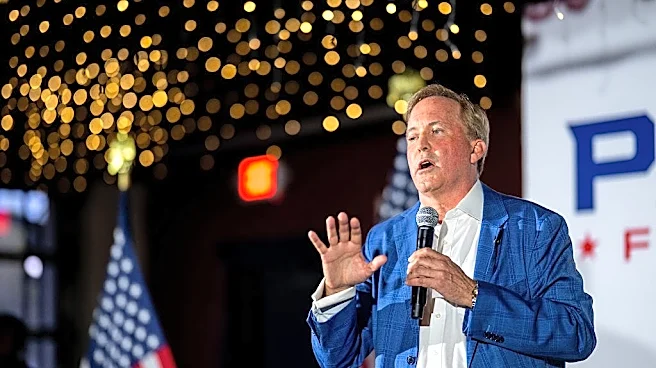
When the long, scandal-ridden past of the Republican nominee for the race Ken Paxton is mentioned, this same crowd that wants to ostracize Talarico is quick to defend Texas’ Attorney General by saying something along the lines of “no one is perfect.”
What?
To any average observer, such a double standard on faith makes no sense. But to those in the conservative movement, they make perfect sense. The reason is transparent: Christianity’s use in political campaigns is reserved exclusively for them.
Such a mindset begs this question: who designated the conservative movement as the authority on Biblical scripture and its use?
Well, no one. I read the Bible from cover to cover and have yet to find the exact moment when the authorization for exclusive use of its content was granted to the American conservative political ideology.
Maybe someone can point me to that scripture.
Those who decry the Democratic nominee for Senate in Texas as “evil” – among other descriptors – do so as if they are the authority on Christianity.
Folks, like the Constitution, there is not a universal, authoritative method to interpret the Bible.
If there was, there would be no Protestant break – with its many denominations – of the Christian faith, let alone different versions of the Bible. Due to those basic aspects, it is absurd to suggest there is only one manner to interpret the sacred text.
Consequently, it is equally evil for people of faith to judge someone who uses his faith as the reason for public service as evil.
As the campaigns rage into Texas’ fall season, there should be a lot of conversations about character. In leadership positions, character and integrity matter. What molds those traits is also important. If we judge others’ faith through a partisan perspective, we are not defending Christianity; we are distorting it.
I think of my wise grandfather often and wonder what he would make of this. I have no reason to believe he would do what he always did when the preacher became too political: in one ear and out the other.
Drew Landry is an assistant professor of government at South Plains College. His views do not necessarily represent those of SPC.
This article originally appeared on Lubbock Avalanche-Journal: Landry argues religion has no home in one particular political party