



Editor’s Note: Jack Becker, Librarian Emeritus, TTU Libraries, is the editor of Caprock Chronicles. He can be reached at jack.becker@ttu.edu. Today’s article is by Tom Ashmor, President of the West Texas Archeological Society.
The Lonesome Dove TV series, created in 1985 from Larry McMurtry’s book, is still considered by western movie aficionados to be one of the best and most authentic recreations of an 1860s Texas cattle drive. What many don’t know is that McMurtry drew on the real-life story from one of several Charles Goodnight and Oliver Loving’s cattle drives. Those cattle drives ran through the wild and barren lands of West Texas.
What made the Goodnight-Loving cattle drives unique was their trail was entirely different from all the others
of the time, which headed north to Kansas. They wanted to find a market that would increase their profits. Consequently, they found they could triple their profit if they drove their cattle to Fort Sumner, New Mexico, where they would be paid in gold.
Neither Goodnight nor Loving knew of a trail through West Texas, but they knew that before the Civil War, the Butterfield Overland Mail ran through part of where they wanted to trail their cattle. All they had to do was follow the abandoned Butterfield Trail to the Pecos River, then follow the river north to Fort Sumner. It sounds simple, but they found out different.
That’s where I come in. The Butterfield Trail runs from east to west, seven miles from my home in Dove Creek near San Angelo, and I’ve been documenting that long-lost road and its way stations from Fort Chadbourne, near Bronte, to Fort Stockton for the past 17 years. Because they were one and the same, I was also documenting the Goodnight-Loving Trail.
An additional reason for Goodnight and Loving to use the Butterfield Trail were stagecoach swing stations set at reasonable distances apart with good water and a place to rest before moving on. The first stop they made after leaving Fort Chadbourne was at the old Grape Creek Station. We found this site in
2017 and worked on it for three months. We were also very lucky in 2017 to find Grape Creek with good water in it from a recent rain.
Waterman Ormsby, in 1858, a correspondent for the New York Herald wrote, “The station was near Grape Creek, a fine stream, and also near fine timber, two desirable things not to be found everywhere in Texas.” In a 2017 drone image, the red arrows indicate the old road and the white arrows the old corral. The log cabin was a dog-trot construction with an additional room added for the Mexican handlers.
From Grape Creek, Goodnight and Loving made their way down to Johnson’s Station on the Middle Concho River, 30 miles distant. Johnson Station was the first station I found and worked in 2009. It was similar to Grape Creek Station, having a dog-trot log cabin and a circular corral. This station was a stopping point for many after it was abandoned.
The last station on the river was Head of the Concho Station. Here, they rested and watered the cattle for three days, because they were about to cross the barren Llano Estacado section of the trail, which contained no water. The Head of the Concho Station was made entirely of stone. It was archaeologically recorded in 1996. It provided good protection for the drovers, who were always under threat of attack by Indians.
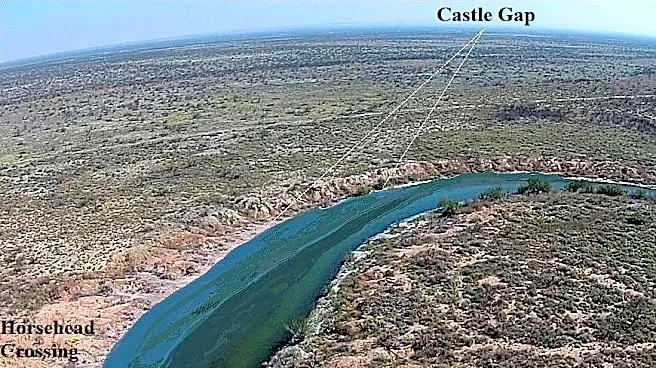
When they crossed the Llano Estacado section they found they could not stop or the cattle would just lay down and die. They kept them moving for 72 hours straight. At 66 miles they entered a narrow canyon called Castle Gap. It was the only way through a 40-mile stretch of mesas to the Pecos River.

Goodnight tells the story himself. “As soon as they smelled the cool air, they became wild for water, and when they reached the river those behind pushed the ones in the lead right on across before they had time to stop and drink…
The point of the river for which they were headed was like a ditch, with banks from six to ten feet high. When they reached the river they never halted but poured right over the bank and the remainder of the horses went in with them.”
By this time, the partners had lost a total of 500 head but they gathered their remaining 1,500 head and moved them up the east sides of the Pecos, eventually reaching Fort Sumner, where they were paid $12,000 in gold, (about $360,000 in today’s money). They made two more drives over the next few years, each one more successful than the last. Unfortunately, Oliver Loving died on the third drive when attacked by Apache, famously reenacted in the Lonesome Dove series. Goodnight, however, continued to carry Loving as his business partner for the next two years, sending half the proceeds to Loving’s family.
This article originally appeared on Lubbock Avalanche-Journal: Caprock Chronicles on the Goodnight-Loving Trail through West Texas