





He played for 19 seasons in Major League Baseball
By any yardstick, that falls somewhere between unusual and phenomenal.
His lifetime .282 batting average, in today's low-average, strikeout-filled game, would stand out as excellent.
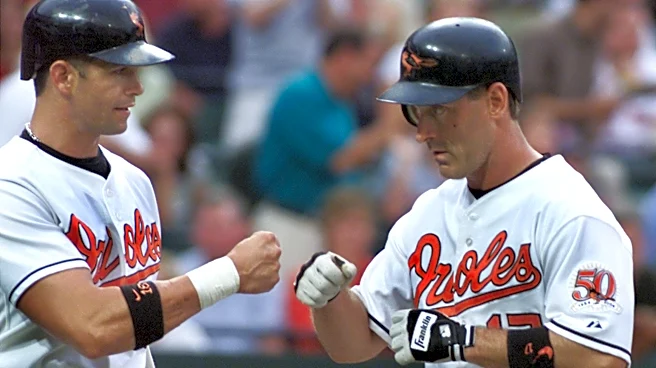
As it was, B.J. Surhoff, who grew up as a three-sport (football, basketball and baseball) star in Rye, had a very good career playing for the Milwaukee Brewers, Baltimore Orioles, Atlanta Braves and then the Orioles again after being drafted by the Brewers first overall in 1985 out of the University of North Carolina at Chapel Hill.
Adding to his resume, Surhoff, now 62, played for the 1984 U.S. Olympic team when baseball was an Olympic demonstration sport and also played a year earlier on two other national teams, including
at the Pan Am Games.
Those things alone make for an interesting story. In some ways, that only scratches the surface of who Surhoff is and why he was chosen to be the first subject in an upcoming film series about well-known figures — athletes and others -— with close ties to Westchester County.
"Origins: Legends of Westchester" is the brainchild of former White Plains High School wrestler and All-County football player Wayne Anderson, who went on to have an All-American football career at the University of Albany, where he's a member of its Athletics Hall of Fame.
Surhoff's story is slated to be released on film in October (date still to be determined), with a private showing hosted by the city of Rye and Rye Mayor Josh Nathan. A subsequent showing at Westchester County Center is planned and free digital access will be available at www.originsseries.com. Admission to the public screening will be free to students from the Westchester public school system.
The series, whose future subjects include, among others, football player Art Monk and basketball player Saniya Chong ,is being made in partnership with Westchester County and the Westchester Sports Hall of Fame and with support from several local businesses, including White Plains Hospital.
Westchester County Executive Ken Jenkins explained the county's support in part. "By sharing the stories of local legends, we are not only honoring their accomplishments, but also giving the next generation someone to look up to, and showing them what is possible when you believe in yourself and your community," Jenkins said.
Anderson, who works in promotion and public relations, appreciates superb athletes and what goes into making them.
He also appreciates athletes whose lives don't end with their final at-bat, final basket or final yard gained.
While he no longer has tens of thousands of fans cheering for him spring to early fall, Surhoff, who has continued to make Maryland his home following his playing days, now has people seeking information about autism from him.
Surhoff, whose son, Mason, is autistic, is co-founder and president of Pathfinders for Autism, a nonprofit group that has made it its mission to aid autistic individuals and their families in Maryland, linking them to support services and also providing them with recreational opportunities.
Surhoff's story
If not for his son's condition, Surhoff's present-day life — as well as his last three decades — would no doubt have been much different.
Surhoff, son of the late Dick Surhoff, who played in the NBA for two seasons, grew up uncertain about which of three sports to pursue in college.
It wasn't until during his senior year of 1981-82 that baseball jumped the line to become his future focus.
Surhoff's talent was such that he thought of playing small-college basketball and was recruited for football by several colleges, including some Ivy League school teams.
But, in baseball, his play was on an entirely different level. He recalls 10-15 pro scouts being at his Rye games his senior year. Following that season, the Yankees drafted him in the fifth round of the 1982 MLB Draft.
He opted to instead go to UNC, his high selection by the Yankees giving him "some confidence my abilities would measure up."
"I hoped I was good enough to be able to play. You don't know until you get there," he said.
His strong performance during fall ball his freshman year, though, preceded a strong performance during the spring season, after which he played on two national teams.
"(I) played really, really well and that started springboarding me in professional scouts' minds and the pro game, but also confidence-wise, because I got a look at a lot of the better players around the country and I was able to play as well, if not better, than they were," Surhoff said.
After his sophomore season, came the Olympics. In 1984, the U.S. team was still all amateurs but most didn't remain amateurs for long.
Among Surhoff's most noteworthy Olympic teammates were future Hall of Famer Barry Larkin, Mark McGwire, Will Clark, Bobby Witt, Chris Gwynn and Cory Snyder. Only Larkin played as many seasons in the MLB as Surhoff.
One thing that helped his longevity was his versatility. While most recognized early on as a catcher, before making him the country's top selection, Milwaukee saw him play shortstop for UNC during a game vs. Arizona.
During his Major League career, he'd catch, play left field, third base and DH.
Not every position came easy but Surhoff, who went straight from A ball to Triple A and was in the Majors by 1987 — less than two years after he was drafted — put in the work to make his defensive play at least look easy.
He recalled being moved by the Brewers from behind the plate to left in 1996.
"It was a challenge to me," Surhoff said. "I had to learn to play the outfield, play it well, instead of just being put out there. So, the fact I could move around, I took that as a challenge, but I didn't mind it at all. (That) kept it fresh. helped me learn the game. and it made me have to work at all of it and if there was a way that it helped our team be better, that's all I cared about — and the fact I got to stay in the lineup every day."
But, beyond his ability to play multiple positions, his quick rise and ability to stay on MLB rosters, was due to in his mind, talent for the game and his ability to change through the years.
"You learn how to play in the big leagues," Surhoff said. "You make adjustments constantly. I had to make changes and had to adjust day-to-day, game-to-game, year-to-year. There's a competitive nature, a loathing of losing as much as liking to win. ... I know some people would question, but, deep down inside, I loved what I was doing and the challenge of it all. And it's what I wanted to do. I enjoyed it. I've seen many players that played that actually didn't like playing. They just did it because they were pretty good and they could make a living. You usually don't last very long doing that. So, this is what I knew. I got better at it as I got older. I made adjustments and I enjoyed the competition and playing and trying to figure out how to beat the other team."
Surhoff's lone all-star appearance came as an outfielder in 1999, when he hit .308 on the season with 28 homers and 107 RBI.
By that time, he and his wife, Polly Winde Surhoff (an All-American swimmer for UNC), had all four of their children. Their second born was Mason, whose continuing accomplishments clearly surpass, in his dad's eyes, anything his dad ever did on a baseball diamond.
Pathfinders' story, Mason's story
Surhoff remembers the first time he ever heard the word autism was while watching the 1988 Academy Award-winning film, Rain Man.
Mason, who was born in March 1992, was diagnosed in 1994 as autistic at two years and two months of age.
With Surhoff on the road a lot with the Brewers, much of the day-to-day stress, work and work to get answers fell on his wife.
"She dove into it," Surhoff said. "She started doing research . She found out more about it. and in terms of home life and what was going on. We didn't really know what to expect because there wasn't a lot of information. We had no idea. So, she found some stuff. We started trying some experimental therapy at home. ... As (I've gotten) older, I have a much greater appreciation of how much she held everything together at our home."
While Polly was able to gather some information, this was still in largely pre-Internet days. Hunting for answers was arduous for everyone.
In 2000, Polly, B.J. and some other parents they knew with autistic children banded together to form Pathfinders for Autism, a parental service and support group.
"(The) initial goal was just to be an online database, a resource. center, (to let people know) they weren't going through it alone. There were other families," Surhoff said.
Everyone involved was a volunteer.
But things evolved and continue to do so.
Initially located in a small area in a local church, the group was able to get a much larger space from a local commercial realtor and to hire staff.
Events were added, like "family fun nights" in which Pathfinders does things like renting the National Aquarium and inviting autistic children and their families to attend.
"We have about 1,500 come," Surhoff noted of the aquarium.
Pathfinders became so well known that Maryland State Police reached out to ask whether the group could provide insight into and training for its cadets in how to deal with those with intellectual disabilities.
"That's grown from there and expanded all around the state with police, fire, EMS, EMT, you name it," Surhoff said. "They all have to do in-service.. ... (That's) just as an example. Last year, we did over 150 law enforcement trainings around the state."
Maryland is the group's sole focus because, as Surhoff explained, "The need is there and we're capable of doing it."
The plan is by 2030 to have paid staff members in what Surhoff described as the five regions of Maryland — staffers coming from each region to foster trust "that we're not outsiders," and better measure commun ity need.
Surhoff, who has worked intently with Pathfinders since his retirement after the 2005 season, has seen massive changes with autism since the group's founding with studies, services and therapies (including applied behavioral analysis therapy) increasing and insurance paying for diagnosis and treatment.
But also the number of people diagnosed as autistic has greatly risen. Surhoff attributes the latter partly due to increased awareness among parents, family members and pediatricians, although, he said, many people still don't know what autism is because its definition is broad.
Surhoff considers autism to be of "almost epidemic proportions," with an estimated one in 31 people born today in the U.S. diagnosed with it.
"(I'm) just shocked at the numbers. If (you) do a timeline on the numbers, it's staggering to see what they are. A lot of it is awareness and a lot is people understanding, 'OK, I have to do something about this and not hide and be embarrassed. about it.' They got better at diagnosing."
"There's been more money in research involved but (it's) still not being where it needs to be ," he added.
Reflecting on Pathfinders, Surhoff said he's proud of the organization's staff and of the group's growth, the respect it is given and the impact it has had in Maryland.
"People talk about the trainings we've given them — some insight. Families that come to me, come to us, they call and I hear the stories — just to hear someone on the phone and to be relieved they're not alone and there's some hope," he said. "People who are desperate for answers and we're able to help them do that — get those answers and point them in the right direction. The work we do and to have families come up to you and thank you for helping them or a grandparent come up to you and tell you how much the work our staff does has helped their family.
"There's a loneliness. There's something wrong with your child. and you don't know what to do, where to go. Just the fact (to know) there's somebody that's going through what you're going through ... So, I'm very proud of our staff and the work they do. ... We have a seat at the table and we're involved in commissions and panels and doing ... research, finding out what the families need and trying to target that to make sure they're getting the help and information. ..."
The Surhoffs' work has also paid dividends at home.
Mason, once non-verbal, now speaks and holds multiple jobs, including at area libraries and part-time with Pathfinders.
"We've had some wonderful people work with him in traditional and non-traditional ways. A couple of young women never, ever put restrictions on him," Surhoff said. "He's very bright. He reads. He can write. He can speak but he has other issues that are part of his disorder. The fact he can teach himself things and memorize stuff — he's taught himself to be a librarian. He does data entry on a computer. He has skills. It's just figuring out what they are and how to get them out of him and having him do some things that make him feel good.
"Did we have any idea of where it was going to go? No. I'll never forget when he said his first words and how happy I was he had spoken. and we didn't know where we were going with that. There's no book. There's no path. There's no straight-line path. The path is up down, back, forward, all around and you don't know where it's leading you so, fortunately for us, we've all been together, my kids ... are all involved in his life. We've met a number of people throughout our life in Milwaukee and here, who've been able to help us help him."
"My kids don't know any different," added Surhoff, who noted all his children are involved with helping at Pathfinders.
"I've told my wife a couple of times, 'This is the hand we've been dealt and we have to make the best of us for us, for him and in our lives,' " he said.
Of their work with Pathfinders, Surhoff said, ... "We made a conscious decision to stay here in the State of Maryland and we want to be accessible to every single family or person that needs help. That's our goal."
And he and Pathfinders want people to understand one important thing.
"Understand it's not a death sentence. This not a death sentence. It's difficult," he said. "It's very difficult. But there is help available somewhere."
"People," he said, "have gotten better."
Nancy Haggerty covers sports for The Journal News/lohud.
This article originally appeared on Rockland/Westchester Journal News: Baseball star B.J. Surhoff, subject of new film, discusses autism org