




Strengthening New York's artificial intelligence protections is front of mind for several state officials this week as the Trump administration recently announced plans to plow ahead with its development.
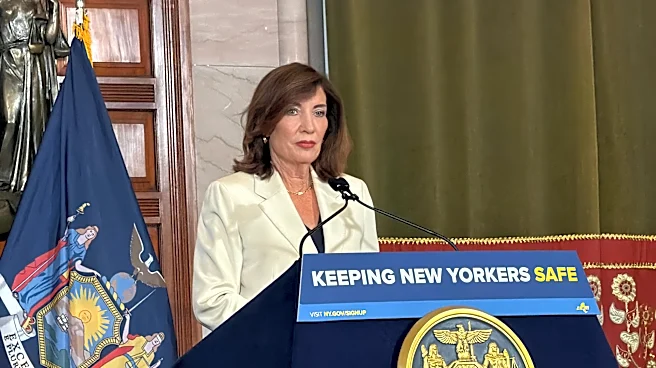
Gov. Kathy Hochul and Attorney General Letitia James joined Assemblymember Alex Bores and Sen. Andrew Gounardes, both New York City Democrats, in the city on Monday, Sept. 21, to share more information about the state's new Responsible AI Safety and Education (RAISE) Act, which goes into effect in January.
Included in the announcement was the appointment of Marc Gilman as the state's deputy director for the RAISE Act as well as a vow from Hochul to explore ways to expand the legislation in the coming months.
"We'll look closely at additional ways
to build on the RAISE Act and strengthen our AI laws," Hochul said. "May even explore safeguards like AI kill switches if they're deemed feasible and in the best interest of our state."

Over the weekend, President Donald Trump said he plans to create an "AI Force" and appoint a new artificial intelligence czar — both intended to support the country's growth of AI — in response to recent calls to slow down the development of AI.
"It's not about being first, it's about being first to get it right," Hochul said when speaking about the state's AI development on Monday.
Here's the latest on the New York's AI protections.
How will the RAISE Act increase AI protections in New York?
The RAISE Act, which was signed by the governor in December, increases AI transparency and strengthens AI protections in New York by placing regulations on large frontier AI developers. Specifically, these developers will be required to register with the state starting in November in preparation for the enactment of the new law in January.
Then, as of Jan. 1, 2027, they will be required to do the following:
- Establish safety and transparency frameworks that are then posted on their websites.
- Report critical safety incidents to the state's Office of Digital Innovation, Governance, Integrity and Trust within 72 hours and other related government authorities
- File quarterly assessments of catastrophic risks to the DIGIT Office and pay the assessments.
- File a disclosure statement at least every other year.
If the developers don't submit the required reporting or make false statements, the AG's Office can bring civil actions against them. Penalties for first violations are up to $1 million and up to $3 million for any subsequent violations, according to Hochul's office.
What other AI protections are currently in place in New York?

The AI protections established in this new legislation build on actions already taking place in New York.
In July, Hochul signed an executive order banning new hyperscale data center development statewide for one year. Through the moratorium, state environmental permits for data centers that can use 50 or more megawatts of power will be temporarily paused for up to a year to better understand how New York ratepayers as well as the environment, energy grid and communities will be impacted statewide.
Last month, Hochul announced the state would be taking a closer look at how artificial intelligence will affect New York's workforce through a series of listening sessions. The information gathered through these listening sessions will be collected and help inform a set of recommendations to be released by the end of this year by the FutureWorks Commission, or a group of experts selected by the state to "identify real-time data strategies for monitoring AIs impact" on New York's workers.
And most recently, James stressed to New Yorkers who work in the AI industry last week to report unsafe and illegal conduct by companies developing AI technology to her office's secure whistleblower portal.
"The extraordinary promise of artificial intelligence is not an excuse for big tech to break the law, ignore serious safety risks or put New Yorkers in danger," James said on Monday. "My office will hold companies accountable when they cross that line."
Sen. Gounardes also took his time in the spotlight beside Hochul and James on Monday to share his hopes to push the envelope even further in the upcoming legislative session. The lawmaker said he has introduced two bills to build on the RAISE Act — one that would require independent, third-party audits of the frontier developers and another that would strengthen the mandatory safety frameworks.
"We have a responsibility not just to protect New Yorkers, but until the federal government acts, we bear responsibility to protect all Americans from the catastrophic risks that can ensue," Gounardes said.
Emily Barnes covers state government for the USA TODAY Network-New York with a focus on how policy and laws impact New Yorkers' taxes, communities and jobs. Follow her on Instagram or X @byemilybarnes. Get in touch at ebarnes@usatodayco.com.
This article originally appeared on Rockland/Westchester Journal News: This new NY law increases AI protections as Hochul eyes 'kill switch'