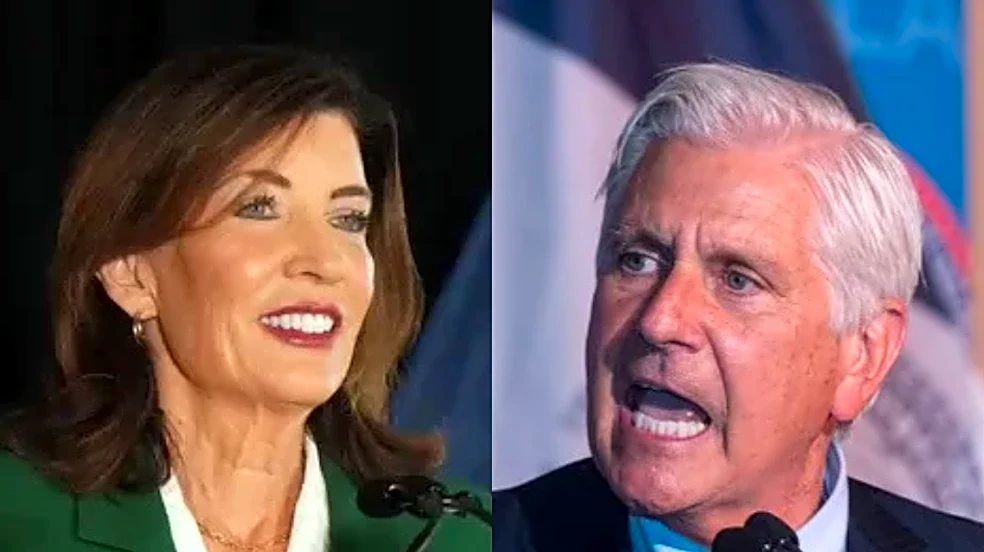



As some New Yorkers scroll through social media, a video of what appears to be New York City Mayor Zohran Mamdani and Gov. Kathy Hochul walking through Central Park in New York City pops up on their phone screen.
It quickly becomes clear the politicians' voices sound odd and the script seems removed from their typical messaging. Then, a voice more fitting for a medication ad cuts in and starts listing off the "side effects" of having Hochul as governor — chronic wallet shrinkage, higher tax, higher utility bills — over AI deepfake clips of Hochul gardening and Mamdani riding a bike through a park.
There isn't anything in the 43-second ad that lets New Yorkers know it's been made with artificial intelligence, leaving it up to the viewers to decide
what to believe.
Republican gubernatorial candidate Bruce Blakeman's campaign, who posted the ad and others like it, have consistently brushed off concerns about the AI ads as "obviously satire," arguing that those types of videos don't need legal disclaimers.
It feeds into the gray area of a recently amended state law, which requires disclosures on campaign ads that use "materially deceptive media," unless the ads are considered to be satire or parody.
At the same time, political experts and some state officials are raising alarms that New York is failing at performing the increasingly important task of protecting New York elections from AI-related misinformation, according to a USA TODAY Network review of state records and interviews with state officials and AI policy experts.
Hochul addressed the issue during a recent governor's race debate, asserting she plans to revisit legislation aimed at curbing negative impacts on elections from AI-related content, while Blakeman described his campaign's use of AI as "just another tool."
Who has oversight of campaign ad violations in New York?
The state's Board of Elections (BOE) is responsible for administering and enforcing New York's election laws, according to their website. The agency also has a specific Division of Election Law Enforcement, or DELE, which is tasked with investigating violations of the state's election laws.

When the USA TODAY Network in August requested the number of AI-related complaints DELE has received for all candidates running for a position in state government this year, its response in part asserted AI was not a category DELE uses to classify complaint types.
However, a second request for the complaints sent in September yielded a different response. The BOE's response was split between two agencies — the BOE and the Public Campaign Finance Board (PCFB) — because Blakeman is part of the latter's matching campaign funds program.
The PCFB, which is also part of the BOE, denied the records request, asserting the records are "being compiled for law enforcement purposes," meaning there has been at least one complaint filed and that it possibly violates state election law. The BOE also shared a complaint it received about Blakeman's campaign in May, which claims an ad depicting Hochul and Mamdani used undisclosed AI. The agency withheld the name on the complaint, citing privacy laws.
This second response also came after New York State Democratic Committee Chair Jay Jacobs filed a complaint with the BOE on Aug. 10, alleging Blakeman's campaign has "repeatedly disregarded" the recent amendment to state election law that requires political campaigns to disclose when they're using "materially deceptive media."
The USA TODAY Network also requested copies of AI-related complaints filed to the New York Attorney General's Election Protection Hotline from the 2024 election cycle through Aug. 7, as the hotline, which has been in operation since 2012, fields election-related complaints across the state.
The AG agency's response on Sept. 14 included a single complaint filed by Assemblymember Jake Blumencranz, a Long Island Republican, from 2025, which asserted Mamdani's campaign at the time used AI in an ad without a disclaimer.
The AG's Office has a broader responsibility to enforce the state's Voting Rights Act, which protects fair, open, and equal access to the ballot box. Overall in 2026, the AG's office had received 103 complaints through its hotline through July 29. In 2025, the hotline received 473 complaints, and in 2024, there were 856 total complaints made.
Are AI campaign ads problematic in NY?
A recent poll conducted by Beacon Research reveals just over half of voters in New York, 57%, say they've seen political content in the past year they know or suspect was made with AI.
In that same study, 84% of New Yorkers say it's unacceptable for a campaign to use AI to create realistic video or audio of an opponent saying or doing something they never did. And 75% of New York voters say even clearly labeled AI parodies of an opponent is unacceptable to them.
E. Stefan Kehlenbach, a University at Albany assistant professor of political science, says going all in on AI advertisements is "kind of a risky strategy" and could be a "dangerous game" for politicians.
"There's been quite a lot of backlash against these sorts of things," Kehlenbach said, adding that the pushback is "probably justifiable."
"I think there's a real potential that voters will reject this and will see you as not being authentic and not engaging with them in a real way and that will have electoral consequences," he continued. "So I can see why there might be some skepticism."
Kehlenbach also says he doesn't see much difference between an AI attack ad and a regular one. The purpose of campaign attack ads, he asserts, is to muddy the waters. And the AI ads are doing that, he says.
"I think substantively, they're making the same type of claims," Kehlenbach stressed. "So I don't see them as being uniquely problematic from a messaging standpoint."
What sets Blakeman's campaign apart, however, is their representation of other people, like Hochul, in a way they haven't consented to, Kehlenbach says. He also doesn't see Blakeman's ads as satire and isn't sure "if the satire argument will work." But he believes the Republican candidate, who polls show has struggled with name recognition among voters, sees all of this discussion about his AI ads as a positive.
Whether or not AI campaign ads are impactful is fuzzy, though, especially when comparing their effect to regular campaign ads.
"That is a really big or difficult can of worms just because you're sort of doubling up on a thing that's very hard to measure," Kehlenbach says. "It's very hard to measure how impactful things like campaign ads actually are and how much they move the needle."
So, where's the AI oversight?
Kehlenbach says what Blakeman is doing isn't unique. For example, he says, candidates collaborating with a super PAC "is a fine line that everybody knows exactly how close to get to it."
"I think this idea of knowing election law really well and knowing how far you can go is the game that all candidates play, because every candidate wants an advantage and they want to try to gain as much of an advantage as possible," Kehlenbach added.

During the first and only debate between the two gubernatorial candidates on Oct. 13, Blakeman defended his campaign's use of AI in their ads, comparing those calling for tighter regulation to someone urging a return to horse-drawn buggies from automobiles.
Part of the challenge the state is facing in its oversight of the amended law, however, is the fact that AI-related election laws are relatively new and it's hard to tell what is or isn't a violation, says Kehlenbach. But it's something the BOE is going to have to get a handle on because he says he thinks these issues are here to stay.
"The challenge of bureaucracy is it's reactive," Kehlenbach says. "It is limited by its statutory mandates and things like that, so it tends to be a little reactive. But I think I would expect that this is something that they're going to have to grapple with because these questions are not going to go away and candidates are going to continue to take chances to do this sort of thing."
With less than three weeks until Election Day, it's highly unlikely anything will come of any AI campaign ad-related complaints filed against candidates in this midterm election cycle ahead of Nov. 3. But it's something that has definitely caught the eye of state officials.
In the Oct. 13 debate, Hochul said she was planning to revisit a bill that would ban campaigns from using AI in their ads within 90 days of an election. The following day, the AG's Office released new guidelines encouraging New Yorkers to file online complaints if they come across misleading or inaccurate information about elections.
In the callout, the AG's Office, led by Democrat Attorney General Letitia James, specifically referenced the recent "materially deceptive media" amendment and instructed residents to contact the agency's Election Protection Hotline if they come across any violations of it.
"I think (AI) is an evolving thing that we have to decide what is acceptable in our elections and we get a chance to do that on the statewide level," Kehlenbach says. "I don't think it's a settled thing by a long shot."
Emily Barnes covers state government for the USA TODAY Network-New York with a focus on how policy and laws impact New Yorkers' taxes, communities and jobs. Follow her on Instagram or X @byemilybarnes. Get in touch at ebarnes@usatodayco.com.
This article originally appeared on Rockland/Westchester Journal News: Records reveal why AI political ads raise alarms in NY | Exclusive