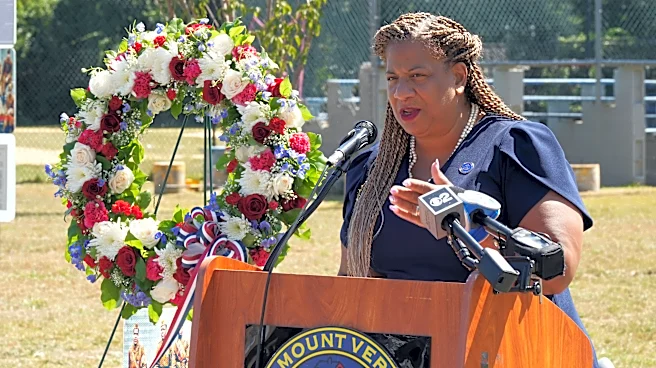







Two years after becoming cancer-free, Mount Vernon Mayor Shawyn Patterson-Howard is publicly revealing the health crisis she quietly navigated while continuing to lead the city.
In 2024, what Patterson-Howard initially believed was exhaustion turned out to be a massive saddle pulmonary embolism affecting both of her lungs. During the medical intervention, doctors discovered she also had leiomyosarcoma, an aggressive form of cancer.
On Monday, Aug. 17, Patterson-Howard shared the story publicly for the first time during a special Mount Vernon Monday segment with Dr. David S. Geller, a board-certified orthopedic oncologist with Montefiore Einstein in the Bronx.
A diagnosis she never expected
Patterson-Howard
said she is not someone who typically goes to doctors, but this time she knew something was different.
"I could not recover from being tired [and] exhausted," she said. "I knew my body. I knew that I did not feel well, I knew that I could not recover."
What doctors discovered was a massive saddle pulmonary embolism affecting both of her lungs.
A pulmonary embolism occurs when a blood clot blocks blood flow through the lungs. A saddle embolism is a large clot that sits at the main pulmonary artery and extends into the arteries leading toward both lungs.
Geller explained that the condition can prevent the body from properly oxygenating the blood and can be fatal.
“It blocks the ability of oxygenating the blood. So you might be taking air in but you’re not transferring that oxygen to the blood. Any large pulmonary embolism, unfortunately, can lead to death.”
Patterson-Howard said doctors told her just how close she had come to dying.
“They told me clearly if I would have ever gone to sleep that I would have not woken up,” she said.
Geller said recognizing the condition and getting treatment quickly can be critical. “A lot of times identifying it and getting treatment started is the biggest hurdle,” he said. “So unfortunately, there are folks that are either too far away, or it’s not recognized right away and that opportunity is lost.”

The clot reveals leiomyosarcoma
While treating the pulmonary embolism, doctors discovered another serious problem. Patterson-Howard was diagnosed with leiomyosarcoma, or LMS, an aggressive form of soft-tissue sarcoma.
Leiomyosarcoma is a rare cancer that develops in smooth muscle tissue. One of the challenges with sarcomas, Geller explained, is that they may not cause pain or obvious symptoms early on.
“The hardest thing with sarcomas is many of them don’t hurt, they’re insidious, they’re kind of sneaky,” he said. “We’re primed as people to respond to pain and if something doesn’t get better we tend to think there’s something wrong.”
Patterson-Howard said she had received other explanations from doctors for what she was experiencing, but she remained convinced there was another answer. She sought multiple medical opinions until the correct diagnosis came to light.
Geller said that experience is an important lesson for patients.
“If you don’t feel heard as a patient, don’t stop,” he said. “If you feel something, say something ... you’re your own strongest advocate.”
Mayor Shawyn Patterson-Howard undergoes 18-hour surgery
Patterson-Howard ultimately underwent an 18-hour surgery, followed by months of recovery and continued medical care. She said the effects of the experience continue today, including lymphedema.
Lymphedema occurs when lymph fluid builds up in tissue because the normal lymphatic drainage system has been disrupted. It can cause swelling, heaviness and discomfort and can persist as a long-term complication following cancer or cancer treatment.
Despite being hospitalized and undergoing treatment, Patterson-Howard said she continued working as mayor. She participated in Zoom meetings from the hospital and maintained her responsibilities to the city.
But she made a deliberate choice not to disclose her medical condition publicly at the time.
Why Mount Vernon mayor kept it private
Patterson-Howard said she needed time to understand her own diagnosis before sharing it with the public.
“I needed time to process it,” she said. “I needed an understanding of what the prognosis was looking like, what the treatment was going to look like.”
She also did not want her health to become part of the political conversation surrounding her role as mayor.
Even while continuing to lead the city, she said she believed she had a right to keep the most difficult parts of her life private. “You don’t owe anyone your deep private information while you are going through maybe the worst storm of your life,” she said.
Patterson-Howard described her cancer diagnosis as devastating and said there were nights when she prayed for hours.
“The diagnosis was devastating. There were moments and nights of prayers, all night just sitting up praying," she said.
Her faith and relationship with God, she said, helped guide her through the uncertainty.
But she also came to see something unexpected in the sequence of events: the pulmonary embolism that nearly killed her was ultimately what led doctors to find her cancer.
“You turn to gratitude and greatness,” Patterson-Howard said. “Not only was I at risk for dying once, but twice.”
That perspective has shaped how she looks back on the experience, not simply as a period of illness, but as a reminder of the importance of paying attention to her body and advocating for herself.
"Being where I am now, I'm just grateful for where I stand. This has deepened who I am as a person. I think I'm stronger than I've ever been in the past," Patterson-Howard said.
This article originally appeared on Rockland/Westchester Journal News: Mount Vernon mayor shares health journey 2 years after cancer battle