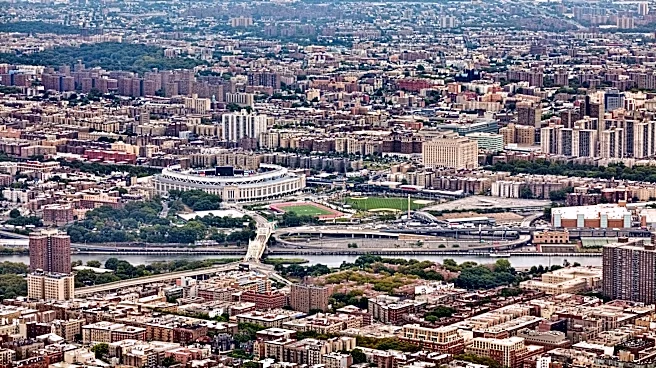







The New York City Health Department has ordered the immediate cleaning and disinfection of 10 cooling towers in the South Bronx, including one at Yankee Stadium, after preliminary testing detected Legionella bacteria.
Legionella can cause Legionnaires' disease, a severe form of pneumonia, according to the Centers for Disease Control and Prevention.
The cooling towers are located in the South Bronx neighborhoods of Melrose and Morrisania, within ZIP codes 10451 and 10456. City health officials ordered the towers cleaned after preliminary polymerase chain reaction, or PCR, testing detected the presence of Legionella bacteria.
However, officials emphasized that the test does not determine whether the bacteria were alive or dead and does not establish
whether any of the cooling towers are responsible for the outbreak. Additional culture testing is underway and could take up to two weeks. Only live Legionella bacteria can cause illness.
How do you get Legionnaires' disease?
The CDC says Legionnaires' disease is most often contracted by breathing in tiny water droplets containing Legionella bacteria or by aspirating contaminated water.
Common sources can include cooling towers, plumbing systems, showers, decorative fountains and hot tubs.
Individual window or wall-mounted air conditioners used in homes, apartments and hotels, along with car air-conditioning systems, are generally not sources of Legionnaires' disease because they do not use water as a cooling source.
Legionnaires' disease is not typically spread from person to person.
What are the symptoms of Legionnaires' disease?
Symptoms usually develop two to 14 days after exposure and may include:
- Cough
- Fever
- Headache
- Muscle aches
- Shortness of breath
People at higher risk for severe illness include adults 50 and older, current or former smokers, and people with certain underlying health conditions such as:
- Cancer
- Chronic lung disease, including COPD and emphysema
- Diabetes
- Kidney failure
- Liver disease
- Weakened immune systems
How many people have contracted Legionnaires' disease in the Bronx?
The New York City Health Department said nine people have been diagnosed with Legionnaires' disease in connection with the South Bronx cluster. One person has died, three remain hospitalized, four have been discharged and one person was asymptomatic, according to the department. (Note: Case numbers change often, for the latest, check the Health Department.)
Officials continue to investigate the source of the outbreak.
The Occupational Safety and Health Administration says about 6,000 cases of Legionnaires' disease are reported in the United States each year, although the actual number may be higher because the illness can be difficult to distinguish from other forms of pneumonia.
According to the CDC, about 1 in 10 people who contract Legionnaires' disease die from complications of the illness.
What does this mean for Yankee Stadium?
The announcement that Legionella was detected in a cooling tower at Yankee Stadium came during a weekend Subway Series between the New York Yankees and New York Mets that drew thousands of fans to the Bronx.
The cooling tower at 1 E. 161st St., the address of Yankee Stadium, was among the 10 sites ordered to undergo remediation.
In a statement, Yankee Stadium said its most recent monthly Legionella test, conducted Aug. 20 and submitted to the Health Department, was negative. The stadium also said additional water-quality testing conducted Aug. 26, Sept. 2 and Sept. 9 did not detect Legionella.
The stadium noted that the Sept. 11 PCR test conducted by the city differs from routine testing because it can detect Legionella DNA but does not determine whether any bacteria are alive or whether the cooling tower was the source of exposure.
"No current cases have been associated with Yankee Stadium," the stadium said in a statement. "Additionally, the New York City Department of Health has not at any point this month asked us to postpone our games."
What should residents do?
Health officials say it remains safe to drink tap water, shower and use air conditioners in the affected neighborhoods. They also said there is no additional risk from being inside any of the buildings where the cooling towers are located.
Anyone who lives, works or has visited the affected area since late August and develops symptoms such as fever, cough, muscle aches or shortness of breath should contact a health care provider immediately, city officials said.
The Health Department is scheduled to host a community town hall meeting Tuesday evening in the South Bronx.
This article originally appeared on Rockland/Westchester Journal News: Legionella found at Yankee Stadium cooling tower. What to know