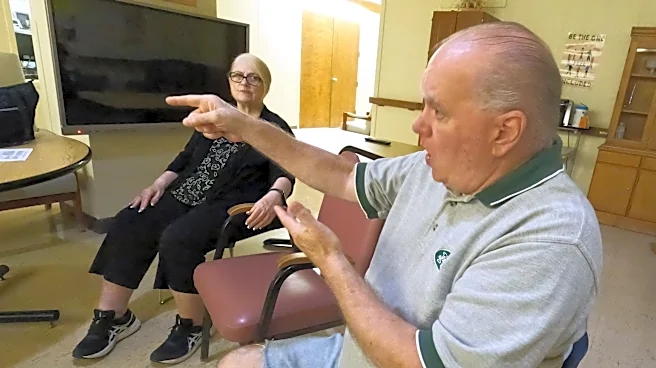









When Bob Russell schedules a doctor's appointment, he often makes a request along with it: an in-person American Sign Language interpreter.
Russell, 66, a retired deaf resident of New City, said that request is not always reflected when he arrives.
"I go to the doctor and they give me [Video Remote Interpreting or VRI], and I [ask] 'what about an in-person interpreter?'" Russell said. "I go 'what are you doing? Are you ignoring me? What's the problem?' I requested to have an in-person interpreter, and I don't know why there's confusion sometimes."
Russell's experience reflects a concern among members of Rockland County's deaf community. Even after years of advocacy for better access to in-person American Sign Language interpreters, patients say
they continue to encounter barriers when seeking them.
Westchester Medical Center Health Network announced a new policy last spring for providing ASL interpreters across its network. That action came after more than three years of advocacy from some deaf patients over the lack of in-person interpreters.
The policy represents progress for some advocates. However, patients are still having to navigate a system in which VRI is presented first, even when an in-person interpreter has been requested.
The Journal News/lohud.com reached out WMCHealth's communications director for comment on the new policy and any operational issues but did not receive a response.
'You should have a choice'
The policy followed advocacy from the Rockland Deafness Task Force, including a Dec. 15 meeting with Sen. Bill Weber and WMCHealth executives at Good Samaritan.
Under the process, a deaf patient schedules an appointment and requests an in-person ASL interpreter. The hospital first offers VRI. If the patient insists on an in-person interpreter, the patient must contact the Patient Experience Department to make the request again.
George Potanovic Jr., a longtime ASL interpreter and co-chair of the Rockland Deafness Task Force, said he does not believe patients should have to push back against one option to receive another.
"You should have a choice," Potanovic said.
Insufficient communication or lack of clarity about policy changes can be challenging for people who are unfamiliar with advocating for themselves in medical settings, Potanovic said.
"A lot of deaf people don't really know about advocating for themselves," he said.
Patients describe what happens when interpreters aren't there
For some deaf patients, the problem begins before VRI is even offered: an interpreter they requested simply is not provided.
Maryann Nemeth, a residential counselor at the Marty Langer Home in Suffern, is deaf herself. She recalled situations during her own medical appointments when she requested an interpreter but one was not provided.
More recently, Nemeth said, she went to the dentist and found there was neither an in-person interpreter, which she requested, nor VRI available. She called her daughter for help.
"It was a little bit sad. The dentist [had] really no interpreting at all," Nemeth said.
Nemeth said experiences like these can leave deaf patients dependent on family members to help communicate during medical care.
That is particularly concerning because medical appointments can involve information about diagnoses, medications, procedures and treatment that patients need to understand directly.
Potanovic said patients may also be reluctant to rely on written communication as a substitute.
"When people are in a medical situation, they're not feeling good. They're not going to want to write on a piece of paper back and forth," he said.

Why patients say in-person interpreting matters
For Russell, the concern is not simply that VRI exists. It is that hospitals and medical offices often prioritize it over an in-person interpreter. He has used VRI during medical appointments but said he finds the experience different from having an interpreter physically present.
"I'm not happy with the decision to put VRI first," Russell said. "With VRI, I just don't feel a connection to the doctor. To have an in-person interpreter is clearer," Russell said.
Nemeth hears similar concerns through her work with deaf residents.
"I'm trying to help deaf people live with an in-person interpreter and while I understand there is VRI, I try to help them communicate and be respectful," she said.
VRI can provide access to a remote ASL interpreter through a video screen, and federal law recognizes it as one possible way for covered health care providers to provide effective communication.
The law focuses on effective communication
Under Title III of the Americans with Disabilities Act, private hospitals generally must provide effective communication to patients with communication disabilities.
The law does not give every deaf patient an absolute right to an in-person interpreter simply because one is requested. VRI can satisfy the requirement when it is "effective under the circumstances."
However, the U.S. Department of Justice says providers should consider factors including the nature, length and complexity of the communication, the context and the person's normal method of communication. Providers are also advised to consult with people with disabilities about what auxiliary aid or service is appropriate.
Federal regulations specifically recognize situations in which VRI may not be effective, including when a patient has difficulty seeing the screen and when multiple people are exchanging highly complex information.
The National Association of the Deaf has also developed specific guidance for the use of VRI in medical settings. The organization recommends considering factors such as the patient's preferred method of communication, ability to see and focus on the screen, medical condition, the complexity and pace of the communication and whether multiple people are involved.
NAD also identifies situations involving informed consent, surgery, diagnosis, treatment and other high-risk medical decisions as circumstances in which an in-person interpreter may be more appropriate.
Those considerations can matter for deaf patients because ASL is a visual language. Nemeth said she hears from people who have difficulty seeing the VRI screen.
"Maybe the patient can't see very well or maybe they're partially blind, or they just have difficulty understanding," she said.
Also, the DOJ specifically identifies complex, fast-paced communication involving multiple people as one circumstance in which VRI may not be effective.
Emergency rooms can be different
Advocates recognize that emergency rooms present different circumstances.
A patient may need immediate care, and an in-person interpreter may not be immediately available. The DOJ acknowledges that VRI can be useful in emergency situations when an on-site interpreter is unavailable.
Potanovic said the circumstances should still be considered rather than assuming VRI will work for every deaf patient.
"A hearing person in the upstairs business office should not determine that VRI meets the 'effective communication' needs for a deaf patient being rolled into an ER and requesting an in-person ASL interpreter," Potanovic said.
"That decision belongs to the deaf patient."
This article originally appeared on Rockland/Westchester Journal News: Rockland deaf patients seek better access to ASL interpreters