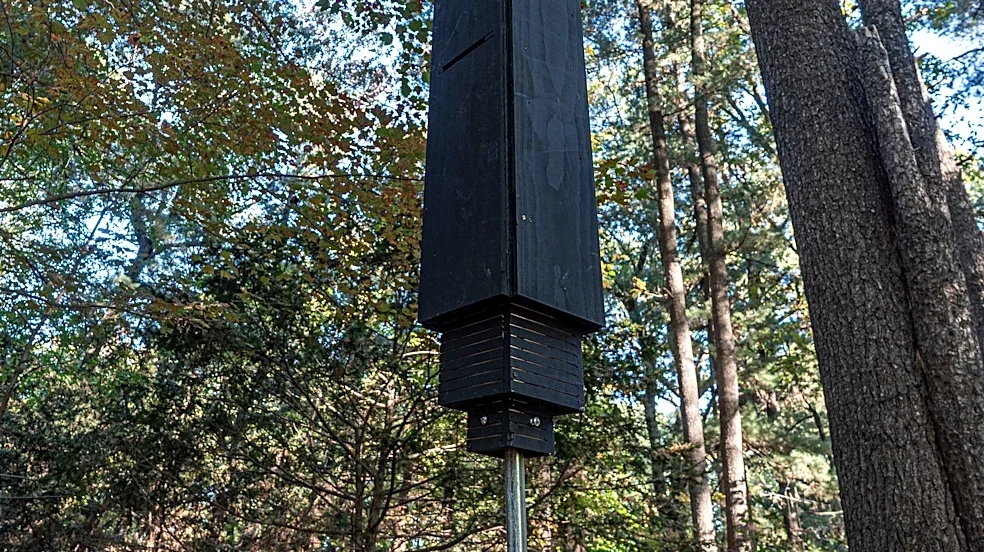








SCARSDALE - Amid the trees and off the circuitous paths that wind through the Greenburgh Nature Center sit a few tall, skinny black boxes on poles that look a bit like goth-style birdhouses. They are, in fact, a refuge for creatures that take flight — bats.
Sam Morgulas, a senior at Scarsdale High School, has constructed what are known as rocket boxes to provide safe roosting habitat for local bats. He's placed three at Nature Center at Greenburgh and Westchester Land Trust.
The boxes provide a daytime respite and a home during winter "torpor" periods where bats are less active to save energy during winter months when food is scarce.
The bat boxes are intricately designed. Little grooves on the outside help bats climb (they have fingers at the end
of their wings and clawed thumbs!) up into the structure and inside, areas are warrened off to keep air circulating and prevent overcrowding.
Why such a dedication to bats? Because, despite their scary reputation, bats are an integral part of our ecosystem and do a lot of things that make our life better, Morgulas said.
"To dumb them down to scary flying rats is just reductive to their role" in our ecosystem, Morgulas said.
What's so great about bats?
The nocturnal flying mammals get a bad rap, Morgulas acknowledged. There's the Dracula story, and the idea that they feed on blood, Just three out of 1,400 known bat species are blood-feeding and those don't live in North America.
Most bats, including ones around here, eat insects, including mosquitoes.
That natural pest control helps humans, who are at risk of viruses like West Nile transmitted by mosquito bites.
There are also many bat species that eat fruit and nectar. They help with the cycle of pollination and spread seed through guano (bat droppings).

Keep a safe distance from bats
But there's also concern about these animals. Bats are warm-blooded and can be vectors for certain viruses.
That includes the family of coronaviruses, which they can transmit, even if they don't get sick from them. SARS-CoV-2, the virus responsible for the COVID-19 pandemic, has been linked to bats. The World Health Organization has reported "zootonic spillover" as a leading theory of the virus' generation and spread.
But culling bats, researchers say, would likely make the risk of disease spread worse. According to the National Institutes of Health, disrupting bat colonies can actually increase the risk of viral shedding or spread.
Rabies is also a concern. While less than 1% carry rabies, according to the New York State Department of Environmental Conservation, a healthy bat isn't one you are likely to encounter.
A bat that is on the ground or slow is showing potential signs of the deadly virus. A bat should never be handled with bare hands, according to the DEC, and anyone who comes into contact with a bat should seek immediate medical attention and for preventive treatment. Rabies infection is considered 100% fatal, if the proper medical care isn't provided in time.
"There's a reason to keep your distance from any wild animal," Morgulas said. In general, he said, bats are "very timid."

Bats at risk
Bat's native habitats are being threatened. Urban development cuts down swaths of open forest and light pollution can disrupt their natural nocturnal rhythms, making them weaker and less able to forage.
Morgulas said his boxes at the nature center help keep bats safe and draw them to an environment with stable food sources.
Morgulas said other threats loom for local bats, which include little brown bats (they are thumb-sized, with dark brown fur and a wingspan up to 10 inches) and big brown bats (up to 5 inches long with a 13-inch wingspan).
In New York and other parts of North America, bats are dying from white-nose syndrome. The fungus was discovered in New York in 2006 and millions of bats have died from exposure since.
More than 15 bat species are currently listed as federally endangered, threatened or under review in the candidate or petition process under the Endangered Species Act. That includes the little brown bat, which is a common species in New York.
Nancy Cutler writes about People & Policy for lohud.com and the USA Today Network New York. Reach her at ncutler@lohud.com; follow her on Twitter, Threads and Instagram at @nancyrockland.
This article originally appeared on Rockland/Westchester Journal News: Scarsdale teen's bat boxes keep flying creatures safe in suburbia