








As families prepare for the new school year, back-to-school shopping often means picking up the usual supplies: notebooks, pencils, backpacks and new clothes.
For some students, the list may also include sensory and fidget tools designed to help them regulate and stay engaged in the classroom.
Fidget tools, at times known as fidget toys, are perhaps the most recognizable example, but sensory support can take many forms. Sensory tools are designed to provide different types of sensory input, which can include tactile, auditory, visual or movement-based input.
For some children, these tools provide input that can help them regulate their nervous system and better manage the demands of the school environment.
And the sales of such tools continue to increase.
According to Fortune Business Insights, the global fidget toy market is expected to grow from $9.57 million in 2026 to $17.65 million by 2034.
To learn more, The Journal News spoke with Dr. Dana Smith, the founder of Westchester Physical and Occupational Therapy, which operates as Sensory Jim Pediatric Therapy in Scarsdale. Read on to see what we discovered.
What are fidget toys and tools used for?
"Fidgets are primarily used as a pathway for someone's ability to focus,” Smith said. "In a classroom setting if a child feels the need to get up … it helps to channel one's energy so they can, for the most part, focus."
A fidget, for example, gives a student something to manipulate with their hands. A wobble chair or other movement-based seating provides an opportunity for physical movement while a child remains at their desk.
Fidgets aren't one-size-fits-all
Fidget tools have become increasingly common in classrooms, with options ranging from fidget cubes and Tangles to stress balls, Pop-Its and therapy putty.
But popularity doesn't necessarily make a particular tool appropriate for every student. Some fidgets are quiet and discreet, while others can make noise or require significant visual attention — potentially creating the very distraction they're intended to address.
“Movement and sensory input is not necessarily a distraction from learning,” Smith said. “I think really good educators understand that all of us can benefit from it at times.”
She added that sensory needs vary from child to child, meaning a tool that works well for one student may not have the same effect on another.

Popular school-friendly sensory, fidget toys and tools
Sensory support can come in many forms, from small handheld fidgets to tools that incorporate movement or reduce sensory input. Some common school-friendly options include:
- Fidget cubes and other quiet fidgets: These provide tactile input through buttons, switches, wheels or other movable components. Smaller, quieter options may be easier to use in a classroom.
- Stress balls and squeeze tools: These provide resistance and tactile input through squeezing and releasing.
- Therapy putty: Children can stretch, squeeze and manipulate the putty, providing resistance and tactile feedback. Because it can be messy, parents should check whether it's appropriate for their child's classroom.
- Tangles and twistable fidgets: These can provide repetitive hand movement and tactile input without necessarily making much noise.
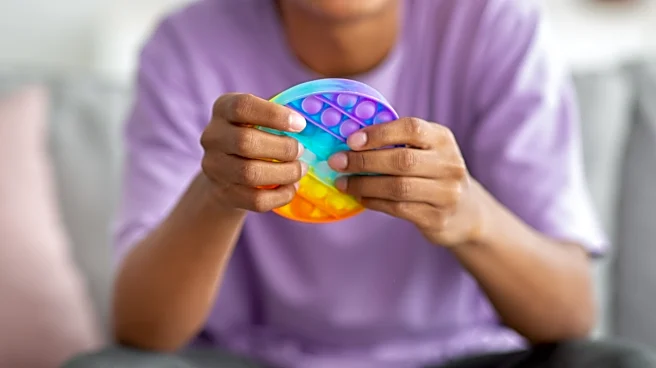
- Pop-Its: These provide repetitive tactile input through pushing silicone bubbles. Depending on the child and the classroom, they may be more appropriate during breaks or less structured activities.
- Wobble chairs and movement-based seating: These allow students to incorporate movement while seated and are an example of sensory support that can be built into the classroom environment.
Sensory tools should support learning, not distract from it
The goal of a sensory tool is not to keep a child entertained during class. It should provide a type of input that supports the child's ability to participate in the activity at hand.
“It's really important sometimes as a supplemental tool,” Smith said. “It shouldn't really be considered a toy, because toys are much more distracting in an educational setting.”
A tool may also be appropriate in one setting but not another. A sensory item that helps a child during occupational therapy, for example, may not be appropriate to use during a quiet classroom lesson.
The same applies to fidgets. If a student is watching, clicking or playing with a tool instead of listening to the lesson, it may not be serving its intended purpose.
Finding the right tool for your child
There is no universal “best” sensory tool. A child who seeks movement may respond differently to a wobble chair than a child who benefits from something tactile in their hands. A student who becomes overwhelmed by classroom noise may benefit more from reducing auditory input than from using a fidget.
For Smith, determining what type of sensory support a child needs can be a process of figuring out exactly what works for that individual.
“As a sensory-trained therapist, I find it more like private investigative work,” she said, explaining that even when two children have needs involving the same sensory system, “they need different input.”
Parents considering sensory supports for the school year may want to talk with their child's occupational or physical therapist, as well as their teacher or school team, about what type of support makes sense.
The goal isn't necessarily to keep a child still or occupied. It's to provide the sensory input they need so they can be more comfortable, regulated and available for learning.
This article originally appeared on Rockland/Westchester Journal News: Back-to-school with sensory support: How fidget toys help students