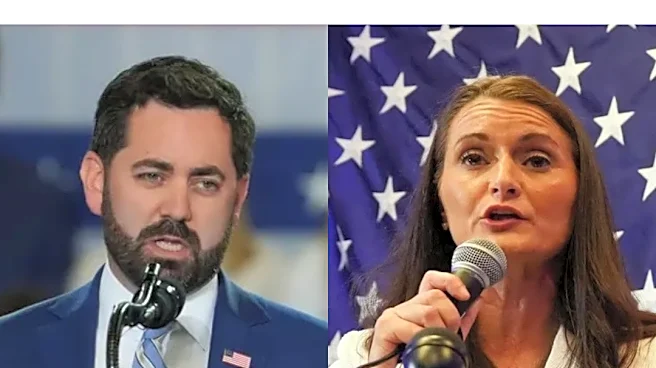

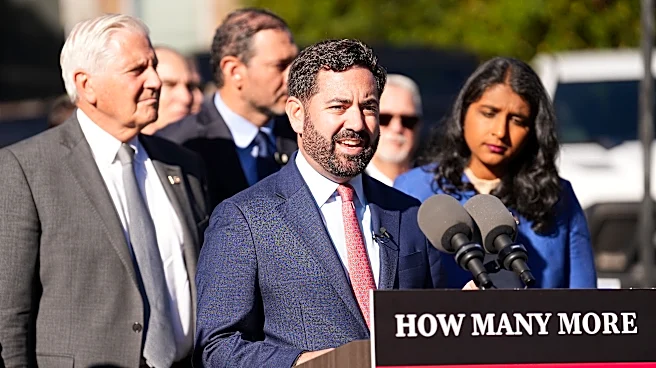
Rep. Mike Lawler and challenger Cait Conley are trading shots over the hot-button issue of data centers as both try to position themselves against an unpopular industry in the last weeks of their high-profile House race.
The attacks have been flying for weeks, mirroring a national campaign trend but fueled also by recent controversies over data center projects in New York's 17th Congressional District. Each has made claims to suggest the other is untrustworthy — due to past votes or employment — to stand up to artificial intelligence companies that are building data centers with vast power and water needs.
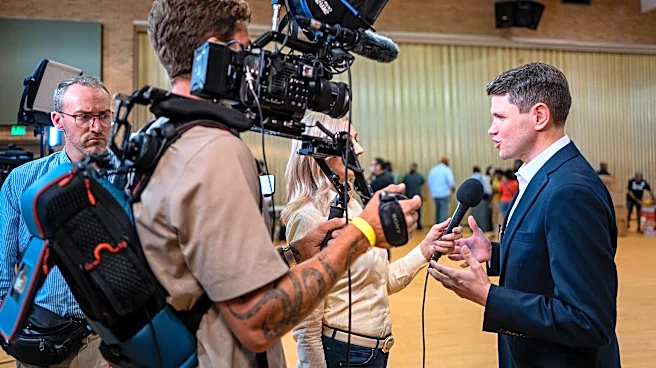
"Just a few weeks ago, she was saying we need data centers," Lawler, a second-term Republican, said during a pair of interviews with both candidates
on CNN's "State of the Union" in September. "Now she's trying to change her tune because she knows this is problematic in the election."
"This is not a guy who's actually going to follow through on anything he's saying," Conley fired back in a televised debate on News 12 later in the month. "He's looking out for himself, he's taking hundreds of thousands of dollars in big tech donations while he's fighting for their interests, period."
Despite the friction, the two actually agree on a proposal in Congress aimed at shielding consumers from the huge costs of supplying data centers with power. The House passed Ratepayer Protection Act with bipartisan support and almost no dissent in September. (Lawler voted for it, and Conley's campaign said she supports it). But the bill has stalled in the Senate, where Democrats say it's too weak because the standards it presented were strictly optional for states.
Aside from that agreement, Lawler and Conley have traded a barrage of claims about data centers and AI. Here are some:
Conley's tech jobs

Lawler has seized on Conley's recent jobs with two tech companies to question her sincerity about policing AI companies and the data centers they are building. Conley, an Army combat veteran and former national security official, has been a consultant for Primer AI and Hidden Level — a drone detection company — since leaving the Biden administration and launching her run for Congress last year.
"Only one of us is receiving a paycheck from AI and Big Tech, and that's her," Lawler said during the News 12 debate. "She's received hundreds of thousands of dollars for a no-show job in which she can't tell you what she does."
Conley has defended her consulting work as a continuation of her career in protecting the public, but has declined to detail the nature of that work due to non-disclosure agreements. She rebuts the notion that she's beholden to AI companies by pointing to her support for Gov. Kathy Hochul's order in July to halt state permits for large data centers for a year — a step that Lawler opposes.
"Instead of fighting for greater regulation, Mike Lawler opposes a moratorium on data centers," she said. "I support a moratorium on data centers."
Lawler and Rockland's data centers

Conley has also tried to tie Lawler to a cluster of data centers built in the last dozen years in Rockland County's Orangetown, where he lives. Conley said at the News 12 debate that five data centers were built in Rockland "on Mike Lawler's watch" — "with three more on the way."
These operations in the Orangeburg section of Orangetown are much smaller than the behemoths now emerging around the U.S. to serve the artificial intelligence boom. But the proposed expansion of the recently built DataBank center has set off an uproar and drawn attention to the cluster that took root in Orangeburg with little notice, before a furious public backlash against data centers began.
There are no obvious links between Lawler and the data centers built in his town.
Lawler served on no Orangetown boards that granted approvals for the projects, and he had no say over them as a state assemblyman and then a U.S. House member since 2021. He did hold the position of deputy town supervisor from 2018 to 2020, but he was appointed and held no seat on the Town Board. (What's more, that board held no votes pertaining to data centers during that time, according to Lawler's campaign.)
Conley's "we need data centers"
Lawler's campaign has filled the airwaves with an ad hitting Conley with what seems a damning clip: a two-second video of her saying "we need data centers." Those words are replayed several times in the commercial, which implies Conley supports data centers because of her tech consulting work.
The line was extracted from a much longer statement that actually gave a much different view. Taken from an April 27 candidates' forum by the Sierra Club, Conley said in her full response that local officials "need to understand the harm" data centers bring; that data centers "are literally profiting off the backs of our communities," without creating long-term jobs; that the federal government should regulate them; and that they should be powered with clean energy.
"We need data centers," she said toward the end. "We're not going to get rid of them. But there is no excuse that they're not running on all renewable energy."

Conley casts her attitude toward data centers in simple terms. "My policy on data centers has been very clear," she said during her interview on CNN's "State of the Union." "If they're going to be built, they need to be a net positive for the communities, not extorting the communities that they're being built in."
Lawler, for his part, advocated a multi-faceted approach in his own interview on that show: "The fact is," he said, "you need to have a coherent strategy at the federal, state and local level dealing with this issue."
New York's data center moratorium
Hochul's one-year moratorium has effectively put the brakes on large new data centers — any needing 50 megawatts of more of electricity — for a year while the state studies their impact and crafts regulations. Conley has backed Hochul's order, while Lawler opposes it with the argument that the state should let local communities decide whether to declare moratoriums — as Orangetown and East Fishkill have done in his district.
House vote to block state AI regs
Conley has rebuked Lawler for a House bill that would have stopped states from regulating the artificial intelligence industry for 10 years, putting any such rules in the purview of the federal government. That prohibition would have prevented states from setting regulations on the fast-developing buildout of data centers, the National Association of State Legislatures said ina letter of opposition to Congress in 2025.
Republicans approved that proposal in their initial version of the "One Big Beautiful Bill Act," the GOP's giant package of tax and spending cuts. But it was opposed by the Senate and removed from the legislation before President Donald Trump signed it into law in July 2025.
"Why should voters in your district believe that you support local control when you voted in Congress to take that authority away?" host Dana Bash asked Lawler in her "State of the Union" interview on CNN.
"Well, the final bill did not include that provision," Lawler answered. "But secondarily, I've always supported local control of zoning."
Chris McKenna covers government and politics for The Journal News and USA TODAY Network. Reach him at CMcKenna@usatodayco.com.
This article originally appeared on Rockland/Westchester Journal News: Lawler, Conley clash over data centers in NY-17 race. Where they stand