

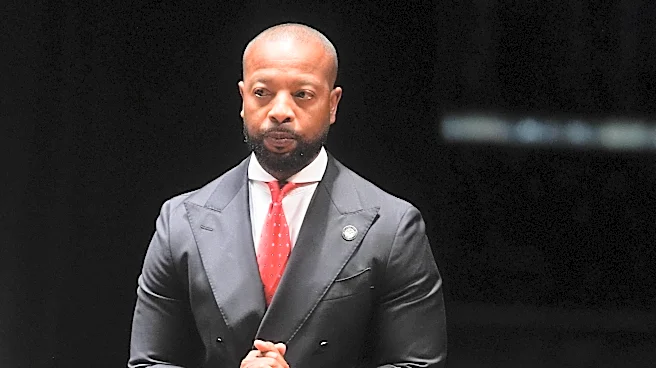


Some Stockton City Council members sought to reconsider Mayor Christina Fugazi’s appointment of public information officer Jason Teramoto following allegations that he improperly pressured City Clerk Katherine Roland during the June 2 primary election.
The council discussed whether to reconsider Teramoto’s appointment as the mayor’s public information officer at its Aug. 18 meeting after Vice Mayor Jason Lee and District 4 Councilmember Mario Enríquez requested that the matter be brought before the council.

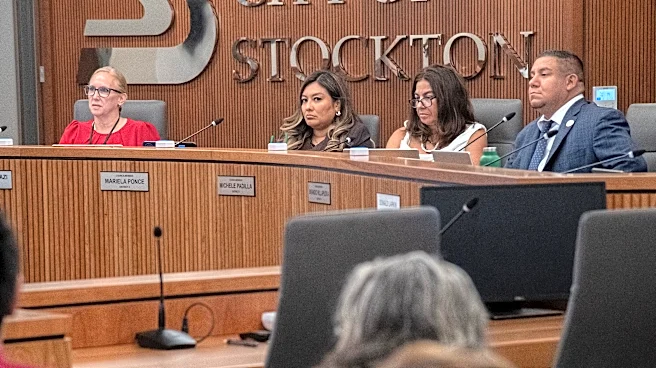
Before the discussion began, Fugazi recused herself because the item involved the mayor’s office, leaving Lee to preside over the meeting. District 1 Councilmember Michele Padilla also recused herself, citing an unspecified "personal matter"
and saying she was doing so “out of an abundance of caution.” District 2 Councilmember Mariela Ponce also recused herself but did not publicly state a reason.
Interim City Attorney Donald Larkin said councilmembers were required to state the basis for a recusal but were not required to provide additional details.
The recusals left Lee, Enríquez, District 3 Councilmember Michael Blower and District 5 Councilmember Brando Villapudua to participate in the discussion. Villapudua later abstained from voting on motions related to the item and left the council chambers without giving a reason. The discussion later ended after his departure left the council without a quorum.
The council did not take action to remove Teramoto.
Larkin told councilmembers that the city charter gives the mayor authority to appoint the public information officer, who serves at the mayor’s pleasure, and that the council could not undo the appointment after confirming it.
"Under the charter, Section 11.53, the mayoral position that's at issue is appointed by the mayor, and serves at the pleasure of the mayor," Larkin said.
Larkin said the council could discuss the appointment and the resolution approving it but could not reverse the mayor’s appointment.
"The council's free to put this on the agenda, have some limited discussions on the resolution itself, but ultimately can't undo the approval that was given," Larkin said.
Teramoto was appointed by Fugazi four months after her previous spokesperson, Leenisha Ward, left the mayor’s office in August 2025. The council unanimously confirmed his appointment on Dec. 9, 2025. According to city records, Teramoto earns an annual salary of $106,535.54.
The city's job specifications list public information, communications, data analytics and performance management among the position’s responsibilities.
Measure O, approved by Stockton voters in November 2016, amended the city charter to require funding for at least three positions in the mayor’s office, including a public information officer.
The charter was later amended by Measure M, approved by voters in November 2024, to distinguish the city’s public information officer from the mayoral public information officer. Under the current charter, the mayor appoints the mayoral public information officer, who serves at the mayor’s pleasure.

Election allegations draw scrutiny
The discussion follows allegations that Teramoto attempted to interfere with the June primary election by contacting the city clerk’s office about the ballot materials of District 1 City Council candidate Tamica Small.
Lee’s attorney, Walter Mosley, sent a June 16 letter to then-City Attorney Marci Arredondo requesting an immediate investigation into Teramoto’s conduct.
Mosley wrote that Lee had been informed that Teramoto approached the city clerk’s office regarding Small’s ballot designation and candidate statement. The letter said Teramoto questioned the designation and asked the city clerk’s office to change the candidate’s materials. When he was told he should not make the request, Teramoto responded, “Be creative.”
Roland later requested an investigation into Teramoto over allegations related to the June primary election, according to a July 1 email from Arredondo to councilmembers. Roland first documented concerns about her interaction with Teramoto on April 23, writing that the encounter occurred the previous day and that she told him she was required to remain unbiased in administering the election.
Teramoto did not respond to a previous request for comment on the allegations.
During the Aug. 18 meeting, Lee entered into the council record a 12-page complaint to the State Bar of California requesting an investigation into Arredondo’s handling of the issue.
The complaint said Arredondo advised the council that the city clerk could qualify as a whistleblower and that adverse action against her could raise retaliation concerns.
Lee said he was later informed by the city’s human resources director that Arredondo had directed the department to pursue the city clerk’s voluntary resignation and that approximately $250,000 was offered in connection with the resignation. He said the alleged offer was made without prior authorization from the council or an identified budget source.
While discussing the matter, Lee questioned why Teramoto had not been placed on administrative leave amid the allegations.
"We don't use admin leave in every single circumstance in which there's an investigation," Larkin said. "It's very fact dependent, and I don't know any of the facts of what we're talking about."
Lee asked whether the city clerk’s allegation that a staffer was interfering in the election and asking her to do things that could be "illegal or nefarious" warranted serious consideration.
"All complaints need to be taken seriously," Larkin said. "It doesn't always mean that somebody ends up on admin leave."
Lee cited Stockton Municipal Code Section 2.36.180, which restricts competitive service employees from taking an active role in municipal political activities, using their official influence to modify political actions or engaging in political work during duty hours. He asked Larkin whether city employees are permitted to engage in political activities while on duty.
"They shouldn't be engaged in political activities," Larkin said. "Taxpayer funding can't go toward political activity."

Residents criticize Teramoto’s conduct
Several residents spoke during public comment about Teramoto’s conduct.
Yolanda Amen criticized Teramoto’s interactions with residents on social media, saying a public information officer should communicate with the public and media on behalf of the mayor’s office, inform the community about city events and activities, and promote the office’s work rather than engage in personal disputes with residents who criticize the mayor.
"It is not the job of the PIO to police the public or attack residents who disagree," Amen said. "When residents go onto the mayor's page and question decisions, disagree with an opinion or simply express criticism, they shouldn't be met with disrespect or personal attacks from the city employee acting on the mayor's behalf."
Amen said Teramoto had personally reprimanded her and that she had seen other comments from him that she believed crossed the line. She said some of the comments were later deleted, but removing them did not erase their impact on those who had already seen them.
Julie Dunning, who said she previously worked as a public information officer for the state, criticized the position, saying she believed it contributed to division in the city. She questioned why the city and mayor’s office each needed a separate public information officer to communicate with the public.
"It was explained to me by the former mayor and a former councilmember that the mayor's office needed to be able to put out their own information on behalf of what they saw in the city," Dunning said. "Since we're not a strong mayor city, it doesn't make sense to me. They are one of seven members on a council, and we should have one representative voice for our city."
Dunning said she had witnessed Teramoto respond to members of the public in a disrespectful manner online and that such conduct was inconsistent with the role and responsibilities of a public information officer. She said she respected the city attorney’s advice but believed the council should, at a minimum, rein in Teramoto’s conduct.
David Sengthay, president of Stockton Democrats Together, questioned whether the city had investigated Roland’s allegations and asked the council to provide information about the status of any investigation.
When Enríquez later asked the interim city attorney whether an investigation was underway, Larkin said, “I’m not at liberty to say one way or the other.”
Pandora Crowder said she believed Teramoto had made inappropriate statements but cautioned against singling out one employee when all councilmembers have said things they probably should not have said.
"If we're going to hold one accountable, we're going to hold them all accountable," Crowder said.

Council weighs options but takes no action
Enríquez said the purpose of the discussion was to allow the public and councilmembers to address concerns in a formal government setting while staying within the legal limits governing personnel matters.
"I believe that the council has a responsibility to revisit its actions when legitimate concerns arise, and also to have on the record from the public what their thoughts are," Enríquez said.
Enríquez said he did not want to discuss confidential personnel matters in public but hoped that, since the meeting was recorded, the mayor could listen to what the public had to say and decide how to respond.
Blower said it was an interesting item because he felt the discussion was somewhat limited in what councilmembers could say given that it involved a personnel matter. He added that ultimately, the mayor’s public information officer is an employee of the mayor and that it is up to the mayor to decide how she wants to supervise her employees.
"I would hope that the mayor will look into the things that she's heard and listen to what the public had to say and go from there," Blower said. "Ultimately, that will be her decision."
Lee said the council could not remove Teramoto but asked whether it could consider other actions, including referring the position to the Charter Review Advisory Commission to determine whether a charter amendment is needed or how the council should fund the position.
Larkin said the council could refer the issue to the Charter Review Advisory Commission to consider potential charter changes. He also said the council has authority over the city budget but could not defund a position created by the charter.
Lee asked whether the council could rescind the resolution approving Teramoto’s appointment.
Larkin said the council’s rules allow it to rescind a resolution, but doing so would have no legal effect on Teramoto’s appointment.
"It could potentially have some symbolic effect, but you really can't undo, really, as I said earlier, you can't unring the bell," Larkin said. "The appointment's been made."
Lee then moved to refer the mayor’s public information officer position to the Charter Review Advisory Commission to consider what safeguards, or “guardrails,” should apply to the position. The motion was seconded by Blower.
The discussion ended after Villapudua left the dais, leaving the council without a quorum.
During council comments later in the meeting, Lee said the discussion accomplished what he had intended by allowing residents to see how the council handled the item.
"I came in here knowing that we couldn't vote to take somebody out of the mayor's office," Lee said.
Fugazi, who recused herself from the discussion, later addressed the matter during council comments.
She said she wished someone had brought concerns about an employee in her office directly to her so she could work toward a solution.
"I wish somebody would have come to me," Fugazi said. "This all could have probably been rectified, but nobody came and talked to me about somebody that works in my office."
She also emphasized the importance of following the city charter.
"We have a charter," Fugazi said. "That charter is our Constitution. We are to follow the charter. Whether we do or not remains to be seen, but ultimately, that is our roadmap for governance in the city of Stockton."
Record reporter Hannah Workman covers news in Stockton and San Joaquin County. She can be reached at hworkman@recordnet.com or on Twitter @byhannahworkman. Support local news, subscribe to The Stockton Record at https://www.recordnet.com/subscribenow.
This article originally appeared on The Record: Stockton council told it cannot remove mayor’s PIO amid election allegations