






There’s something about the end of summer that has always felt more like a new beginning to me. Perhaps that’s because so much of my life has been built around summertime’s slowdown. After grade school, I spent more than a decade studying and working in academia, and orchestras’ schedules tend to follow the same yearly rhythm. Whether it’s the start of a new school year (now experienced through the eyes of my two sons) or the beginning of a new orchestral season, I see late summer as a natural time to reflect on the year that has passed and look ahead to what’s to come. This year, the life and music of Ludwig van Beethoven are top of mind.
Over the summer, I had the opportunity to travel down the Rhine River with the Panama City Symphony, performing
chamber music by composers influenced by the region at each stop along the way. The stretch of the Rhine from Basel to Cologne has inspired some of the most familiar names in classical music: Brahms, Schumann, Wagner, Schubert and perhaps the most revered name of all, Beethoven. Our final day of the voyage was spent in Bonn, where Beethoven was born. For a musician, visiting a composer’s birthplace can feel very much like a pilgrimage. Beethoven’s influence on history (not to mention on me personally) is so great that walking the same streets and hallways he once walked was a deeply moving experience. He left Bonn for Vienna at age 21 and never returned, but the experiences of his early life would stay with him and, in some ways, seem to echo all the way to his monumental Ninth Symphony.
During our visit to Beethoven-Haus Bonn, a recording of the famous choral finale of the Ninth Symphony was played for us, altered to sound as Beethoven himself might have experienced it at the premiere. Beethoven was nearly completely deaf by that point in his life, and the sound was muffled and distant, with only the faintest bass line emerging from a cloudy, garbled mess. It was difficult to fathom that this was how he experienced his own music. The guide then played the same passage as we hear it in concert halls around the world today, in all its glory, and I was surprised by the wave of emotion it caused. Hearing the two versions side by side made me listen differently. I heard the music not simply as a great musical achievement, but as a gift from someone who knew he would never experience it as most of us do. Beethoven still felt a deep desire to share this extraordinarily optimistic vision through his music.
“Oh friends, not these unpleasant sounds” are the first words sung in the near half-hour finale. The unpleasantness is written into the music: dissonant chords and furious rhythms reflect the turbulence of the human experience. Beethoven knew that turbulence well. His hearing loss is perhaps the most famous of his hardships, but his struggles began much earlier. For instance, his father suffered from alcoholism and was abusive, and after his mother died when he was just sixteen, Beethoven became a surrogate father to his younger siblings. Yet he maintained an extraordinary sympathy for the plight of humanity throughout his life. The tragedies of Beethoven’s life, and the determination with which he faced them, make what follows in his Ninth all the more powerful. He wrote the exhortation himself: abandon the unpleasantness and, instead, “let us sing more pleasant and joyful songs!”
When he penned these words to introduce Schiller’s “Ode to Joy,” Beethoven was 54 years old, nearly completely deaf, and would die just three years later. He was living through one of the most consequential political eras in European history and had developed a grand vision of what a united humanity might look like. For him, the music wasn’t simply a vehicle for that idea, but an example of the idea itself. That is one of the things I love about what I do. Each time the orchestra and audience gather in Jacksonville, we have the opportunity to experience something together that cannot happen in quite the same way anywhere else. An orchestra and its audience are, for an evening, a reflection of Beethoven’s vision for humanity.
As we prepare for another season at the Jacksonville Symphony, I find myself immensely grateful for this community and for the chance to make music with and for the people of Jacksonville. This season is filled with music spanning centuries, each composer bringing their own voice and message. And every concert gives us the chance to experience a bit of Beethoven’s vision: to sit together, listen together and share a common experience. I think that’s time well spent. I hope to see you there!
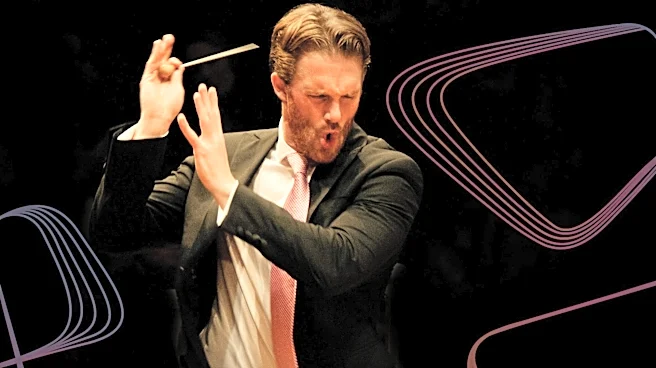
Nathaniel Efthimiou is the Jacksonville Symphony's Associate Conductor and JSYO Music Director.
This article originally appeared on Florida Times-Union: Why Beethoven still inspires us to find joy today