





The appeal of Amendment 3 is easy to understand. According to Florida TaxWatch, the measure would save the average homeowner $2,085 when the new homestead exemption takes full effect. Everyone likes a tax cut, and the upfront savings are significant.
However, what would it cost?
The same analysis estimates Amendment 3 would reduce local government revenue
by $4.9 billion next year, rising to almost $12 billion annually by 2031.There are reasonable discussions to be had about home affordability and government spending, but property taxes fund critical services. A reduction in funding for services does not reduce the need for them.
Across the state and from all sides of the ideological spectrum, public officials, economists, policy experts and public safety
labor unions have come out to oppose Amendment 3 and shared concerns about how core governmental functions could possibly be expected to continue with the unprecedented reduction in public funding that Amendment 3 would enact.

Florida Nonprofit Alliance and the nonprofit sector are equally concerned.
This summer, we asked nonprofits across the state how they expected the amendment to impact their work. Over 90% of nonprofits told us that local government support is highly important to their mission, while 60% expect demand for services to increase if Amendment 3 takes effect.
Parenting Matters, a nonprofit providing child abuse prevention programs, said cuts to local government funding would force it to eliminate programs and staff.
Bike/Walk Central Florida relies on local government investment to increase pedestrian safety. Their contributions have had measurable success in reducing injuries and fatalities, but they expect their work to be reduced or eliminated if local funding is no longer available.
211 Broward, which manages its local 988 Suicide & Crisis Lifeline, says fewer available resources would increase the risk of homelessness, suicide and other negative outcomes related to mental health.
When local governments are forced to eliminate support for these services, and nonprofits no longer have the capacity to meet public need, at what point do we decide that saving a few thousand on your property tax bill is far too expensive a proposition?
Sabeen Perwaiz, CEO and President, Florida Nonprofit Alliance, Jacksonville
Not voting for Donalds

The Florida Republican gubernatorial nominee is U.S. Rep. Byron Donalds, a Black politician from Naples. Born and raised in Brooklyn, New York, Donalds moved to Florida and attended Florida A& M University. He later transferred to Florida State University and graduated there.
I am a Black woman and a native of Jacksonville. I will not vote for Donalds, who could become the first Black governor of the state of Florida. I suppose I should be filled with pride to witness the election of this Black man to the most powerful office in Florida state politics, but I am not.
Perhaps, I should see Donalds’ election to governor as advancement of Black political power and prestige. I do not.
Even more, maybe I should hold my tongue, to wait and see what the election of this Black Republican could bring to the needs and interests of Florida’s Black population. I will not do that.
I believe that Donalds will behave like other far-right Republican elected officials. He will oppose civil rights and voting rights legislation, and deny the need for police reform. He will support banning books which advance diversity and inclusivity themes. He will also not advocate for minority representation on state boards, councils and commissions.
Former Congressman Al Lawson implored Black voters to consider Donalds’ voting record as reason for nonsupport. The fact that Donalds has the endorsement of President Trump is an affront to most African Americans. However, a statement by Donalds’ Democratic opponent, former Republican Congressman David Jolly, better clarifies my decision.
At a recent town hall meeting, Jolly was asked about his switch from Republican to Democrat. His answer was to the point: “I don’t think the problem is that I used to be a Republican. I think the problem is my opponent still is a Republican.” As a Black voter, that is all I need to hear.
Marcella Washington, Jacksonville
True socialism doesn't match GOP rhetoric

"Red-baiting" is a prominent element of political campaigning for the top of the GOP state ticket in Florida's upcoming general election.
An Ashley Moody ad is an example: "Here's where socialists actually stand on the issues: Abolish police, empty prisons, defund the military and seize every farm, power company and doctor's office. Angie Nixon actually signed up for that."
Byron Donalds, James Uthmeier and Blaise Ingoglia have numerous similar ads on TV and online.
Yet, socialism — as it was implemented in the United States — has a history that belies the GOP rhetoric.
A 2024 doctoral dissertation in history by a Liberty University student paints a realistic portrait of socialist municipal government over an extended time period.
Milwaukee served as the national model of "sewer socialism," a term coined by opponents that was embraced by socialists and their supporters as they demonstrated over five decades (roughly 1890-1950) that socialist governance could maintain municipal solvency, public health and clean city management, including throughout the Great Depression.
In short, Milwaukee socialists provided municipal services citizens needed at affordable prices.
A heavy-manufacturing industrial hub, Milwaukee began to decline following World War II, one of many cities in the Rust Belt that deindustrialized due to the offshoring of manufacturing jobs overseas and to non-unionized Sunbelt states. Deindustrialization was paralleled by reduced union membership in Milwaukee and elsewhere in Wisconsin, undercutting electoral support for socialism.
Socialism in Milwaukee was viable in that earlier half-century because it reflected the priorities of voters who participated in regularly scheduled, transparent, free and fair elections. This was democratic socialism in action. Today's GOP election denialism and attempted media censorship will lead to one-party rule with its cult of personality, intrusive state surveillance and laws that benefit only the wealthy.
Michael Hoffmann is a retired history teacher who has lived most of his life in Duval County.
Don't vote for book banners
On Oct. 6, the board of Duval County Public Schools recently voted to ban a graphic novel adaptation of George Orwell's "1984." During the meeting, District 1 board member Anthony Ricardo talked about images in the graphic novel that Orwell's original required readers to conjure from their minds.
If the images can be imagined from the text, then what is to stop the board members from also banning the original version from all the schools that they control?
Both Orwell’s original "1984" and its graphic novel adaptation are disturbing — but that discomfort helps us recognize and prevent the dangers they portray. The challenger is therefore wrong to answer “NO!” when asked, “Is there any value in this material?”
If we do not elect good school board candidates, then the bad school board members are going to get more aggressive in banning books. My worry is that Orwell’s "1984" will be next.
"1984" is about the dangers of communism under Joseph Stalin. Orwell spoke out against the human rights abuses of the Soviet Union, and his fictional work draws heavily on Stalin's very real totalitarian regime. Food shortages, government control of the press, militarization of culture, spying on citizens, mass arrests and torture of supposed enemies were all part of life in Soviet Russia.
Parents who feel their child is not ready to select books independently can use the opt-out form to prevent them from checking out books in the Young Adult category.
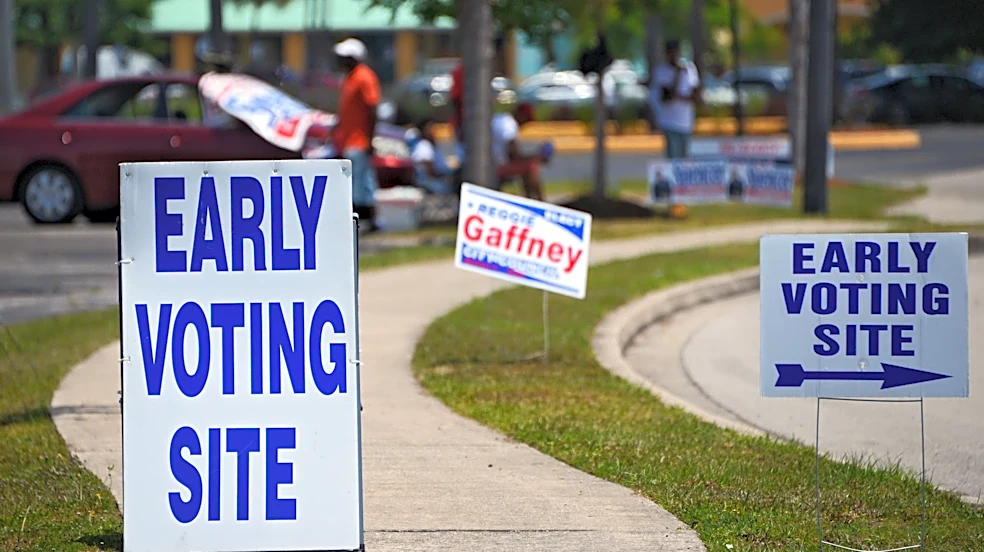
In the upcoming election, please vote for the school board candidate who is not a book banner, or "1984" could be next. Early voting begins Tuesday, Oct. 20, and extends through Sunday, Nov. 1, in Duval County.
Susan Aertker, retired certified public accountant and public school advocate, Jacksonville
Support for Amendment 3

I am voting for Amendment 3 after sitting on the fence for a while. Mayor Donna Deegan's statement that they wouldn’t be able to give rich developers grants, loans and write-offs to build downtown if the amendment passed pushed me to support the amendment. My research on this history of the homestead exemption pushed me further.
The city of Jacksonville has given many of these rich developers hundreds of millions in property tax write-offs alone, going out up to 20 years.
For example, just the total property tax incentive for the Four Seasons portion of Khan’s Shipyards development on the downtown riverfront is now up to $56 million over 20 years.
Add into the mix that we heard the same "doom and gloom" back in 1980 when Amendment 4 passed, increasing the homestead exemption from $5,000 to $25,000, which was 55% of the median value of a Florida home back then. That $25,000 is only worth a little over $6,000 in today's dollars.
The increase in home prices has been double that of the Consumer Price Index inflation rate. If our homestead exemption kept being adjusted for the increase in home prices, it would be $180,000 today. Tax collections would still have increased and city budgets swelled as the population has also increased greatly and more houses, apartments and businesses to serve have been built.
An elderly couple, disabled person, nor anyone else should lose a paid-off home to the tax collector. Amendment 3 really is an adjustment for inflation on an exemption that hasn't changed in decades.
Brian Murphy, Jacksonville
JEA rates could be worse

There's an interesting online database at Kadoa.com that one can use to compare electricity prices nationwide. Looking only at Florida, for the past five years JEA has been predominantly well below the Florida state average on the cost of a kilowatt-hour and somewhat below the Florida average on the average monthly bill.
While FPL's rate is currently shown the same as JEA's, the monthly FPL bill is about $10 greater than that of JEA. Nationwide, average rates have risen from roughly 13.4 cents per kWh to 18 cents per kWh (about 35%) over the past five years. For the same period, Tampa Electric's rates have increased about 67% while FPL's have risen 33%, JEA's have risen 29% and Duke's have risen 28%.
The database also presents European electricity prices (by country), where some have seen prices climb by 83% or more. So it appears increased costs are not only a JEA problem.
This does not absolve JEA from getting their business and management structure in order, but it appears we are getting a pretty good deal on our electric rates and total costs. Let's not throw the baby out with the bath water; it seems we can do much worse.
Ken Shacter, Arlington
LETTERS POLICY: Letters should be no more than 350 words, with an average preferred length of 200 words. All letters are edited for space, clarity and newspaper style. Submissions must include name, phone number, address and occupation. To submit, email letters@jacksonville.com.
This article originally appeared on Florida Times-Union: What Florida's Amendment 3 will really cost if passed | Letters