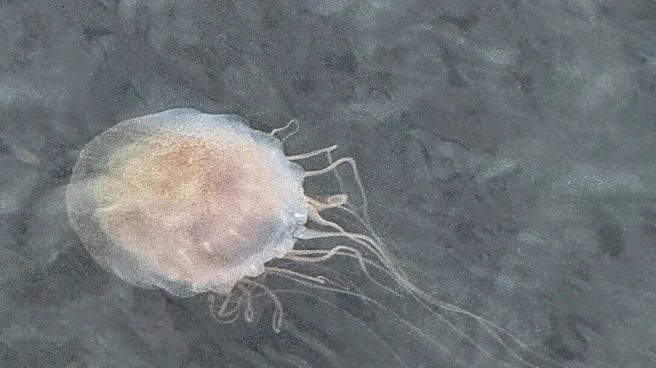







The recent drought and extremely warm temperatures has led to some unusual visitors into the St. Johns River. While not exactly rare, they are not as common in the typically freshwater portion of the river as they are closer to the mouth near the ocean. These are jellyfish.
A reader recently sent me pictures of jellyfish he had seen in the Riverside area. About three years ago we had a similar drought situation that allowed a jellyfish relative, the sea walnut or comb jelly, to show up in the river near Switzerland in St. Johns County.

Jellyfish are one of the more fragile but fascinating species that occur in Northeast Florida. They have no brain but a network of nerves, no heart, bones or lungs. Their bodies are roughly 95% water. That results
in a transparent, gelatinous body that is an umbrella-shaped bell called a medusa. That term is from Greek mythology where Medusa was described as a woman with living snakes in place of her hair.
Jellyfish have tentacles with stinging cells hanging from their bell-shaped bodies. The stinging cells are nematocysts. Some species have very painful nematocysts while others are harmless for most people. The jellyfish uses the stinging cells to stun their prey before consuming them.
Oceanic jellyfish are termed stenohaline, meaning they can only tolerate narrow salinities, while the ones we encounter in the St. Johns River estuary are euryhaline, or able to tolerate a broad range of salinities. There are freshwater jellyfish that can occur in inland lakes.
The life cycle of jellyfish is amazingly complex for a simple creature. The recognizable dome-shaped adult jellyfish is the sexual and motile phase. Their reproductive organs form a distinctive, flower-like or horseshoe-shaped pattern clearly visible on their bell, with females typically displaying pink hues and males appearing mostly white. Males release sperm into the water, which females capture for internal fertilization. The resultant planula larva develop briefly in specialized pouches on the female's oral arms before dropping off as free-swimming, flattened planulae larva.
These larvae then attach to a hard surface, and metamorphoses into small, sessile polyps that resemble a tiny sea anemone. While attached to the seafloor, the polyp feeds on passing microplankton and reproduce asexually by budding or creating stacked segments (strobilation). The segmented pieces break off from the polyp as tiny, free-swimming juvenile forms called ephyra, which grow and mature into adult medusae.
Here in Northeast Florida, we have several species of jellies. In the water, they can be beautiful and fun to watch swimming with a regular undulating motion. The moon jellyfish has a clear, saucer-shaped body (8 to 12 inches wide) with a four-leaf clover pattern inside. Their sting is very mild or hardly felt to most people. We also have cannonball jellyfish with a distinct round, dome-shaped body that can be up to 10 inches wide with a brown or purple rim and short tentacles. They truly look like cannonballs and are mostly harmless to humans.
Then we have the Atlantic sea nettle or stinging nettle with its pale umbrella that can reach 10 to 16 inches wide and marked with reddish-brown stripes and long, stinging tentacles. They cause moderate to very painful stings. Locally these are also called lion’s mane, but there is another much larger species that also has the same name found in colder waters.
There are two other species that you can encounter on our local beaches. One is the Portuguese man o' war with its bright blue, gas-filled floating sail and exceptionally long, highly venomous and painful tentacles. It is not a true jellyfish, but a floating colony of tiny organisms. It delivers a very painful sting even after they have washed up on our beaches. Never touch a Portuguese man o' war even when it appears to be dead on the beach.
And we also see the beautiful blue button, which is also bright blue with a small disc-like floating body that is typically 1 to 1½ inches in diameter. They can cause mild skin irritation, so it is also not advisable to touch them when you see them washed up in the sand.
Jellyfish are beautiful but can be a painful reminder to always be wary of what you touch in the water.
Glad you asked River Life
How much impact to the salinity in the lower St. Johns River has the recent drought caused?
Despite the more recent rainfall, the entire Southeastern United States remains under drought conditions. The drought has caused an increase in salinity in the lower basin with readings of 18 to 24 parts per thousand (ppt) in the area near Jacksonville University where more typical non-drought conditions are 12 to 18 ppt. Ocean salinity is 35 ppt with freshwater being 0 ppt. We have also seen water temperatures over 900 F.
River Life runs the first Tuesday of each month in The Florida Times-Union. Email Quinton White, professor emeritus and former executive director of Jacksonville University’s Marine Science Research Institute, with questions about our waterways at qwhite@ju.edu. For more on the MSRI, visit ju.edu/msri.
This article originally appeared on Florida Times-Union: This species appearing in the river has no brain, heart, bones or lungs