






The big box stores began putting out holiday décor in August. August!! By September, reindeer with flashing lights were invading the seed displays. And now, with Halloween still weeks away (for Pete’s sake!) it’s like gardening is done and forgotten for the year.
Well, that’s just not so. In fact, October is a great time for the garden. The temperatures are milder, making it easier on the gardener. Our new garden additions will revel in the cooler temps that reduce transplant shock. All that while the soil is still warm enough for roots to develop before winter dormancy sets in.
So, when Valentines Day rolls around and the last frosty nights are probably behind us, our new garden is ready to take off.
That’s the plan. And this year I’m going to
“work the plan.”
That’s why in September, while I tried to ignore the heat, I started taking inventory around here. Things that worked —or didn’t. Plants that already have outgrown their space — and their welcome. Empty spaces where something died in the winter of ’24-’25 and I never knew with what to replace them.
And there’s the rub. I want to stay true to my southern roots, but be sustainable, too. I want a garden that’s full and lush AND resilient as it experiences more extreme heat and heat waves: self-sufficient as rain and storms become more unpredictable and responsible water management becomes more essential; and stronger as more and new-to-us pests and diseases show up.
I want to plant a landscape that’s going to survive as we move into the future.
“Sustainable,” a word bantered about. Let’s be clear about what makes a plant sustainable.
- It thrives in its location’s heat and humidity, sporadic rain or drought, soil, and sunlight.
- Once it’s established, it doesn't need much or any additional irrigation.
- It’s resistant to local pests and diseases and therefore doesn’t need a lot of chemical pesticides.
- Ideally, it feeds, shelters and houses local wildlife.
- It doesn’t frequently involve all the expensive unsustainable aspects of replacement, like transportation costs (like diesel fuel, packaging materials) and labor.
Sounds like native and Florida Friendly non-native plants, doesn’t it? So that’s where our plant selection and maybe replacement will begin.
Who doesn’t look forward to spring and one of the most iconic plants of southern landscapes, azaleas? Perhaps yours have been failing recently, too. We want a good foundation plant with some flowers in spring, and low maintenance.
I found three “maybes.”
Simpson’s Stopper (Myrcianthes frangrans) checks all the sustainability boxes while being a native shrub suited to North Florida and good in both sun and shade.

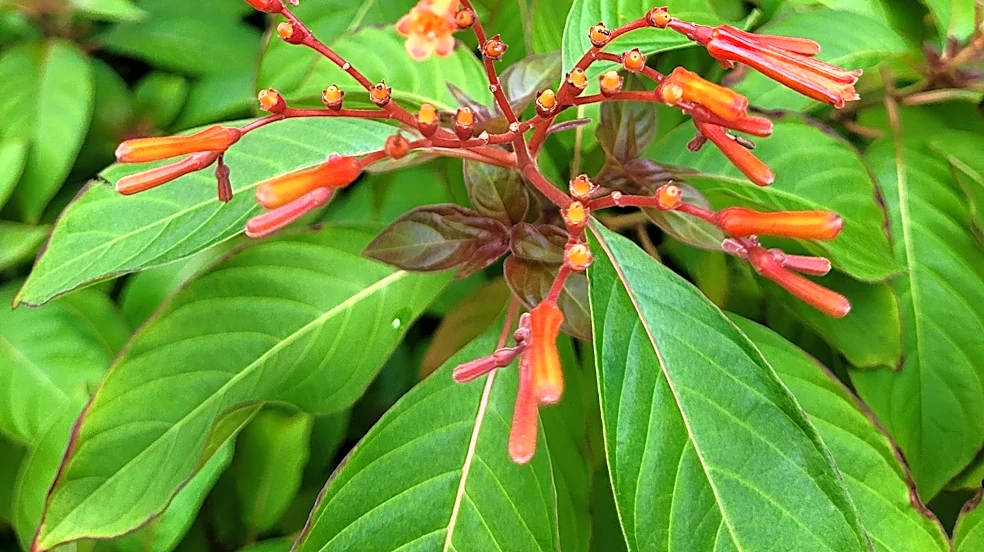
Dwarf firebush (Hamelia peantens ‘Compacta’) is more heat and humidity tolerant than azaleas. Once it’s established, it virtually takes care of itself. The butterflies and hummingbirds can’t get enough of the orange-red flowers that continue for most of the year. Just understand that ‘Compacta’ is a hybrid and its parent native shrub can grow very tall and wide. Stunning plant, but you need to know what you’re buying.
Dwarf Walter’s viburnum is another plant I’m looking at. Native, evergreen, shrub-like, with plenty of spring flowers in April.
If you don’t want to abandon azaleas all together, maybe you ought to consider different azaleas, like the native species. Native azaleas are deciduous, more open and looser than evergreen hybrids. It definitely deserves consideration for a spot in the landscape.
My very old and once envied bigleaf hydrangea don’t stop traffic anymore. They’re too heat-sensitive to put on the show they once did. Add drought and changing winter conditions, and they no longer produce a dependable display.
A hydrangea that won’t disappoint is the native oakleaf hydrangea. They grace many home gardens around northeast Florida. Mine are in a shade to partial shade corner of the yard. Part of it has reached into a full sun space and is still doing well. Now that’s it’s well established, it’s another plant that takes care of itself.
To highlight plants that aren’t native but are still sustainable, look to two hydrangea cultivars bred to take the place of our bigleaf mopheads. For instance, consider the ‘Annabelle’ and ‘Incrediball’ hydrangeas.
The ‘Incrediball’ cultivar, resembling bigleaf mopheads, was developed from a native smooth hydrangea (Hydrangea arborescens), indigenous to the eastern US including north Florida. They’ve been bred to produce large blooms on stronger, upright stems to withstand harsh weather. The growers report that Incrediball hydrangeas, once established, will generally adapt to our region.
I’ve learned a bit about trees not adaptable to our region. To fill that hole in the landscape, tree shopping was needed.
I automatically grabbed for a crape myrtle. Why not? They’re pretty. UF/IFAS says it is well adapted to our heat and drought. No down-sides.
But its dependability has made it ubiquitous. To break with conformity the shopping began.
Simpson’s stopper again. Native, evergreen, flowers, fruit, wildlife. Can be kept a large shrub. Checks all the boxes.
Chickasaw plum. Native, spring flowers, nice shape, edible fruit of wildlife (and people). Pruning can become problematic and it has a shorter life span.
By accident, I learned about Flatwoods plum (Prunus umbellate). It’s native and a cousin of the Chickasaw plum. Its smaller mature size will fit its space. Flatwoods plum almost never suckers and is easier to control in a landscape than Chickasaw plum.
UF/IFAS describes its “spectacular display…in late February, these small trees take on a white, billowy, almost cloud-like appearance when they are clothed in the profuse, small, white flower clusters.”
The flowers are valuable or even essential to the life cycle of several familiar butterfly and moth species like the Eastern Tiger Swallowtail, and the giant leopard and sphinx moths. The moths are in fact very common in our area but seldom seen because they’re nocturnal.
The resulting purple berries are attractive to all kinds of wildlife. The fruit, along with the insects it attracts, are important bird food for many species. The berries are very small and, though edible, will be a major chore to prepare for jams, which I understand is the only way people find them palatable.
Speaking of food, Flatwoods is also known as Hog plum, a reference to its historic use as a livestock food. So, if you’re considering growing you own bacon …
As we continue to scour magazines for ideas, and dream of what our gardens will look like one day, it’s time to also emphasize sustainability as we shop. The planet will love you and your sore back will also give you thanks.
Paula Weatherby is a Master Gardener Volunteer with the Duval County Extension Service and the University of Florida/IFAS. For gardening questions, call the Duval County Extension Office at (904) 255-7450 from 9 a.m. to noon and 12:30 to 3:30 p.m. Monday-Friday and ask for a Master Gardener Volunteer.
This article originally appeared on Florida Times-Union: Why your garden needs a sustainable makeover now