






In between choosing Florida’s next governor and deciding whether to overhaul the state’s property tax exemptions, voters from Jacksonville to the Gulf coast are being asked whether judges on the 5th District Court of Appeal should keep their jobs.
Who are these people?
Judges on Florida’s appeals courts are all appointed by the governor initially but can only keep their jobs by passing “merit retention” votes within two years of taking office. After that, every DCA judge faces another retention vote every six years.
Although most people don't know their names, judges their can make a mark in the law. One 5th DCA alum, Jamie R. Grosshans, is now a Florida Supreme Court justice. Another, Jordan Pratt, is a federal judge in Jacksonville.
Three 5th
DCA judges are on the ballot in 2026: John M. Harris, Scott Makar and F. Rand Wallis. Here are some basics about the vote and the people seeking another term.

What is the 5th District Court of Appeal?
District courts of appeal rule on legal challenges to decisions by local judges and some DCA decisions are appealed later to the Florida Supreme Court.
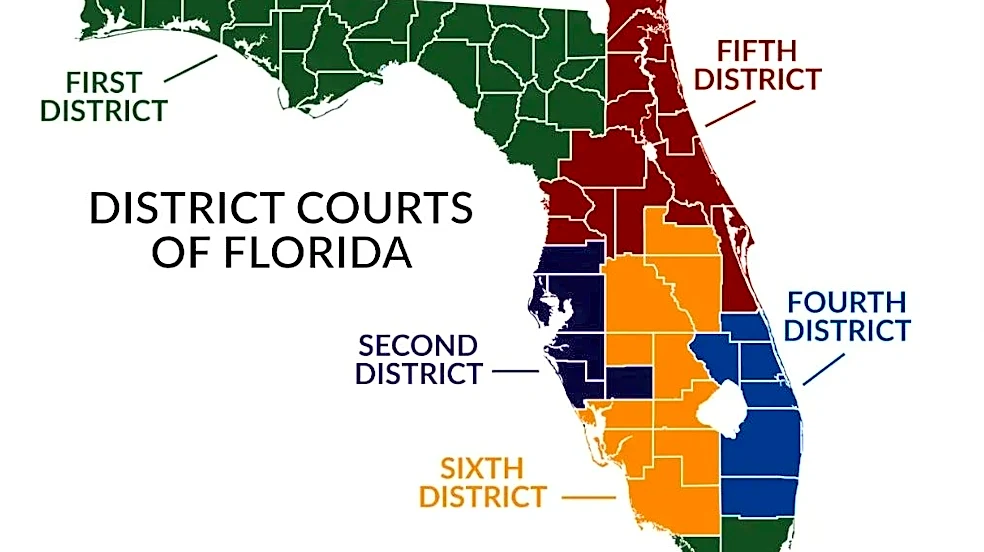
Florida has six appellate districts, with the 5th DCA, which is based in Daytona Beach, handling cases for areas where about 5.3 million people live.
The 5th DCA’s territory includes Northeast Florida’s Fourth Judicial Circuit (Duval, Nassau and Clay counties) as well as the Fifth Circuit (Lake, Marion, Sumter, Citrus and Hernando counties); Seventh Circuit (Putnam, St. Johns, Flagler and Volusia counties); and 18th Circuit (Brevard and Seminole counties).
The court has 12 judges, who usually review cases through three-judge panels.

Who is Judge John M. Harris?
Harris is a Brevard County native who was chief judge for the 18th Judicial Circuit (Brevard and Seminole counties) when former Gov. Rick Scott appointed him to the appeals court in 2018. With 16 years’ experience as a county and circuit judge, he has a Florida Supreme Court certification as a judicial mentor.
One notable ruling Harris was involved with was a 2020 finding that an Orange County man accused of vandalizing a home that his ex-girlfriend was visiting ― and his cell phone was found ― couldn’t be required to tell investigators the pass code to open the phone because the U.S. Constitution’s Fifth Amendment protects a person from being required to incriminate himself. The Florida Supreme Court later upheld the 5th DCA ruling.

Who is Judge Scott Makar?
Makar is a onetime Jacksonville attorney and University of Florida law school graduate who was appointed to 1st District Court of Appeal by former Gov. Rick Scott in 2012. He was reassigned to the 5th DCA in 2023, when Northeast Florida’s Fourth Judicial Circuit moved from one DCA to the other.
Makar’s record as an appeals judge includes a 2022 decision when he disagreed with the rest of a 1st DCA judge panel that said a Gainesville court should have dismissed a class-action lawsuit by a University of Florida student claiming UF committed breach of contract during the pandemic by requiring students to pay both tuition and regular campus-related fees but held classes online and told students to avoid the campus.
“Little doubt exists that an enforceable written contract of some sort exists,” Makar wrote in a dissent that was at least partly validated in 2025, when the Florida Supreme Court overturned the appeals court ruling and said the lawsuit could keep moving toward trial.

Who is Judge F. Rand Wallis?
Wallis is a Central Florida native who graduated from Stetson University’s law school. He was a Ninth Judicial Circuit judge for five years before being appointed to the 5th DCA in 2013.
In one notable case, he wrote the DCA panel’s 2019 ruling overturning the first-degree murder conviction of a female defendant who, as a 17-year-old runaway with a below-average IQ (75), arranged online to meet a man for sex and let two robbers into his home. The ruling said police kept the teen under their control for nine and a half hours, questioning her intermittently and sending away her father when he came looking for her, before an officer read her a Miranda-rights notice that’s legally required for statements to be admissible in court.
The DCA panel ordered a new trial for the defendant, who was convicted of second-degree murder in the 2013 killing and released from prison in 2023.
This article originally appeared on Florida Times-Union: What to know about Florida's 5th DCA judges on the 2026 ballot