






The official grand opening of the University of Florida campus in LaVilla may still be a day away, but classes quietly started late last month, and 12 students in the inaugural architecture program are already hard at work.
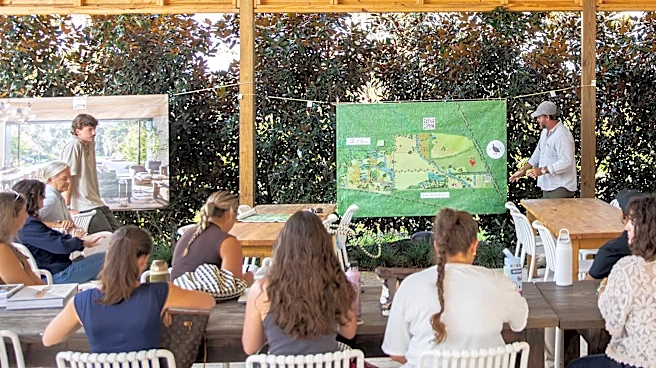
Known as JaxLab, the program highlights three focus areas: Historic Preservation; an Integrated Path to Architectural Licensure; and Sustainability, Regenerative Design and the Built Environment. It's the latter area that drew the students out to the sprawling Congaree & Penn property recently.
A 330-acre working farm, restaurant and agritourism site, Congaree & Penn has been chosen as a "living lab" for the Sky Institute Design Competition, which aims to explore how architecture, planning, agriculture, ecology and technology
can work together. The grad students are tasked with thinking beyond individual buildings to consider the larger systems that make communities resilient, beautiful and enduring.
The winner will receive a scholarship, with the amount to be announced at a later date.
What is the Sky Institute?
The Sky Institute is a nonprofit foundation focused on developing sustainable building concepts and prototypes. Established by Julia Starr Sanford, president and founding principal architect at Starr Sanford Design, the foundation is an international collective of urban planners, architects and craftsmen dedicated to sustainability and resilience.
Now, local students have been added to the mix, an idea that grew out of a previous collaboration between Sanford and the university's School of Architecture in Gainesville.
"We had a wonderful experience with them in 2007, and right after that we decided to found the Sky Institute," Sanford said. "When we learned the UF campus would be opening here, we thought it would be a wonderful opportunity to engage with students on a real site that could serve as a 'living lab' for ideas that can be tested."
How was Congaree & Penn chosen for the project?

Sanford noted that Congaree & Penn was the institute's first choice for the project and owner Scott Meyer was onboard immediately.
The two previously worked together on The Eleven, an upcoming agrarian residential community of 11 homesites on the west side of the property, each of them on 10-acre lots. According to Meyer, this is the first time Congaree & Penn has been involved in a design competition of this sort.
"Our team is always looking for fresh perspectives, and the Sky Institute really aligns with our ethos: working with the land, long-term sustainability and trying to create something new, as we've evolved over the past decade," Meyer said.
Meyer added that the big question for his operation has always been how to achieve conservation goals while inviting the public (and eventually residents) to cohabitate with nature. At the same time, his team wants to create new retail opportunities, with the whole mix integrated into into farm living.
Towards that end, Meyer pointed out that Congaree & Penn strives to maintain the same land use that the property has had for the last 100 years. The upcoming residential development of The Eleven will be deed-restricted, and no schools or large-scale shopping centers will be added to the site.
"We're keeping it low density," Meyer said.
How did the students respond?

During the students' visit to the property last month, Meyer was impressed with their enthusiasm for understanding the history of the area and the reasoning behind various decisions made over the years. Noting that they had "a lot of information coming at them" on tour day, Meyer said "a lot of really good questions" were asked.
Sanford noted that the competition has two phases, with the first being collaboration, where students will work together to develop a shared master plan, looking at the whole property in terms of land use, conservation and other elements. The second phase will see the students working individually to develop a speculative but buildable design that fits the larger vision of the team while reflecting the character of Congaree & Penn, as well as the mission of the Sky Institute.
They are encouraged to be creative, she added, without too many constraints or focus on "something to be built."
"That's the great thing about young minds," Sanford said. "Congaree & Penn is like a blank canvas for them."
Where are some of Sanford's other projects?

One of the architect's best-known projects is Alys Beach in the Florida Panhandle, where she was selected in 2004 to design one of the first residences in the planned oceanfront community. The resulting pristine white-washed structures — reminiscent of homes along the Greek seaside — set a new standard for Florida architecture: resilient to the state's formidable storms, while luxurious and elegant at the same time.
Closer to home, Sanford worked on the restoration of a 1905 farmhouse in Riverside Avondale, as well as Eartha's Farm & Market, the urban infill farm operated by the Clara White Mission. Formerly known as White Harvest Farm, it grew out of a master plan created by the Sky Institute.
Other projects include the Fish House in Atlantic Beach, the sale of which set a record for real estate in Duval County last year. Coming up, Sanford's team is overseeing renovation plans for the Swisher estate, as well as those of the property sold by the Sontag Foundation earlier this year.
When does the competition end?
Throughout the fall semester, students will participate in workshops and intensive seminars led by UF faculty, along with local architects. They will also prepare midterm and final presentations, with their research and outcomes fully documented.
Meyer is looking forward to visiting the students in the studio later in the semester.
"I'm excited to see what happens after they've had time to process the information and flesh out their ideas," he said.
Sanford stressed the importance of the Congaree & Penn model in determining future development, noting that all the remaining developable land in Florida is inland, due to many decades focused on building out the coast. She hopes the project will provide a blueprint for development of that land going forward.
In a previously prepared statement, Sanford expressed her faith in the students' ability to create lasting change through their work.
“Architecture has an extraordinary ability to shape not only how we live, but how we relate to one another and to the natural world,” she said. “This competition gives students the opportunity to consider the larger systems that make communities resilient, beautiful and enduring to inform a more meaningful way of living for generations to come.”
A member of the Times-Union team since 2011, Anne Hammock has worked as a writer and editor for more than 35 years, currently focusing on real estate features and managing the Opinion section. She can be reached at ahammock@jacksonville.com.
This article originally appeared on Florida Times-Union: New UF Jacksonville students challenged to think 'beyond buildings'