



I participated in the Great Southeast Pollinator Census. The University of Georgia started the census in 2019, and more states in the Southeast have since joined. Why are we concerned about pollinators? Well, one third of the food you eat depends on pollination.
Grass crops like wheat and corn are wind-pollinated, but most fruits and vegetables need pollination by insects, even leafy greens need pollination for seeds. Some plants even depend on animal pollinators, like birds and bats. Pollinators' economic benefit is in the billions of dollars for food and honey. Their ecological benefit is extensive in maintaining habitat.
We've been given a scare with the colony collapse disorder of the European honey bee, and we now know that we shouldn't depend
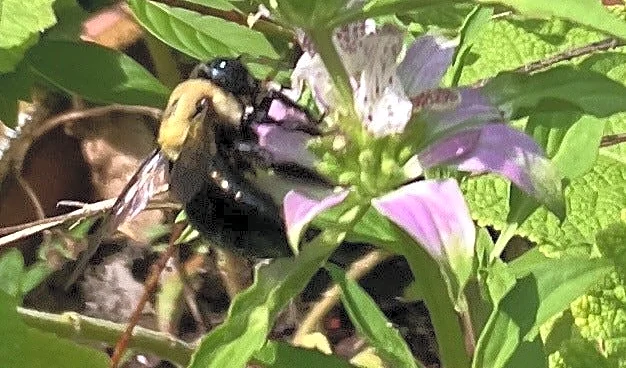
on one species for pollination. Our native bees are solitary bees, some of which are specialists in pollinating certain plants at certain times of the year. Others are active most of the year in Florida. They need a variety of flowering plants and locations for nests, such as hollow stems, bare soil and untreated wood.
I participated in two Pollinator Census locations: the Mandarin Garden Club and the University of North Florida. The garden club has a large variety of blooming plants, and the university has some flower beds we observed. My observed results: a large variety of flowering plants attracted more pollinators.

Salvia, two different blue varieties attracted lots of different bees, but a hybrid large-flowered red salvia nearby had no visitors. (The native red or pink salvia does attract pollinators, though). A round pollinator bed at the university wasn't getting any bees landing on the flowers. The parsley in the center of the bed had been pollinated, as it had lots of seeds. The red-orange flowered milkweed did not have any bees alight, though there was a tiny damselfly occasionally resting on the flowers. (Perhaps it was eating mites.)
There were lots of bees flying above the double marigold flowers around the perimeter, but none alighted for nectar. My conclusion was that you should avoid highly hybridized flowers that are too large or too double for bees to reach the nectar and pollen. Save the fancy hybrid plants for accents or pots by the door and use single flowers and inflorescences of multiple flowers to attract pollinators. A bunch of single yellow flowers will have the same impact as double flowers seen from the street or your patio.
You can help save pollinators by planting native flowering plants that our native bees evolved to pollinate. This list has both native and non-native flowering plants that are good for pollinators: https://blogs.ifas.ufl.edu/polkco/2021/07/21/celebrate-pollinators-a-sample-plant-list/. The Florida Wildflower Foundation provided handouts at the census locations. The "20 Easy-to-Grow Wildflowers" and the "Guide for Choosing Native Plants" are brochures you can download or print. If you'd like to grow your wildflowers from seeds, they're available from Welcome to the Florida Wildflowers Growers Cooperative. Leaving bare sandy soil and stems over winter is important for native bees' survival. This site has more information: https://blogs.ifas.ufl.edu/brevardco/2026/03/05/protect-the-native-bees-that-visit-your-yard-and-vegetable-garden/. If you want to shop for flowering plants locally, look for a busy local plant nursery. One busy with bees and butterflies visiting the plants in their displays!

You can help protect pollinators by providing appropriate flowers in your display gardens and around your vegetable gardens for their nectar and pollen needs. Provide locations for their nests: bare soil, hollow stems, untreated wood. Limit the use of pesticides and herbicides. Use only if absolutely necessary and follow the label. Don't spray on flowering plants or during active bee activity during daytime.
Something is blooming year-round in Florida, so plan your garden for year-round bloom. Florida bees usually aren't aggressive unless you are bothering their hive or nest. I like to smell flowers and have had a bee leave fussing at my nose when I smelled a flower; I didn't see him. He just moved to another flower, and I just moved my yellow, pollen-dusted nose to a different flower.
Brenda Daly is a Master Gardener volunteer with the Duval County Extension Service and the University of Florida/IFAS. For gardening questions, call the Duval County Extension Office at (904) 255-7450 from 9 a.m. to noon and 12:30 to 3:30 p.m. Monday-Friday and ask for a Master Gardener volunteer.
This article originally appeared on Florida Times-Union: How to pick the right flowers to save native bees