


Young Americans may not be able to vote, but their voices are powerful and they’re already dreaming of the world they’ll someday lead. Their ideas on topics from education to energy could shape our democracy and even influence today’s decision makers. We’re excited by the creative power that can only come from young minds, so, we’re passing them the mic and asking students to tell us the future they want to inhabit.
This year, in honor of the United States’ 250th anniversary, The Florida Times-Union, in partnership with USA TODAY and Students United News Network (SUNN) – a non-profit organization publishing the nation’s best student journalism and civic media – is launching a series of three contests calling on middle and high schoolers to share
their vision of America.
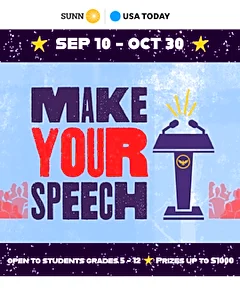
Make Your Speech, the second of these non-partisan contests, invites young Americans to step up to the political podium. We’re asking them to imagine that they’ve just been elected as president and they’re delivering their first inaugural address in a 2-3 minute video. We want to be inspired, educated, and motivated by their agenda for the next four years – and called together across political divides.
Our judges include some of today’s most influential creators, thinkers, and civic leaders. Together, we’re not just looking for great performances from young presidents; we’re looking for bold ideas, provocative questions, well-researched solutions, and a unifying vision for the future of our democracy.
This contest is not just an opportunity for the rising generation, but also for adults to learn from the dreams, worries, and priorities of young voices that often go unheard. After all, it’s the world they build that will sustain hope and shape the future of our democracy.
Quick contest facts
- Our contest portal is open for submissions through midnight Pacific time on October 30, 2026.
- To enter, students or a parent/guardian should submit a 2-3 minute video of the student delivering an inaugural presidential address and the written text of the speech via the submissions portal.
- Entrants must be in grades 5-12; a parent/guardian must submit for students aged 12 and younger.
- Entries will be judged in two categories: middle school and high school.
- 1st place winners will receive $1,000
- 2nd place winners: $750
- 3rd place: $500.
Inaugural speeches: a unifying message
Presidential speeches are milestones in political history. We study them, quote them, and sometimes even make fun of them. When they directly talk to the American public, presidents educate us about national events, console us after tragedies, and spur us to action. Their words can be like those of your best teachers: they lift us up, they push us forward, they remind us who we are and who we can become.
Presidential inaugural speeches are nearly as old as the USA itself: George Washington gave the nation’s first inaugural address after being sworn in, and every president since has done the same. It’s an important moment. They’ve spent months connecting to their bases as a candidate; this speech is their moment to speak to everyone – including those who voted against them – as their leader.
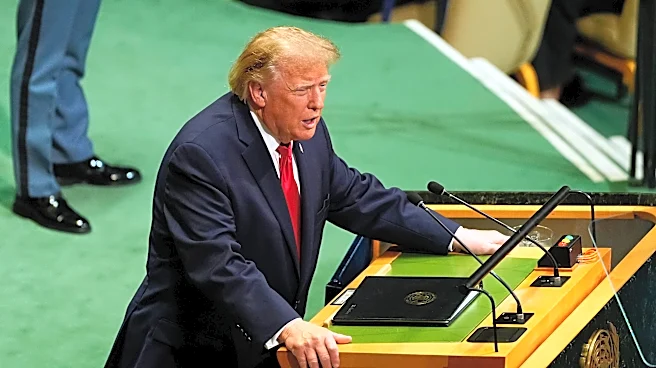
President Donald Trump closed his first inaugural address, which came after a divisive campaign season, by reminding Americans of their commonalities. He said, “whether a child is born in the urban sprawl of Detroit or the windswept plains of Nebraska, they look up at the same night sky, they fill their heart with the same dreams.”
George H.W. Bush spoke of a shared future at his 1989 inauguration, saying "I do not mistrust the future. I do not fear what is ahead. For our problems are large, but our heart is larger. Our challenges are great, but our will is greater."
These reminders of a collective identity and commitment to America continue to be relevant today. After all, a great political speech meets the moment and also stands the test of time.
While inaugural speeches are directed toward all, their words can have a personal effect.
In 1961, John Kennedy said in his inaugural address: “And so, my fellow Americans: Ask not what your country can do for you — ask what you can do for your country.”
Kennedy’s words hit 19-year-old Donna Shalala“like a splash of water” and changed the course of her life. The next year, Donna joined the Peace Corps. She became a professor. She served as US Secretary of Health and Human Services and as a congressperson. Later, she was awarded the Presidential Medal of Freedom.
Presidents have used this opportunity to address young people directly.
Richard Nixon stated: “We see hope in the youth of today. I know America's youth. I believe in them. I can be proud that they are better educated, more committed, more passionately driven by conscience than any generation in our history.”
Although he said this in 1969, it feels as relevant now for Gen Z and Gen Alpha as it did then for Baby Boomers.
In 2009, Obama spoke of the next generation carrying “forward that precious gift, that noble idea… that all are equal, all are free, and all deserve a chance to pursue their full measure of happiness.”
We’re excited to see how young Americans, guided by educators, bring that noble idea to life in their speeches.
Ready to submit your presidential speech?
This article originally appeared on Florida Times-Union: Make Your Speech: Students invited to share their vision for America