






The Jacksonville Transportation Authority went into a financial skid that's forcing layoffs and transit service cuts after a pattern of big misses on financial projections that led to two years of budget-busting spending.
JTA is dealing now with the fallout of a roughly $37 million hole in the 2025-26 budget that ended Sept. 30, but the warning signs should have been flashing in the summer of 2025 during the previous fiscal year.
Back then, JTA was telling the City Council Auditor's Office in its quarterly report that JTA was in solid financial shape and on track to record a multimillion dollar surplus in its 2024-25 budget.
Three months after that upbeat report, JTA gave a fiscal year-end update that said JTA had racked up a $19 million deficit
for its 2024-25 budget.
But by then, the budget bus had left the station. City Council had already agreed to the 2025-26 budget approved by the JTA board that largely carried over spending levels while adding about $11 million for the newly launched NAVI autonomous transit shuttles in downtown.
As a result, JTA's spending went millions of dollars over budget for the second year in a row, creating a financial crisis that is forcing deep layoffs of employees and diminished services for riders.
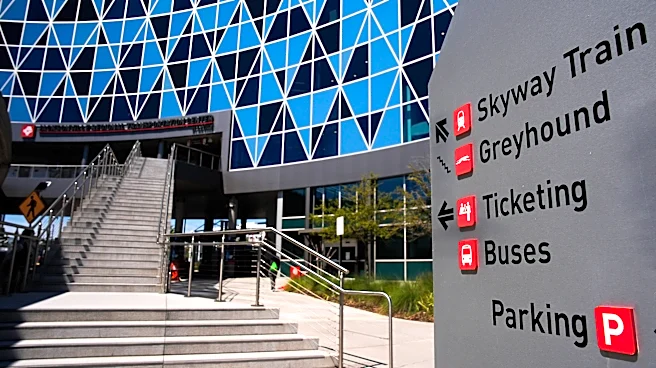
![A sign directs people to the Jacksonville Transportation Authority Skyway at the Rosa Parks Transit Station in downtown Jacksonville, Fla. Wednesday March 18, 2026. [Doug Engle/Florida Times-Union]](https://www.gannett-cdn.com/authoring/authoring-images/2026/03/18/NFTU/89218527007-jki-jacksonville-jta-skyway-014.JPG)
JTA Chief Financial Officer Randall Barnes, who joined JTA two months and a half months ago, said the spending outstripped revenue so much that JTA couldn't pay its vendors on time and was draining money out of its reserves.
"In very simple terms, we were spending a lot more than we were bringing in," Barnes told City Council members. "We used up all of our savings and then we stopped paying many of our bills on time."
After Barnes became CFO, JTA set up a line of credit with a bank to borrow $25 million and catch up on a backlog of unpaid invoices.
The next step toward stabilizing JTA will come Oct. 13 when City Council will vote on allowing the agency to use $30 million of the gas tax money it's collected in recent years to pay off that line of credit and cover other costs. JTA then would have until 2037 to replenish the gas tax money for its intended use of building transportation projects.
Four City Council committees voted in favor of the stopgap fix so it's almost certain to pass at the full council meeting.
"When you see a house on fire, you pour water on it," Transportation Committee Chair Ken Amaro said. "You don't let it burn."
Over the next two months, the City Council's Financial Audit and Oversight Committee will take the lead at City Hall in examining what caused the fire to start in the first place, why it spread as far as it did and what can be done to prevent it from ever happening again.
Big misses on financial projections fueled JTA crisis
City Council President Nick Howland said part of that review will be to find out why JTA has been so far off on the projections it has given in its reports to the City Council Auditor's Office.
Howland said JTA didn't show the full depth of the shortfalls until Barnes came onboard as chief financial officer.
"That's what started to send off red flags," Howland said.
Asked whether he thinks JTA had previously done a bad job with its financial forecasts or was trying to conceal the actual state of the agency's finances, Howland said he doesn't not know at this point.
"But we will find out and that's the purpose of this committee," he said.
JTA and the city's other independent agencies — JEA, JaxPort, the Jacksonville Aviation Authority and the Jacksonville Housing Authority — give reports every three months to the City Council Auditor's Office so it can see if an agency is under budget stress.
At the same time, JTA is an independent state agency that operates with its own board comprised of four members appointed by the governor and three by the mayor.
City Council Auditor Phillip Peterson said the auditor's office relies on projections submitted by the independent agencies because they have "direct access to the day-to-day financial information."
"We do not have access to their financial systems, which increases our reliance on the data they submit," Peterson said.
A July 30, 2025, report submitted by JTA for nine months of the 2025-26 fiscal year showed the agency expected to finish the year on Sept. 30, 2025 with a $3.9 million surplus.
The next quarterly report by JTA on Nov. 30, 2025 showed it actually ended the 12-month fiscal year at the end of September 2025 with a deficit of almost $19 million.
Peterson said it's unusual for quarterly reports to have such a big swing. He said if the information about the deficit spending during the 2024-25 fiscal year had come earlier, his office and City Council could have given more scrutiny to the assumptions JTA used in crafting the 2025-26 budget.
JTA racked up two straight years of red ink
JTA hit its mark for a balanced budget in the 2023-24 fiscal year when it had a $155.6 million budget and ended up spending $159 million. The higher spending was offset by more revenue than expected, resulting in a break-even budget with $111,000 surplus overall.
That was followed by two years of back-to-back budget busts that sent JTA into its financial crisis.
JTA had a $158.1 million budget for the 2024-25 fiscal year and spent $177 million, finishing the year almost $19 million in the hole.
The 2025-26 budget was $162.4 million and JTA was on track to finish the fiscal year with $176.8 million in spending, according to its most recent quarterly report to the City Council Auditor.
JTA also has been hit by revenue drops from the half-cent transportation sales tax that is its single biggest source of money. The combination of excessive spending and falling revenue put JTA on a course to finish the 2025-26 fiscal year with a deficit now pegged at about $37 million after the prior year had a $19 million deficit.
Barnes said he started work at JTA on July 20 knowing the agency faced financial challenges. He said he quickly discovered they ran deeper than he anticipated.
"Cash on hand was extremely low," he told City Council. "Reserves had been depleted."
The agency owed more than $20 million for unpaid invoices.
"Suppliers weren't being paid on time," Barnes said. "Understandably, many threatened to stop delivery or discontinue service."
JTA board frustrated by big swings in budget forecasts
The current fiscal year that started Oct. 1 uses a $139.2 million budget that JTA says is based on conservative estimates for sales taxes and other revenue.
To right-size spending with that revenue, JTA is in the midst of up to 200 layoffs and will be scaling back bus service by eliminating some lower-ridership routes. The Skyway in downtown will halt indefinitely on Nov. 1 and the Neighborhood Autonomous Vehicle Innovation transit shuttles will do the same after the end of December. JTA calls those "pauses" though there is no date for when they will resume.
The drastic cuts have given whiplash to JTA board members who have received a series of changing financial projections from JTA staff.
In February, the JTA board changed fares for the Connexion Plus service and made $14.2 million of cuts in spending that JTA said was needed to bring expenses in linewith a drop in projected sales tax collections.
"The adjustments made today, while difficult, are necessary to ensure we end this year with a balanced budget while preserving the transportation services that citizens of Northeast Florida rely on each and every day," CEO Nat Ford said on Feb. 26.
JTA's next report to the City Council Auditor's Office in May for the six-month point of the fiscal year showed JTA was projecting $2.3 million in deficits at the end of the year despite the cuts it had made.
But like the report given to the City Council Auditor's Office in summer 2025, that report vastly understated the scope of the deficit.
After Barnes joined JTA, he submitted an Aug. 14 report to the City Council Auditor's Office that showed JTA was heading toward a $31.8 million deficit for the fiscal year. (Subsequent presentations to City Council put it at about $37 million.)
The JTA board had already passed a 2025-26 budget in May in order to send it in June to City Hall. The timing of that budget approval and submission requires JTA to use financial information available at the time for revenue projections and spending levels.
When the City Council Finance Committee took up JTA's proposed 2026-27 budget on Aug. 21 and the City Council Auditor's Office weighed in on it, Peterson cast doubt on whether JTA really had come to grip with the reality of its financial situation.
"I have to say you did it calmly, Phillip, but that was probably the most pessimistic I've ever seen you deliver a budget report," Howland told Peterson.
The JTA board then had an in-depth discussion at an Aug. 26 board retreat. After promoting Cleveland Ferguson as interim CEO to replace Ford, who had been hired to run DART in Dallas, the board directed Ferguson to work with Barnes on a plan to decisively fix the state of the authority.
JTA board member Daniel Vallencourt said at the Sept. 23 board meeting the agency still must get a full accounting of what went wrong and ensure board members get better data for informed decision-making.
"I need real-time numbers," Vallencout said. "I can't have March is one thing and April is another and all of a sudden in August it's completely different."
JTA plans to hire a firm that will do an independent forensic audit for an accounting of what went wrong. Barnes said going forward, JTA has put controls in place to ensure spending does not happen unless the budget as money to cover it.
This article originally appeared on Florida Times-Union: Bad financial projections and overspending doomed JTA budget from start