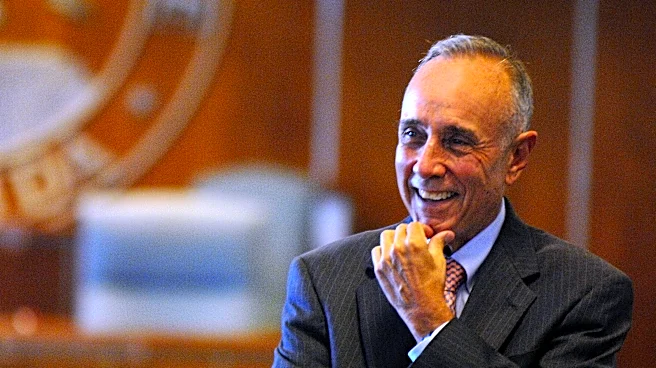






Harry Shorstein, who was Jacksonville’s top prosecutor for 17 years and the city’s onetime general counsel, has died at age 86.
A Marine combat veteran who gained national attention for his efforts to curb juvenile crime partly through rehabilitation, he was also credited with stopping an ill-conceived plan to build floating nuclear power plants in the St. Johns River.
“Harry’s life was marked by extraordinary service to his country and our city,” State Attorney Melissa Nelson said in comments released after Mr. Shorstein’s death was announced October 23.
“He was an excellent state attorney who demonstrated integrity and professionalism and he was an exceptional trial lawyer,” Nelson said. “His legacy of ‘do the right thing’ will endure at the State
Attorney’s Office. We have lost a distinguished public servant and I — and so many others — have lost a valued friend.”
Mayor Donna Deegan tweeted that Mr. Shorstein "was an example to all of us through his many decades of public service ... He believed deeply in delivering justice but also in second chances, a mission that is emblematic of his focus on working with at-risk youth. His wisdom and heart will be missed, but it is carried on through the many people he mentored who are now leading our city today."
Raised in Riverside, Mr. Shorstein graduated from Robert E. Lee High School, later renamed Riverside High, and earned undergraduate and law degrees at the University of Florida.
He enlisted in the Marine Corps after finishing college in 1965 and was eventually posted to a legal unit in the Third Marine Division that operated in battlefield settings during the Vietnam War.
In February 1968, he was a captain sent to work a court martial during the siege of Khe Sanh, a months-long North Vietnamese offensive that killed hundreds of American troops and wounded thousands. After the court martial convicted a soldier of sleeping on post, Mr. Shorstein remained at Khe Sanh during the heaviest shelling of the siege, when more than 1,300 rounds landed in an eight-hour stretch and 10 Marines were killed, according to a book the Marine Corps published in 1989 on military law in the war.
“During the lulls [in shelling] we all filled sandbags and reinforced our positions,” Mr. Shorstein recalled in that volume. He earned honors including the Bronze Star and the Vietnamese Cross of Gallantry before ending his time in the Marines.
Returning to Jacksonville, he worked in the Public Defender’s Office and joined the State Attorney’s Office in the early 1970s, becoming a division head and handling scores of prosecutions and a series of murder trials.
At the age of 33, Mr. Shorstein was picked in 1974 to be Jacksonville’s general counsel, the youngest person to hold the weighty role as top lawyer for the consolidated city-county government.
In that role, he quickly became a crucial obstacle to a plan by business leaders including directors of the JEA and Jacksonville Port Authority to service a business called Offshore Power Systems that intended to build locally nuclear plants that would operate floating at sea but, according to a 1978 report to Congress, carried risks of a core meltdown six to 30 times greater than a land-based nuclear plant.
Raising liability risks for the city, Mr. Shorstein issued a report saying the project was "contrary to the public interest" and could bankrupt the city, making those involved personally accountable. That stalled progress and the dramatic deal soon fell apart.
Mr. Shorstein moved into private legal practice later in the 1970s but returned to the State Attorney’s Office after Ed Austin left the top prosecutor’s post to become Jacksonville’s mayor in 1991.
Appointed by then-Gov. Lawton Chiles to lead the State Attorney’s Office until the next election, Mr. Shorstein won four additional four-year terms that kept him in office through 2008.
Mr. Shorstein’s career as a prosecutor included terms included landing high-profile convictions for defendants including George Loeb, a white supremacist who killed a Black sailor after an encounter outside a Beaches supermarket, and Josh Phillips, who as a teenager killed 8-year-old neighbor Maddie Clifton.
But a focus on preventing juvenile crime became as much a part of his biography as any trial. Shorstein emphasized efforts to rehabilitate youngster before they became established criminals, saying it was financially smarter to prevent crimes than layer punishment on offenders after the fact.
"I don't have any problems putting people away," he told a reporter as his last term neared its end. "We just can't afford it."
He returned to private practice after deciding not to seek another four-year term, and in 2010 was named Jacksonville's best white-collar defense lawyer by U.S. News & World Report. He was a finalist for a federal appointment to be U.S. attorney for Florida's Middle District in 2009 but was passed over.
More recently, his law license had fallen inactive, according to a Florida Bar database.
No plans for services to mark his passing were immediately announced.
This article originally appeared on Florida Times-Union: Jacksonville leaders mourn former State Attorney Harry Shorstein