


Do it again, Jacksonville Jaguars defense.
Finish second (or better) in takeaways and first in rush defense again.
Among the many revelations about the Jaguars last year (4-13 to 13-4, coach Liam Coen as an overnight sensation and quarterback Trevor Lawrence finishing fifth in the MVP voting), the defensive turnaround ranked high on the list.
Led by coordinator Anthony Campanile, the Jaguars improved in points allowed (27th to eighth), yards (31st to 11th), rushing (25th to first), passing (last to 21st) and takeaways (fewest to second-most).
Entering the Sept. 13 season opener against the Cleveland Browns, the Jaguars’ defense will have the same coordinator for only the second time in six years and return 11 of last year’s top 15 players in snaps
played. There is scheme comfort and personnel continuity.
Opposing offenses poured over the Jaguars’ video during the offseason, looking for holes to poke through. But so has Campanile and his staff about those same offenses. Time to start the chess matches.
Takeaways down, sacks up?
The Jaguars’ 31 takeaways in last year’s regular season ranked second in the NFL behind Chicago (33). Campanile’s group was opportunistic in the secondary, feasting on quarterbacks forced to throw because the Jaguars had a commanding lead; the Jaguars had only 12 first-half takeaways.
But matching or exceeding 33 this year? The history isn’t just kind, it’s downright depressing.
Since 2015, 33 teams have posted a season of at least 30 takeaways.
- Only one team (Buffalo in 2024) increased its takeaway total (30 to 32).
- Only three teams — Minnesota (2020) and Dallas/New England (2022) — moved up/stayed first in the takeaway standings. Minnesota moved from fourth to first with two fewer takeaways (31 to 29), Dallas repeated as the takeaway champion with one fewer (34 to 33) and New England matched its total of 30 and moved from fourth to tied for second.
- Only three teams — Dallas/New England (2022) and Buffalo (2024) — reached at least 30 takeaways the following year.
- And only nine teams remained in the top five of takeaways the following year.
In 2017, the Jaguars had 33 takeaways (second), but sunk to 17 (tied for 22nd) in 2018.
Among the biggest declines in the standings were the New York Jets (third to tied for 28th in 2015-16), the Raiders (second to tied for 30th in 2016-17), Detroit (third to 31st in 2017-18) and the New York Giants (tied for first to 28th in 2023-24).
![Jacksonville Jaguars safety Antonio Johnson (26) reacts to his tackle during the first quarter of an NFL football matchup at EverBank Stadium, Sunday, Jan. 4, 2026, in Jacksonville, Fla. The Jaguars defeated the Titans 41-7, capturing the AFC South title. [Corey Perrine/Florida Times-Union]](https://www.gannett-cdn.com/authoring/authoring-images/2026/01/08/NFTU/88090100007-nfl-tennesee-titans-2026-jacksonville-jaguars-134.JPG)
The Jaguars won’t say it, but the way they want to play defense this year, they are almost conceding a downturn in takeaways.
“A big thing we’ve been working on has been challenging (receivers) a little bit more and eliminating some of the easy completions that might have hurt us at times last year,” Coen said. “If you play a little bit more (man) coverage, your eyes are on the receiver, not the quarterback, and that’s always the balance. It’s like, ‘Do you want to get more sacks and ball production in terms of challenging routes or do you want to sit there in a zone and get picked apart, but you’re going to get some turnovers?’ That’s something we’ve been working through.”
So basically, if the Jaguars emphasize more man coverage, it will result in fewer takeaways, but more sacks. Hey, they might even get a strip-sack-takeaway this year.
The Jaguars’ 32 sacks last year ranked 27th in the NFL, but according to Next Gen Stats, their 234 “pressures” ranked eighth; my charting credited the Jaguars with 233 “disruptions” (32 sacks, 56 knockdowns and 142 pressures) in 17 games. Opposing quarterbacks had an average time to throw of 2.74 seconds against the Jaguars, second-quickest in the league.
But the Jaguars know they need more from up front, which will require more from the back end.
“We have to make the quarterback hold it for another click and being a little stickier in coverage on some of those and not giving the quarterback an opportunity to get rid of the ball when the pressure does come,” Campanile told The Times-Union.
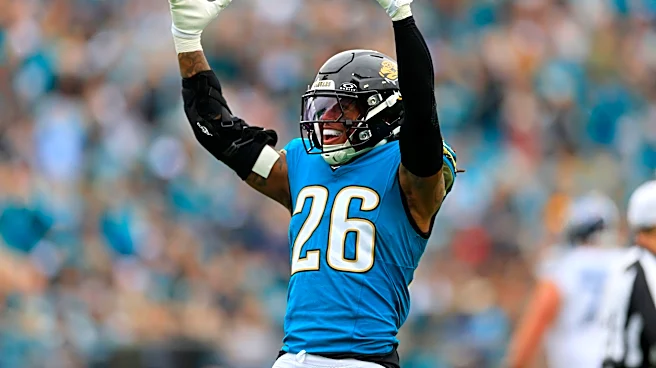
Gone from the secondary is cornerback Greg Newsome and safety Andrew Wingard. The Jaguars get cornerback Travis Hunter (right knee) back and should have confidence in six defensive backs: Hunter and cornerbacks Buster Brown, Jourdan Lewis and Jarrian Jones and safeties Eric Murray and Antonio Johnson.
“I think we’re going to be better in the secondary in ways I believe will help the rush,” Coen said.
Repeating as No. 1 run defense
The positive about playing with the lead during their eight-game winning streak to finish the regular season? Opponents became one-dimensional.
Last year, the Jaguars allowed only 85.6 rushing yards per game (first), 3.9 yards per carry (tied for second) and 34 carries of at least 10 yards (third-fewest). Opponents had 369 rush attempts, fewest in the league by 27 rushes.
In the last decade, only one team (Tampa Bay 2015-16) has finished first in rush defense in consecutive years; the Buccaneers allowed 73.8 and 80.6 yards per game.
![Jacksonville Jaguars Defensive Tackle DaVon Hamilton (52) runs drills during the Jacksonville Jaguars 14th session of NFL Training Camp at the Miller Electric Center in Jacksonville, Fla., Monday, August 17, 2026. [Doug Engle/Florida Times-Union]](https://www.gannett-cdn.com/authoring/authoring-images/2026/08/17/NFTU/91336017007-jaguars-training-day-14-019.JPG)
Overall, seven rush defense champions have stayed in the top 10 the following year, but none gave up fewer rushing yards per game.
The last 10 top rush defenses finished seventh, eighth, seventh, ninth, first, third, third, 13th, 28th and 10th the following year.
Last year, Baltimore gave up 26.5 more rushing yards per game compared to 2024 (80.1-106.6). In 2024, Chicago gave up, wow, 50.5 more rushing yards per game compared to 2023 (86.4-136.3). Don’t expect the Jaguars to have that steep of a decline in rush defense efficiency.
“There are certain teams who have an identity and what we want to be known has is a run-stopping defense,” defensive line coach Matt Edwards said.
Rush defense starts on first-and-10 and “winning” the down (gain of four or fewer yards). In 18 games, including the playoffs, last year, the Jaguars faced 158 first-and-10 run plays according to my charting. They allowed only nine explosive rushes (gain of at least 12 yards), had 34 “stuffs” (gain of one or fewer yards). And they allowed 52 rushes of at least five yards.
“We’re attacking and we strike the man across from us,” was how defensive tackle Matt Dickerson summed up the Jaguars’ rush defense approach.
Sounds about right, doesn’t it? Beat the man in front of you. Get up the field.
“Technique, technique, technique,” said linebackers coach Tem Lukabu, tapping his pen on the conference table in front of him for emphasis. “And then embrace the physicality and having a source of pride that nobody runs the ball on us. It starts with Liam and (Campanile). They talk about it, we plan for it and we drill it in practice. It’s about emphasizing the things we did last year: Eyes, feet, hands and a violent finish.”
The Jaguars didn’t try to re-create the defensive wheel; they didn’t need to. They have a sound scheme. If they stay among the top five in rush defense and increase their sack total, they will repeat as AFC South champions.
Contact O’Halloran at rohalloran@gannett.com or on X at @ryanohalloran. Listen to Ryan on 1010AM on Tuesdays (6:35 p.m. on “Into The Night"), Thursdays (1:15 on "XL Primetime") and Fridays (4-7 p.m. on "First Coast Football Friday").
This article originally appeared on Florida Times-Union: Task for Jaguars' defense: Match, improve last year's numbers