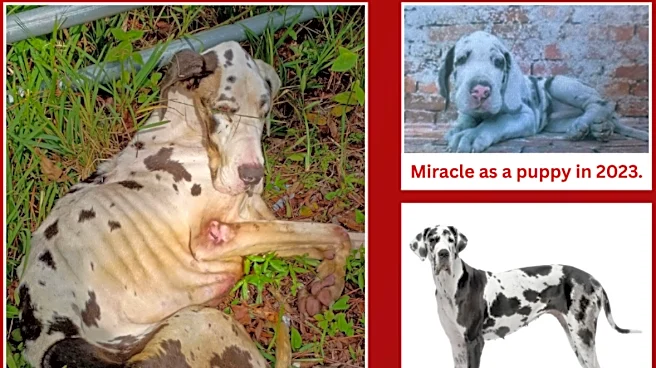




About 210 people submitted letters to Judge Tatiana Salvador urging a maximum sentence for the 43-year-old Jacksonville woman who neglected and abandoned a Great Dane reduced to 52 pounds. He was found on the side of a road barely alive and did not survive efforts to save his life.
With a financial contribution from the woman who found the dog, First Coast Crime Stoppers offered an enhanced reward of $8,000 for information leading to an arrest. A few days later Dawn Lipford was arrested and charged with aggravated animal cruelty. She pleaded guilty on July 15.
On Wednesday, Sept. 30, the letters and arguments weren't enough to convince Salvador to sentence her to the maximum five years in prison or any incarceration time, instead giving her five years of
probation. She must also register with the state's new animal abuse registry, perform 300 hours of community service but not anything animal-related, undergo a mental health evaluation and cannot own any pets during her probation.
Lipford testified on her own behalf and was asked about her three children, two of whom had disabilities due to health issues. She also discussed her own multiple health and financial issues. Multiple times she was asked about how often the dog was fed, and she repeatedly said twice a day and never withheld food.
She said when the dog's condition began to deteriorate, she sought help from vets and was told he was experiencing something common in Great Danes called "failure to thrive" and he would eventually need to be euthanized. She said she also tried to find another home for him but was unable to and couldn't afford the cost of having him put down.
After an emergency hospital stay, she said she decided to do what she did and that she regrets it.
“At that time I felt my back was against the wall," Lipford said. She denied several times that she starved the dog and said she took him with her daughter to 45th Street so somebody would see and help him.
Daughter Talia Lipford appeared more remorseful although also said the dog was fed every day.
“I loved him and I didn’t want him to be by himself. No dog should be left on the side of the road,” she said crying.
What happened to Miracle, real name Oakleaf, the Great Dane?
The dog, named Miracle by Animal Care and Protective Services and described as a "gentle giant" by the woman who found him off Moncrief Road and 45th Street on Nov. 2, 2025, had a microchip that led investigators to the Puppy Galore and More pet store on Blanding Boulevard, according to the arrest report.
Staff there said the dog’s date of birth was Jan. 1, 2023, and he was purchased by Lipford on March 4 of that year, per the report. An animal care officer then spoke with Lipford's daughter who said her mother was in a hospital. She said her mother recently re-homed the Great Dane, named Oakleaf, a couple of months prior and said he was in appropriate condition at the time. She did not have any contact information for where the dog was sent.
The report then noted the "investigation determined the witness provided fabricated statements at the direction of the suspect."

Another woman contacted Animal Care and Protective Services tipline saying she was helping facilitate the re-homing of Oakleaf but that the transfer never took place, according to the report.
Additionally at Crime Stoppers tipster confirmed that Lipford had the dog the whole time and "concocted a lie to tell ACPS and police. The person said Lipford drove Oakleaf to where he found and made her daughter get him out and leave him there. They drove far away from where they live off Townsend Road to distance themselves from being linked.
"The suspect is also known to abuse Oakleaf by striking him, leaving him in a crate all day and constantly pouring cold water on him," the tipster said in the report. "The suspect also fed Oakleaf Oreos and chocolate wishing he would die."
The daughter was then contacted again and advised that while she was at work, her mother was there all day with the dog.
"Furthermore, the witness advised that when she would get home from work, she would attempt to feed the dog because she knew that the suspect would not," according to the report. "She further stated the suspect dumped Oakleaf because he was getting sick and knew he was about to die."
What do Dawn Lipford's supporters say in her defense?

While the community and animal rights advocates churned out letters denouncing Lipford, eight people wrote on her behalf in the court records.
A cousin wrote that she just reached a low point but it shouldn’t define her. She also had three children, including one special needs, to take care of and elderly father.
An aunt wrote that in addition to caring for her family, Lipford faces significant health challenges of her own. She suffers from Lupus, a serious autoimmune disease that affects her daily life.
"Even white managing her illness, she continues to care for her children and father with strength, determination, and love," the aunt wrote. "I have also visited Dawn's home on several occasions and personally observed the care and affection she showed toward her dog, Oak, who is now known as Miracle. I witnessed her regularly playing with him, talking to him, and treating him as a cherished member of her family. Oak was always a happy and well-loved dog in her care."
"When Oak was returned to Dawn's residence after being re-homed, he was left unattended at her door and was not the same dog she had known before," the aunt continued. "Dawn immediately noticed that he was not eating or drinking and that his condition had significantly declined."
She said Lipford did her best to improve his condition.
"Unfortunately, due to her limited financial resources, her own medical condition, and the short amount of time she had to respond to his declining health, she was unable to obtain all of the assistance that was needed in time," the aunt wrote. "I firmly believe that her actions were never motivated by neglect or cruelty, but rather that she was overwhelmed by multiple difficult circumstances occurring at once while still trying to do her best for everyone who depended on her."
Harsher penalties for animal abusers
Coincidentally a new state animal welfare law goes into effect Oct. 1 increasing the penalties for animal abusers.
- What it does: Creates new third-degree felony offenses for adults who encourage or force minors to commit serious animal abuse or who commit certain animal cruelty crimes in front of minors. It also increases penalties for some animal cruelty offenses, requires psychological evaluations for minors convicted of animal cruelty, expands the information published in the state's animal cruelty database, and raises the maximum civil fines for animal cruelty violations.
- What it means:
- Certain animal cruelty crimes are now ranked more severely when it comes time to sentence the offender:
- Committing certain animal cruelty crimes in the presence of a minor, or enticing them to do so, is a third-degree felony punishable by up to five years in jail and/or a fine of up to $5,000
- Fighting or baiting animals is raised from a Level 1 to a Level 5 offense, and doing it in the presence of a minor (or causing a minor to do it) is now a Level 6 offense
- Aggravated animal cruelty in the presence of a minor (or causing or enticing them to do it) is a Level 6 offense
- Sexual activities involving animals in the presence of a minor (or causing or enticing them to do it) is a Level 6 offense
- Juvenile courts are now required to order a minor who commits an animal cruelty offense to undergo a psychological evaluation and, if recommended, receive specified counseling or treatment at the parents' or guardians' expense, with exemptions for financial hardship
- The state's online animal cruelty database must now include all aliases, date of birth, race, county of conviction, charge or charges, case number, disposition, description of any identifying marks and tattoos, and a photograph taken at the time of booking, to be posted for three years for a first misdemeanor conviction, five years for a first felony conviction, and 10 years for any subsequent conviction. The law also requires the FDLE to develop a procedure for people in certain circumstances to petition to have their information removed.
- The maximum civil penalty a county or municipality may enact for specified animal control or animal cruelty ordinances is increased from $500 to $2,500 for a first violation, $5,000 for a second violation, and $7,500 for a third or subsequent violation
- Certain animal cruelty crimes are now ranked more severely when it comes time to sentence the offender:
In addition, last year state lawmakers passed Dexter's Law, which required the Florida Department of Law Enforcement to set up a public database of convicted animal cruelty offenders in the state to allow pet sellers and rescue organizations to screen applicants before they hand over a pet to a former animal abuser. It went online Jan. 1, but only included offender names.
Starting Oct. 1, that database is expanding.
HB 559, passed this year, requires law enforcement to add a few more details, including the abuser's date of birth, mugshot, and the case number and description of their charges, among other identifying information.
C.A. Bridges of USA TODAY Network contributed to this report.
Scott Butler has been an editor/reporter specializing in public safety coverage for 26 years with The Florida Times-Union. He can be reached at sbutler@jacksonville.com.
This article originally appeared on Florida Times-Union: Woman who abandoned dying Great Dane is spared any jail time