




Much of Northeast Florida has experienced about a year of below-average rainfall, according to the St. Johns River Water Management District.
While recent rainfall has improved conditions in some areas, long-term dry conditions persist and continue to affect groundwater levels, rivers, lakes and wetlands, the agency said in a Sept. 3 news release.
Groundwater levels in some areas began declining in fall 2025 due to a shift to below-normal rainfall patterns, and the deficits have continued to accumulate, leading to current drought conditions.
"September marks approximately one year since rainfall began trending below normal across portions of the District," said Clay Coarsey, District Director of the Division of Water Supply Planning and Assessment.
"The conditions we're managing today are the result of deficits that have accumulated over many months. While recent rainfall has been beneficial, recovery takes time, and continued water conservation remains important as our water resources respond."
The deficit in some areas is massive

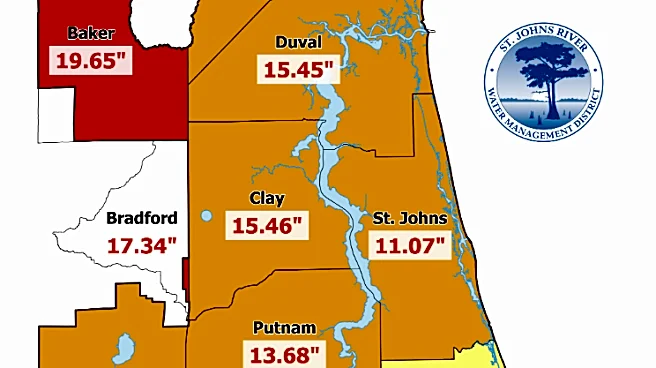
As of late August, some of the largest 12-month rainfall deficits in the area are in Duval, Clay, Bradford and Baker counties. Here are the numbers:
- Duval County: 15.45 inch rainfall deficit
- Clay County: 15.46 inch rainfall deficit
- Bradford County: 17.34 inch rainfall deficit
- Baker County: 19.65 inch rainfall deficit
Although these deficits represent the departure from the normal amount of rainfall these counties receive in a 12-month period, the amount of rainfall needed to fully recover from drought conditions is typically much more.
St. Johns River Water Management District hydrologists estimate that about 3 feet of rainfall may be needed across portions of the affected areas over the next three months to fully restore groundwater levels, replenish surface waters and recover from the impacts of the drought.
"A rainfall deficit is essentially a measure of how much rain an area received compared to what is considered normal," Coarsey said. "Drought recovery is different because not every inch of rainfall directly replenishes our water resources."
Not all rainfall reaches aquifers
According to the agency, Florida's rainy season plays a crucial role in replenishing water resources, but drought recovery depends on more than rainfall totals alone. Water must move through the hydrologic system before it can help replenish groundwater supplies and other resources affected by long-term dry conditions.
When it rains, some is absorbed by dry soil, some is used by vegetation and some is lost through evaporation. Only a portion reaches groundwater aquifers. As a result, recovering from a prolonged drought typically requires substantially more rainfall than the measured rainfall deficit alone.
Water restrictions remain in effect
The district's Phase III Extreme Water Shortage declaration remains in effect within affected areas as staff continues monitoring rainfall, groundwater levels, spring flows and other drought indicators.
Mandatory restrictions remain in place, including:
- Residential and commercial properties are limited to one day per week of landscape irrigation.
- Landscape irrigation is prohibited between 8 a.m. and 6 p.m. daily.
- Commercial and industrial users must suspend certain nonessential water uses.
- Golf course fairway irrigation is limited to one day per week.
- Aesthetic water use, such as decorative fountains, is prohibited.
- Street and pressure washing activities face additional restrictions.
- Irrigation restrictions for new plantings, including sod, have been tightened.
District staff will continue evaluating hydrologic conditions and determining when water shortage restrictions can be modified or removed. Until then, conservation remains a key tool for supporting water resource recovery throughout the region.
Check your irrigation systems

Outdoor irrigation continues to be one of the largest uses of potable water, according to the St. Johns River Water Management District. Residents are asked to check that irrigation timers are set correctly to ensure irrigation occurs only on their designated watering day and during allowable hours. Irrigation systems should also be checked for leaks, and sprinklers should water only landscaped areas, not streets, sidewalks or driveways.
Residents may occasionally see irrigation systems operating in public spaces such as parks, medians and common areas during the water shortage. In many cases, these systems use reclaimed water, which is a highly treated recycled water source that helps reduce demand on potable groundwater supplies. While conservation remains important across all water sources, some reclaimed water systems must continue operating to maintain system function or manage storage capacity.
This story was created by Gary Mills, gmills@jacksonville.com, with the assistance of Artificial Intelligence (AI). Journalists were involved in every step of the information gathering, review, editing and publishing process. Learn more at cm.usatoday.com/ethical-conduct.
This article originally appeared on Florida Times-Union: Why Northeast Florida may need 3 feet of rain to recover