

A growing number of Jacksonville City Council members say it's time to reopen an agreement struck in 2021 that commits $247 million in local gas tax money foroverhauling the downtown Skyway's elevated structure so self-driving transit shuttles can travel on it.
If a review of the agreement between the city and the Jacksonville Transportation Authority ends up shifting some or all of the $247 million to other purposes, it would deal a blow to expanding the NAVI system that started last year along east Bay Street and has been slow to attract passengers.
City Council member Rory Diamond said based on his talks with JTA board members and feedback from City Council members, he thinks JTA and the city would be willing to renegotiate the contract that
can only be changed by mutual agreement.
"It's not going to be fun," Diamond said Aug. 21 during a meeting of the City Council Finance Committee. "It might get a little rodeo-crazy, but I think at the end of the day we'll have a better product than what we locked into from 2021."
The $247 million for converting the elevated Skyway structure so rubber-tired autonomous transit shuttles can run on it is the single biggest item in a list of 17 projects the city authorized JTA to carry out using proceeds from doubling the local gas tax.
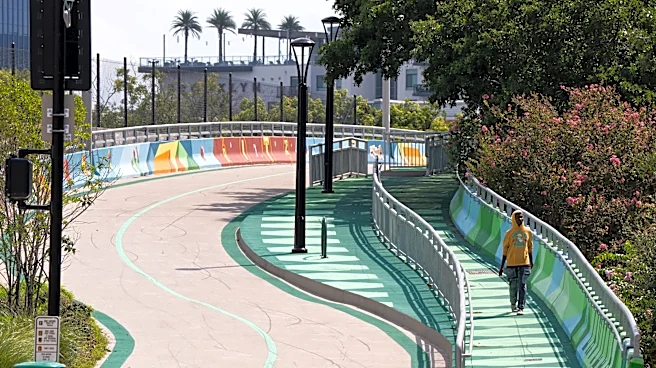
The next-biggest item is $132 million for the Emerald Trail networkthat will connect neighborhoods with 30 miles of paths for walking and bicycling from downtown into surrounding areas.
Mayor Deegan "in full support of the Emerald Trail"
Mayor Donna Deegan is open to taking another look at the 2021 agreement but not in favor of pulling back on construction of the Emerald Trail network, city spokesman Phillip Perry said.
"As we all work in partnership with JTA on next steps, every option should be on the table," Perry said. "At the same time, we must be aware of unintended consequences that could arise, and Emerald Trail funding must be protected. Mayor Deegan continues to be in full support of the Emerald Trail as an economic development driver and a catalyst for previously disinvested neighborhoods."
![A pedestrian walk along the Emerald Trail mural on Park Street near Prime Osborn Convention Center Wednesday August 27, 2025.[Doug Engle/Florida Times-Union]](https://www.gannett-cdn.com/authoring/authoring-images/2025/09/04/NFTU/85972339007-jki-090225-murals-jacksonvilledowntown-008.JPG)
JTA spokeswoman Lynn Opperman said any decision on the interlocal agreement would be made by the JTA board in tandem with the next CEO who replaces Nat Ford, the outgoing head of JTA who has championed autonomous transit.
"Any potential reopening of the interlocal agreement would require careful review and analysis," she said. "Ultimately, that is a decision that would need to be considered by the JTA board of directors in consultation with the authority’s next CEO and in coordination and partnership with the City."
Council President Howland explores process for chaning gas tax list
City Council President Nick Howlandsaid he will talk with Office of General Counsel attorneys about whether City Council can reopen the agreement's list of projects. He said if that can happen, one option might be to use the council's Financial Audit and Oversight Select Committee to "take a deep dive on it."
Howland said there "definitely was a consensus among the Finance Committee" to reconsider the agreement.
Finance Committee Chair Will Lahnen said he's on board with making changes in the projects so they are spread out across the city.
"I'll do whatever I can to help a reprioritization of that project list because I think there is the appetite," he said during the budget hearing.

City Council member Mike Gay noted JTA plans to end some bus routes and increase waiting time on other routes in order to close a shortfall. He said shoring up those services should be the focus of JTA rather than expanding the blue-colored NAVI shuttles to the Skyway structure.
"What I'm seeing is we're changing what's always been done," Gay said of reductions in regular bus service. "We're not changing the pipe dreams of NAVI."
Diamond says JTA finances "an absolute nightmare"
The Finance Committee discussed the agreement with JTA while examining the agency's proposed 2026-27 budget that has $139 million for operating costs, which is 14% less than this year's original budget. To get current spending in line with a sharp drop in sales tax revenue and other financial stresses, the agency has used layoffs and furloughs to cut costs.
JTA also executed a line of credit to borrow up to $30 million for operating expenses and $10 million for capital expenses so it can pay bills because its cash reserves have dropped so much.
"The JTA budget is an absolute nightmare," Diamond said after the Finance Committee meeting. "They're basically out of money and that is unacceptable. We've got to to fix it."
He said one way to get JTA's financial house in order is to redirect gas tax money away from projects like converting the Skyway and use it instead for JTA's basic services.
JTA is in the midst of a study on the future of the Skywaythat is slated for a second round of public meetings in September.
In addition to rebuilding the Skyway for the the NAVI shuttles, other options are making it an elevated trail for walking and bicycling, rehabilitating the existing Skway trains, replacing them with larger trains resembling the current vehicles, demolishing the structure and running street-level autonomous shuttles throughout downtown, or doing nothing and shutting down the Skyway after the current vehicles wear out.
JTA has not yet provided cost estimates for the various options.

The NAVI shuttles on the Bay Street loop recently completed their first year of operation by providing 15,234 trips since service began on June 30, 2025. The operations and maintenance cost for NAVI in the current fiscal year is $10.8 million so that equates to $709 per passenger trip.
JTA recently renegotiated the contract for the the operating and maintenance of the NAVI system. The forecasted cost for the next fiscal year is $5.8 million so if ridership stays at the same level it would translate to $380 per passenger trip.
Nat Ford's departure from JTA removes NAVI champion from debate
The JTA board intends to picks someone from within JTA this month to be interim CEOand then launch a national search for a permanent CEO.
Employees who applied by the Aug. 14 deadline for the interim CEO job are Executive Vice President and Chief Administrative Officer Cleveland Ferguson, Senior Vice President and Chief Operating Officer Jeff Smith and Senior Vice President and Chief Infrastructure and Development Officer Greer Gillis.
Also applying are JTA administrator Richard Clark, who served on the Jacksonville City Council from 2005 to 2015, Controller Russell Caffey, and former chief financial officer Raj Srinath.
JTA could hire a permanent CEO by the end of the year replacing Ford who is moving on to become CEO of Dallas Area Rapid Transit.
![Jacksonville Transportation Authority CEO Nat Ford talks about how the nation's first autonomous vehicle service called NAVI, which is short for Neighborhood Autonomous Vehicle Innovation, is ready to launch, Friday June 27, 2025. The launch will take place on Monday June 30, 2025. [Doug Engle/Florida Times-Union]](https://www.gannett-cdn.com/authoring/authoring-images/2025/06/27/NFTU/84392754007-jki-autonomousvehicleride-jacksonville-navi-004.JPG)
Ford worked with then-mayor Lenny Curry and City Council in 2021 to forge a long list of more than $900 million of road, transit and drainage projects financed by the local gas tax. JTA initially sought $379 million to convert the Skyway for autonomous transit shuttles and also extend those shuttle routes into surrounding neighborhoods.
City Council reduced JTA's request by $132 million and put that money instead into construction of the Emerald Trail network, leaving $247 million for the Skway conversion in downtown.
Diamond, who voted against the local gas tax increase, said Ford's impending departure has opened the way to reconsidering the gas tax list. Ford was the driving force behind JTA becoming the first transit agency in the nation to have autonomous transit shuttles as part of its regular fare-paying system.
"I don't get any pleasure in saying this, but with Nat Ford leaving, there isn't a face to this anymore that people are afraid to criticize," Diamond said. "People like Nat. They didn't want to criticize him. They'd hope he was right about all this. Now that's he's leaving, they can see the facts for themselves without all the politics in the way."
This article originally appeared on Florida Times-Union: Support grows for possible cut to $247 million for Skyway conversion