





Jacksonville is considering a “road diet” for Riverside Avenue through the Brooklyn neighborhood, aiming to reduce vehicular travel lanes to four and convert the outside lanes to on-street parking between the Acosta Bridge ramps and Forest Street.
The approach would mainly involve painting boundaries that mark out fewer lanes for automobiles, with an estimated cost of about $100,000. A traffic study cited by the city found evening commutes could see slight increases in travel time, but overall traffic grades would remain the same. Supporters say the change could make it easier for pedestrians and bicyclists to reach the riverwalk and the Emerald Trail in the Brooklyn area, which has added apartments and retail in recent years, including a Whole
Foods store.
Here are six things to know about the planned Riverside Avenue road diet.
What would change on Riverside Avenue?
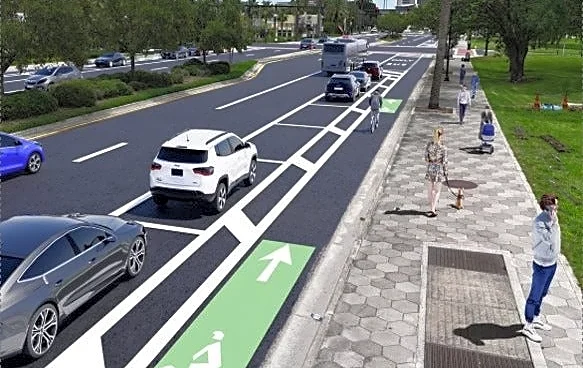
The proposal would convert the outside lanes of Riverside Avenue to on-street parking from the Acosta Bridge ramps to Forest Street, leaving four lanes for motorists.
The existing bicycle lane would run between the new on-street parking and the sidewalk, adding separation for people on bikes.
According to city materials, the estimated cost for the Riverside segment is about $100,000.
How is this different from Park Street?
A 2017 Downtown Investment Authority study examined road diets on Riverside Avenue, Forest Street and Park Street. Only Park Street advanced to construction, shifting from four lanes to two with wider sidewalks and a bikeway at a cost of nearly $11 million, per firstcoastnews.com.
By contrast, proposed changes on Riverside Avenue would largely involve restriping and reconfiguring space, keeping four travel lanes and adding on-street parking, which the city says would keep costs down.
What would it mean for Riverside Avenue traffic?
A traffic study found “slight increases” in evening travel times for drivers on Riverside Avenue if the road diet moves forward.
Even with the change, the study shows the corridor would maintain a level of service “A” in the morning rush and “B” in the evening.
Why now? Connectivity and neighborhood growth in Brooklyn
City Council member Jimmy Peluso, who represents Brooklyn, said the goal is to give pedestrians and cyclists better links to the riverwalk, McCoys Creek and the Emerald Trail network.
"This is a city where the sun is out almost 330 days a year," he said. "We should want to entice people to be outside. We should want people to go on the riverwalk. We should want people to be on the Emerald Trail, and this will help connect people to do that.
Brooklyn is downtown’s fastest-growing neighborhood, and residents have called for easier crossings along Riverside Avenue to reach the riverfront and new retail such as Whole Foods.
How does this fit into the bigger picture?
Elsewhere nearby, the city is also considering low-cost reconfigurations: Forest Street would add on-street parking and a new crosswalk at Magnolia Street, and West Monroe Street in LaVilla could convert from a one-way, three-lane road to a two-way, two-lane street with bike lanes.
According to a city presentation, each corridor — Riverside Avenue, Forest Street and West Monroe Street — is estimated at about $100,000.
Who’s in charge, and how is FDOT involved?
The city owns the portions of Riverside Avenue and Forest Street under review and would decide on changes there.
The Florida Department of Transportation is coordinating with the city to assess any effects on state roads, including the Acosta Bridge. "Based on information currently available, the proposed project is not expected to have a significant impact on operations of the state highway system, including the Acosta Bridge," state Department of Transportation spokesman Hampton Ray said.
This story was created by Gary Mills, gmills@jacksonville.com, with the assistance of Artificial Intelligence (AI), based on original reporting by Times-Union reporter David Bauerlein. Journalists were involved in every step of the information gathering, review, editing and publishing process. Learn more at cm.usatoday.com/ethical-conduct.
This article originally appeared on Florida Times-Union: How Riverside Avenue could change under a 'road diet'