



On the morning of Sept. 11, 2001, Jason McCarthy was living in a cheap apartment in Daytona.
He had graduated from college that spring and didn’t really have a plan for what he wanted to do next. He and a buddy backpacked through Central America. He came back home to Jacksonville, needing a job, and eventually found one at a marketing call center near the Daytona International Speedway.
He woke up that Tuesday morning, turned on the TV, and saw the news report of a plane flying into the north tower of the World Trade Center.
His first reaction was that maybe it was pilot error. He remembered when John F. Kennedy Jr.’s plane had crashed into the Atlantic Ocean. He figured
this was probably something along those lines, only much more tragic because this time a large jet had crashed into one of the tallest buildings in America.
Then he watched as a second plane, another Boeing 767, traveling even faster than the first, slammed into the second tower.
And he knew this wasn’t pilot error.
He remembers sitting there by himself, the shock quickly turning into something else.
“A lot of rage,” he says 25 years later.
When he went to work, people were watching TV, crying. Someone there had a family member in the towers. The news kept getting worse and worse. And it didn’t take long for him to decide he wanted to channel that rage into something: revenge.
McCarthy didn’t grow up with the military as a natural path. His grandfather served in Korea but rarely talked about it. His uncle was a Navy helicopter pilot. But, he says, his father was a hippie and his mother was a tennis player. He’d never really thought much about the military – until 9/11.
In the months after it, he’d finish work and spend hours working out, watching the news, thinking he now had a plan for what was next.
He was drawn in particular to the story of Mike Spann, a CIA paramilitary officer who was the first American killed in combat during the invasion of Afghanistan in November 2001.
He says he wanted to do what Spann was doing and quickly adds, “I’m not special. You have a lot of people like me.”
He’s right that 9/11 did spark a surge in enlistment. According to the USO, in the year after the attacks, 181,510 Americans enlisted in the ranks of active duty service and 72,908 joined the enlisted reserves.
McCarthy applied to the CIA, which he now describes as a “convenient stall tactic” for about a year. When that didn’t pan out — he remembers someone from the CIA telling him, “Look, we don’t just hire kids off the street to do those jobs” — he tried to go the military officer route.
Eventually, one day in the summer of 2003, he hopped on his bike — he didn’t own a car at the time — and rode it from Ponte Vedra to an Army recruiting office off Atlantic Boulevard. He walked in all sweaty and walked out with his name on a special forces contract. Which doesn’t guarantee you become a Green Beret. It just gives you the opportunity to try to pass all the tests and become one.
“That was the best enlisted contract that I could get,” he said. “And, I mean, my goal was to fight. I wasn't trying to join the military for college money. I wanted to be on the tip of the spear.”
He got his wish.
He passed the tests, became a Green Beret and served in the Army Special Forces until 2008. He was in Iraq in 2007, the deadliest year for the U.S. military during the entire conflict.
By the time he left the military, the significance of 9/11 still loomed large in his life, but it also had changed.
“Revenge is what got me in the door,” he said. “But your heart can't stay like that forever. You can never get enough revenge to go back in time and build towers back up and let all those people survive. You can't do it. So at the end of the day, all you really have is a love for the person to your left and right, and that's the service element. I think that's the more powerful and positive lesson that I took from all this.”
Shared weight, carried together
He says all of this while sitting in the Jacksonville Beach headquarters of GORUCK — the company he and his wife, Emily, started in 2008.
They had been friends at Bolles. Before going off to Army basic training, Jason had left a note on the windshield of Emily’s car, telling her all of the things he’d been too shy to say.
Long story short, they started dating, got married and ended up in different parts of the world, him as a Green Beret, her as a CIA case officer, both on the frontlines of the global war on terror after 9/11.
When she was in war-torn West Africa, he worried about her safety. So he made her a “go bag” or a “go ruck,” filled with a bunch of essentials. When some of her embassy colleagues heard about this, they wanted similar bags. And when Jason got out of the military and was again trying to figure out what to do with his life, Emily suggested: Why don’t you do this “go ruck thing.”
Success didn’t happen overnight. Jason recalls driving around the country in the summer of 2010, stopping at stores in 48 states, trying to sell some of the 2,000 high-end backpacks he’d made and not selling a single one.
But since then, GORUCK has taken off. And it’s not just that the company has sold hundreds of thousands of pieces of gear. It’s that it has organized more than 10,000 events and has hundreds of clubs around the world, saying they’re built around a simple idea: “shared weight, carried together, brings people closer.”
That rings particularly true for 9/11.
“If you put it all together — the lives that were lost on that day, the lives that were changed, the ripple effects of it — it's immense,” McCarthy said. “To bear that whole weight is too tough. So you got to kind of figure out a way to share it.”
For 25th, GORUCK events in NYC
They started doing 9/11 events in New York Cityin 2011, a decade after the towers fell.
McCarthy says it’s a solemn day, a sacred day, but adds: “What are you supposed to do, sit at home and watch reruns of the towers falling?”
As was the case 25 years ago, he feels compelled to do something. Only now it’s something quite different. Instead of fighting, he and hundreds of others will be rucking and remembering.
There will be a "heavy challenge" (a 24-hour event), a tough challenge (10-12 hours) and a basic challenge (4-5 hours).
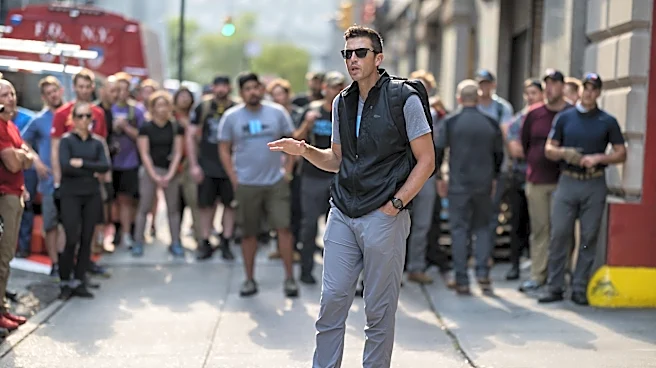
McCarthy says they will walk the city together, carrying weight, literally and metaphorically.
They will do intense “hero workouts.” They will talk about where they were on 9/11. They will listen to the stories of some who were right there, some who lost loved ones and colleagues.
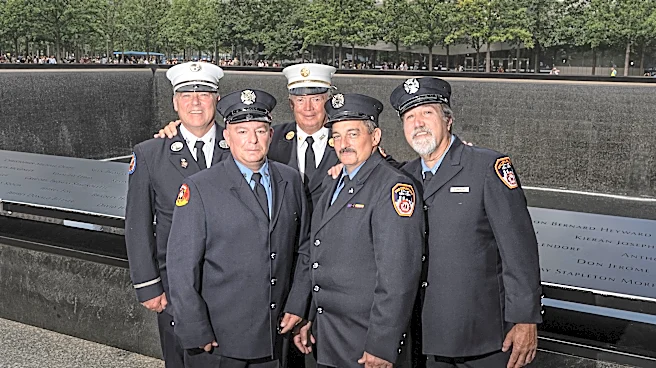
They will go to the 9/11 Memorial and Museum at ground zero. And they will end up at what McCarthy calls his “favorite bar in the world” — O’Hara’s Pub.
Before 9/11, it was a hangout for office workers and financial traders. It was badly damaged on 9/11, but eventually reopened and became a haven for workers at ground zero.
Pub lore is that on the first anniversary, a regular named Big John ripped a patch off a firefighter’s uniform and stapled it to the wall. By the end of the night, there were 250 patches there.
Now there are thousands of patches on the walls, and dozens of flags covering the ceiling.
“It's sort of a living, breathing, full-of-life memorial,” McCarthy said. “So we always end up there. We raise a glass to the fallen and celebrate the life we still have.”
Florida Times-Union columnist Mark Woods: mwoods@jacksonville.com and (904) 359-4212.
This article originally appeared on Florida Times-Union: From rage to remembrance: How 9/11 changed Jason McCarthy, led to GORUCK