





Now that September is here, there is something annoying in my yard that I will talk about. But it isn’t an animal. It’s a plant.
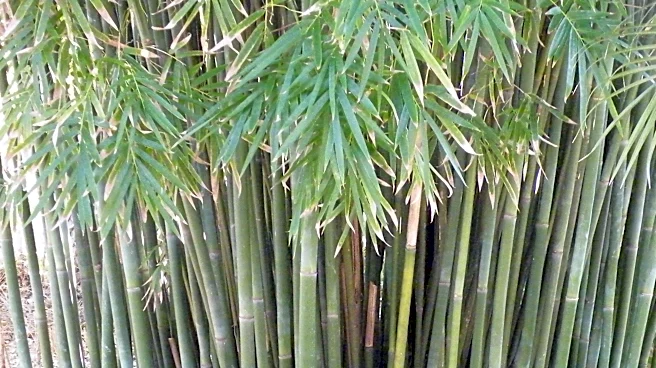
When we moved in, there was a clump of spreading bamboo in the yard. Because we were from “up north,” we did not see the danger it posed. So, it stayed in the yard. It spread … a lot. And removing it has become a challenge. We have tried to remove it over the years and found a lot of methods that failed to remove it.
We aren’t the only ones with this problem. Over the years, I’ve talked to a lot of people with spreading bamboo.
Bamboo has been used for centuries for furniture building and even house building. And it can be used as a privacy screen. The important thing is to choose wisely.
There are two general types: clumping
and running. The clumping type of bamboo is fairly tame and will expand slowly. It can be controlled. It is less cold-hardy.
The running type is an out-of-control, weedy plant that will send out rhizomes underground 20 or 30 feet away in any direction. That means it will pop up in your neighbor’s yards, which is not the best way to make friends with your neighbors. To contain it, you need to surround it with a 40 ml. plastic barrier thirty inches deep. Concrete is often used, but it can crack, and the rhizomes will find those cracks and grow right through them.
Many years ago, when I went to find the best ways to get rid of it, I was horrified. Probably, moving was my best option. (Not an option. I like where I live.)
The rhizomes of running bamboo grow densely up to 12 to 18 inches underground. A good way to remove them is to bring in a backhoe and remove the top eighteen inches of soil. Eighteen inches is a lot of soil.
Mature trees in the way? That is a problem. Neighbor's tree roots in your yard? Again, that could be a problem.
The shiny leaves laugh at the herbicides you might spray on them. It might singe the leaves, but the stems and roots will be fine. Also, some of the herbicides I looked at move in the water table and could kill or damage trees, whose roots can wander hundreds of feet away. So, I wasn’t going to use them. However, all was not hopeless.
Successful removal is challenging. The bamboo can be cut low, and glyphosate or imazapyr applied to the cut stem immediately. The stem will draw the chemical in and translocate it through the roots, spreading the herbicide through the roots. The imazapyr can be stressful for trees nearby, so extra caution must be taken with it. It also stays active in the soil, which you may be uncomfortable with. I am. Both chemicals have their hazards, so care must be taken.
Removing bamboo this way is slow and painstaking. It is effective. It may take more than one application. But if you can’t bring in a backhoe because you have trees you care about, this is a possible solution.
While handling any herbicide, please wear safety gear. Your life and health are valuable.
In Florida, standard baseline personal protective equipment (PPE) recommended by UF/IFAS Extension for handling and applying typical liquid herbicides includes long-sleeved shirts, long pants, socks, closed-toe shoes, and unlined chemical-resistant gloves.
Tyvek disposable suits are available for harsher chemicals that will be applied as sprays and safety glasses should be worn to protect the eyes.
Wash your clothes and shower immediately after spraying. Run the washing machine on hot water afterward, empty, to make sure that all traces of the herbicide are removed from the machine before you wash other clothes in it.
You will have some bamboo resprout, but it should be minimal if you successfully dropped the glyphosate onto the cut surface.
Glyphosate is not available in the big box stores. Check in a farm supply store. It is only available in large bottles. If you are like me, you need a lot anyway.
Don’t just look for Roundup. Roundup comes in different formulations, and the new Roundup, while it would probably work, has more persistence and danger to surrounding plants. If you apply a couple of drops of glyphosate to the cut surface of the bamboo, the surrounding plants are not in danger. The chemical will be absorbed and moved throughout the plant to do its deadly work.
Nature doesn’t care one way or another about bamboo. This is just the wrong plant in the wrong place. Happy gardening!
Becky Wern is a Master Gardener Volunteer with the Duval County Extension Service and the University of Florida/IFAS. For gardening questions, call the Duval County Extension Office at (904) 255-7450 from 9 a.m. to noon and 12:30 to 3:30 p.m. Monday-Friday and ask for a Master Gardener Volunteer.
This article originally appeared on Florida Times-Union: Stop invasive bamboo from taking over your garden